The AV Club as an interview with Susan Coyne, Bob Martin and Mark McKinney, the creators of Slings & Arrows whose first season was about a production of Hamlet:
AVC: Where did the Oliver [Stephen Ouimette’s character] come from? It’s rather unusual to have a ghost as a regular character.
BM: Well, not if the main thrust of your first season is a production of Hamlet.
MM: It was from talking about Hamlet, but a lot of Susan’s best ideas for the series she says and then goes, “Oh no, no, no. Too much, too much.” She came up with the ghost idea, which brought together about eleventy-hundred different things, in a really great way.
[Susan laughs.]
BM: The beauty of it, too, is that it wasn’t specifically a ghost. It’s really interesting to be having this discussion after you were discussing episode four [of season three] and seeing everyone wondering whether he was a ghost or just a manifestation of Geoffrey’s madness. He was always meant to be ambiguous. And remember when we had that conversation about should we have Bill Hutt see him, should we have Charles see Oliver, and how exciting that was?
My old review of Slings & Arrows is here. I really should return to it at some point.

Thursday, May 30, 2013

Thursday, May 23, 2013
The Guardian's Notes & Queries on Hamlet's Kingship.
A reader asks: "How was it that King Hamlet's brother, Claudius, succeeded him to the throne when he died and not his son, Prince Hamlet?"
Many answers. The last one's probably the best because as with most of Shakespeare's plays and the best of fiction, it's the rules of the world of the play (and how a production interprets them) rather than our reality which are arguably of most importance.
Many answers. The last one's probably the best because as with most of Shakespeare's plays and the best of fiction, it's the rules of the world of the play (and how a production interprets them) rather than our reality which are arguably of most importance.
Thursday, May 16, 2013
Hamlet: The YouTube Supercut (2013).
It had to happen eventually. Geoff Klock, an assistant prof at the Borough of Manhattan Community College, New York City has gathered together a couple of hundred references to Hamlet from films and television, crafting recreations of speeches, scenes and jokes about same. Too many to really comment on, but I loved the juxtaposition of Kevin Kline from Soapdish into his earlier appearance in the role [via].
Friday, April 26, 2013
Alexander Graham Bell's Hamlet.
Not yet, but soon. Researchers at the Smithsonian Institute have managed to resurrect Bell's voice from one of his wax-and-cardboard test discs from 1885:
"Early in 2011, Haber, his colleague physicist Earl Cornell and Peter Alyea, a digital conversion specialist at the Library of Congress, began analyzing the Volta Lab discs, unlocking sound inaccessible for more than a century. Muffled voices could be detected reciting Hamlet’s soliloquy, sequences of numbers and “Mary Had a Little Lamb.”Remarkable. The YouTube video of the recording at Wired doesn't include Hamlet but I'll keep my ear out.
Shakespeare at the BBC:
Discovery: Frankenstein's Moon.
Last September, the BBC World Service programme Discovery interviewed forensic astronomer Don Olson who utilises the heavens in an attempt to solve cultural mysteries.
As well as demonstrating that part of Mary Shelley's inspiration for Frankenstein was no embellishment, he "also outlines his theory that a star referred to in Shakespeare’s Hamlet was inspired by a spectacular supernova which blazed in sky one year during the playwright’s childhood."
The quarter hour programme is still available to listen to here.
As well as demonstrating that part of Mary Shelley's inspiration for Frankenstein was no embellishment, he "also outlines his theory that a star referred to in Shakespeare’s Hamlet was inspired by a spectacular supernova which blazed in sky one year during the playwright’s childhood."
The quarter hour programme is still available to listen to here.
Thursday, April 11, 2013
Philip Seymour Hoffman in Tom Stoppard's The Fifteen Minute Hamlet.
Posted as part of Mental_Floss's rundown of "strange" Shakespeare adaptation is this rare find, a television recording of Stoppard's cutdown Hamlet from 1995, starring Austin Pendleton in the title role, with Hoffman as amongst others Laertes and Horatio. Also notable for their work since, Paul Ben-Victor who went on to play Spiro in The Wire and gold plates "that guy" Xander Berkley as Shakespeare. It's a really remarkable interpretation, drama toppling over itself and very moving in places in spite of itself. The director Todd Louiso has some obvious flare -- he's had a long career as a character actor too. Notice that somehow, during this US cable broadcast, the channel still managed to work in a commercial break (breaking the momentum a little bit). Part two is below.
Tuesday, March 26, 2013
The Wolfman (2010)

Hamlet played by Lawrence Talbot (Benicio Del Toro).
As this rather good summary notices, there are plenty of less overt parallel's between The Wolfman and Shakespeare's play (the writer is reviewing Jonathan Maberry's novelisation but the connections are still valid). But without prior warning it's still something of a surprise to be confronted by this splinter of performance with Benicio Del Toro tortuously working his way through a chunk of Yorick, skull in hand.
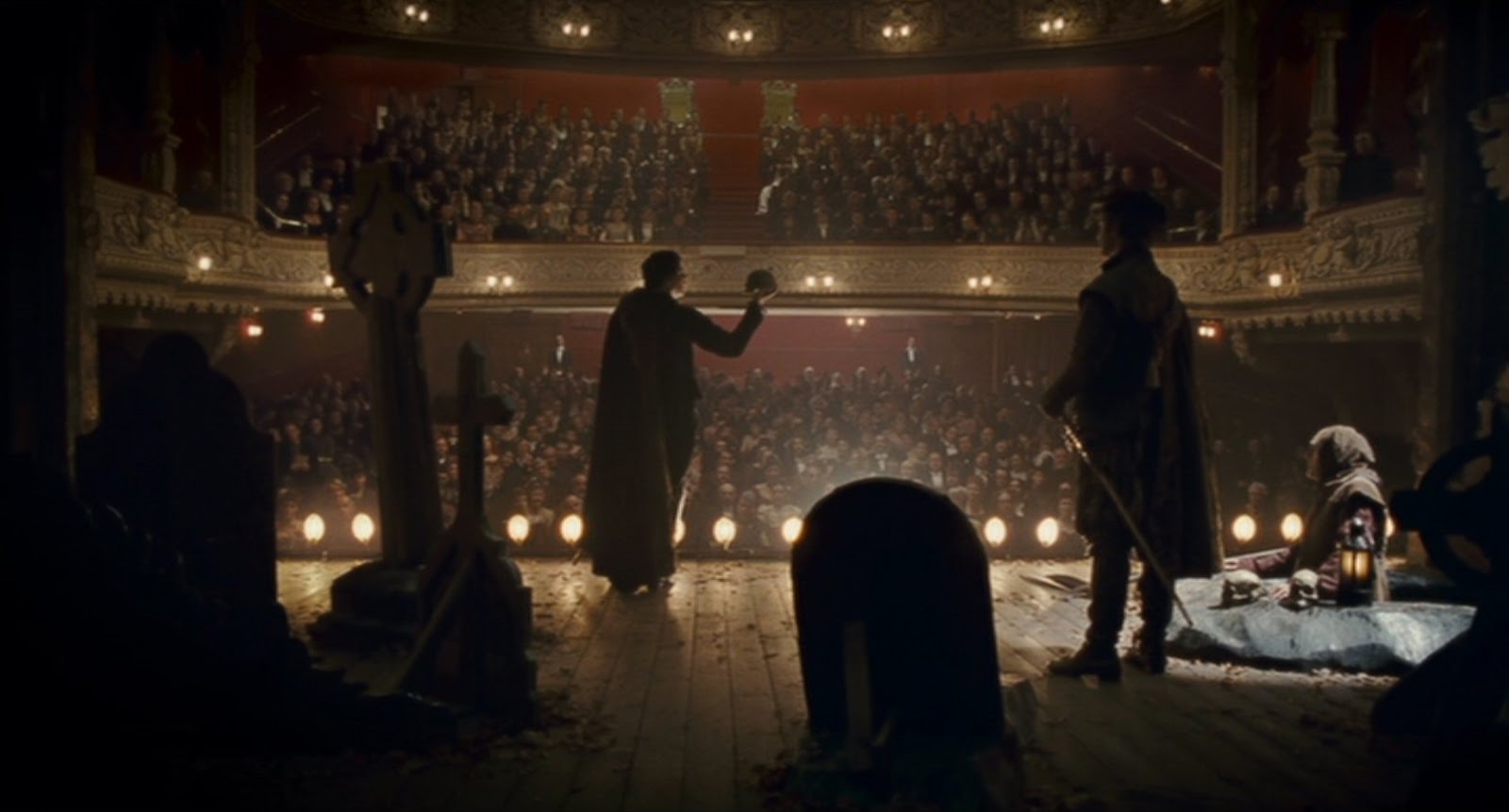
This is the interior of Richmond Theatre, The Green, Richmond in Surrey, southwest of London, which as this reverse shot demonstrates is a classic, old school proscenium arch house. It's 1891, so the audience is still the black tie crowd. Perhaps I shouldn't be too hard on Talbot's interpretation. In 1892, Herbert Beerbohm Tree mounted his famous production of the play, pictured here, and as you can hear from this later recording, the acting style of the time was different and we might imagine Del Toro heard that as part of his research.
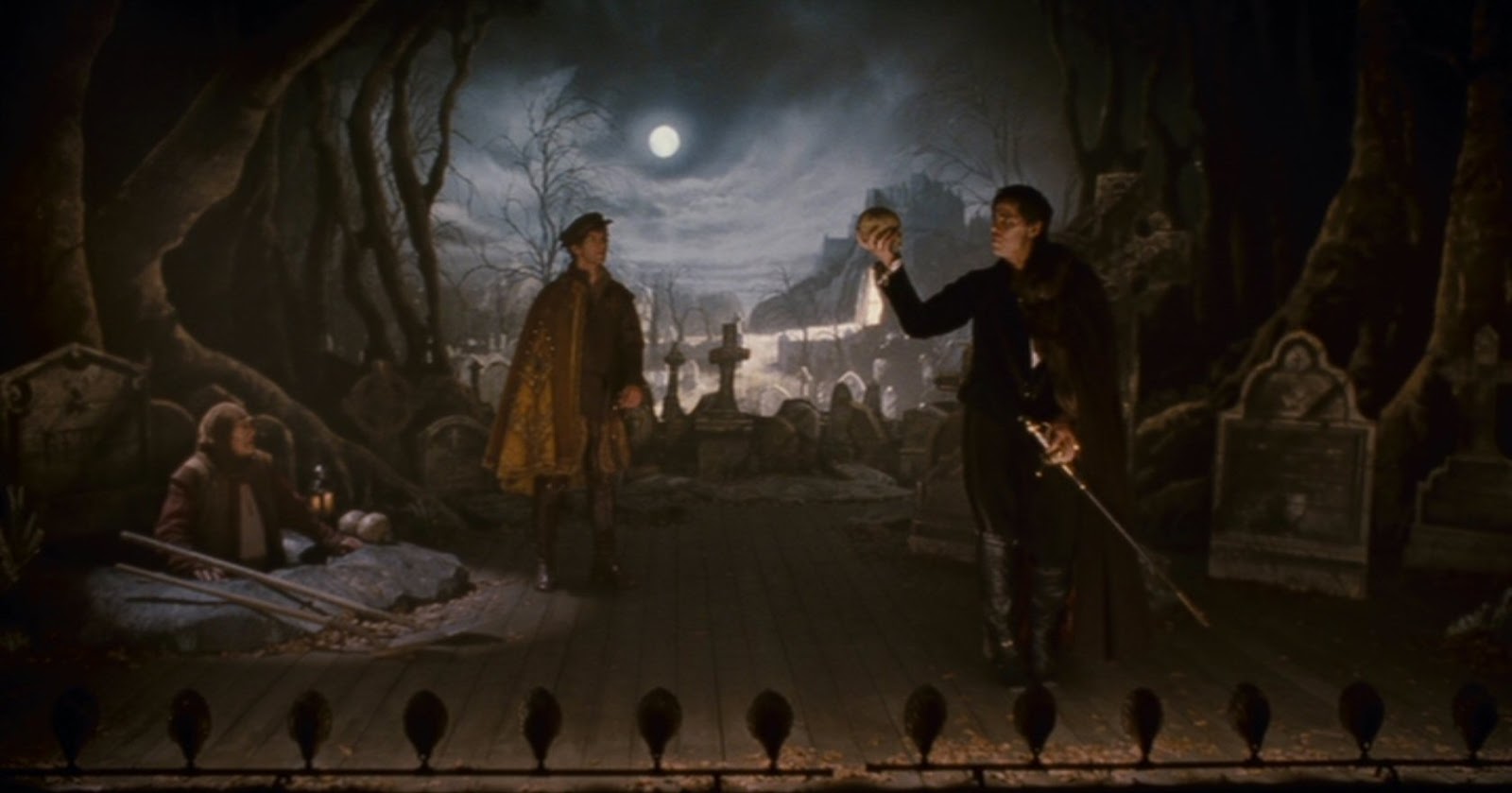
That's an uncredited Sam Hazeldine as Horatio (Barty Crouch Jr. in the Harry Potter films). It's difficult to tell who the Gravedigger is. The next scene is in the post performance party where Elizabeth Croft is credited as an Ophelia (one of her next jobs was as a Vampire Girl on Doctor Who's Vampires in Venice) and Brigette Miller as Gertrude (Emmeline Vance in the Harry Potter films).

Notice how elaborate the set is. The production designers and set decorators are well researched. As The Cambridge Companion to Shakespeare on Stage explains, this was still the period when plays would often be shortened to make way for elaborate effects and recreating worlds on stage, the entire locale changing between scenes, rather than simply between acts or halves as is often the case now. Often plays would be adapted into much shorter versions or spoofs like W. S. Gilbert's parody of Hamlet, Rosencrantz and Guildenstern, which was first produced in 1891.

The next shot in the film is of Emily Blunt's Gwen Conliffe in one of the boxes regarding the performance. In the Hamlet analogy, she's the Ophelia of The Wolfman.

The sequence ends with this shot from above as Hamlet regards Yorrick as actors often do. The full section of the speech is ...
"Alas, poor Yorick! I knew him, Horatio: a fellow
of infinite jest, of most excellent fancy: he hath
borne me on his back a thousand times; and now, how
abhorred in my imagination it is! my gorge rims at
it. Here hung those lips ..."
... the shots changing between clauses even when Talbot/Del Toro ignores the obvious pause where the exclamation point is after "imagination it is".

The scene ends on Blunt's face as he says, "Here hung those lips..." which causes us to immediately look at her lips such is the nature of editing, which is important because she has information to impart.
Tuesday, March 19, 2013
More on the new Hamlet at the RSC.
The RSC has uploaded some videos related to their new production. Firstly, here's Jonathan Slinger talking about the role:
And some audience reaction:
"Absolutely stunning. Absolutely amazing."
And some audience reaction:
"Absolutely stunning. Absolutely amazing."
Hamlet's Dreams:
The Robben Island Shakespeare.

One of the most curious and so most notable objects in last year's British Museum exhibition Shakespeare: staging the world was The Robben Island Bible, the hidden copy of the Alexander edition of the Complete Works which was passed around and inspired the inmates of the prison where Nelson Mandela and his ANC colleagues were held captive. Throughout, the prisoners left their mark or signature on significant quotes or sections of the plays and in this exploration of the implications the book had for the prisoners, David Schalkwyk suggests that although their connection to the text can sometimes be overstated, its implications as an overall symbol of disobedience cannot. The main thrust of the book compares the prisoner's experience to Hamlet, comparing quotations and memoir of inmates, Denmark being an emotional prison, with the young prince's speeches, a character's individual experience expressing a collective reality.
Hamlet's Dreams by David Schalkwyk is published by Bloomsbury and is out now. RRP: £14.99. ISBN: 978-1441129284. Review copy supplied.
Monday, March 18, 2013
The Marowitz Hamlet (1969)
John Wyver at the Screen Plays project on how one of the more avant-garde interpretations of Hamlet made its way to television:
"At 10.55pm on 30 December 1969, BBC2 broadcast an edition of its regular magazine strand Late-Night Line-Up which was devoted to The Marowitz Hamlet. According to the BFI’s authoritative ScreenOnline, ‘Late-Night Line-Up discussed Charles Marowitz’s collage reinvention of the play, with filmed examples performed by the Open Space Theatre Company describes the programme.’ But what is preserved in the BBC film archive is a 59-minute fully-edited film of much of the production, including its opening and closing."As is noted in the comments beneath, this is precisely the sort of experiment which no longer exists on television under current regimes.
Tuesday, March 12, 2013
Jonathan Slinger on Hamlet.
Jonathan Slinger talks to Lyn Gardener at The Guardian about his upcoming appearance at the RSC:
"This is the quote that's going to hang me," he says, "but I'm going to try to achieve what people say is impossible. I want to make him a psychologically understandable Hamlet. I do honestly think that's what Shakespeare wrote: a very complex person. And I'm in a slightly win-win situation: if I achieve it, then amazing. And if I don't – and depending to what degree I don't – the worst that people will say is that it was a wholly unreasonable ambition because nobody has ever done it. It will just serve as further proof to those who say it's impossible."Glancing across at my sidebar, I'd wonder if a few of his predecessors would take issue with that.
Monday, December 17, 2012
My Year Watching Shakespeare.

Shakespeare. Twenty-twelve was an excellent year for Shakespeare. Arguably, of course, every year venerates Bill to some degree but with the Cultural Olympiad deciding that he’s one our greatest exports, twenty-twelve was indeed an excellent year for Shakespeare. Not since the birthday celebrations in 1997, has there been such a focus across the media and in theatres, with the Shakespeare: Staging The World exhibition at the British Museum, the Globe to Globe season at the “replica” with all of the plays in various languages from visiting theatre groups, part of a World Shakespeare Festival.
But for those of us in the provinces, it was still a great year for accessible Shakespeare with his plays appearing across the BBC in various forms which was why at around March time I decided that I’d spend a portion of the year working my own way through the canon, with non-broadcast plays covered by other productions on film, video and audio I’d not had a chance to catch up with yet. So I printed off an alphabetical list and stuck it to my door, ready to be crossed off as I demolished each testament to man’s creative ingenuity. Plus as it turned out Geoffrey Wright’s disastrous gangster version of Macbeth with Sam Worthington in the title role.
Away from the many documentaries, the BBC’s first broadcast productions were on Radio 3. A stripped down production of Much Ado About Nothing appeared in the Afternoon on 3 slot designed to highlight the music Eric Korngold composed for a 1910s production with Daniela Nardini as Beatrice and Liam Brennan as Benedick and although it didn’t hold together as drama due to the brevity of the text it was a treat to hear Korngold’s music in situ and there was real chemistry between the stars despite them obviously reading the play in from a script. It's just a pity that it wasn't filmed as per an earlier A Midsummer Night's Dream which is still available to watch here.
On three Saturdays, the Drama on 3 slot brought Twelfth Night, Romeo & Juliet and The Tempest as well as a repeat of last year’s A Midsummer Night’s Dream. If the four shared anything other than cast members, it was atmosphere, especially Dream which was recorded on location in a Sussex woodland which meant the timber of the voices and footprints created an extra level of twilight magic (a production aided by Roger Allum’s excellent Bottom). David Tennant and Ron Cook bestrode the Night and Romeo in various roles with only The Tempest not quite holding together due to a confusing restructuring of the text. Epic Prosporo from David Warner though.
June brought BBC Four’s broadcast of the RSC’s then current production of Julius Caesar. Produced by Illuminations (whose previous work includes recordings of David Tennant in Hamlet and Patrick Stewart in Macbeth), their grand experiment was to record the play’s public scenes in the RSC theatre during a performance and intercut that with intimate moments shot on location in an abandoned shopping mall, an experiment didn’t quite work for me. The theatre scenes had a glorious energy, which wasn't quite replicated in the interior scenes at first, despite a magnetic Brutus performance from Paterson Joseph.
But it’s worth noting that Caesar isn’t my favourite of Shakespeare’s plays anyway. After a tremendous first few opening acts, it descends into a tedious miasma of skirmishes and spats but, and this is important, this production somehow managed to make those lucid and emotionally charged especially as the loyalties of the conspirators were wrought asunder. But I just couldn’t help, during the scenes artistically shot using iPhones wondering who was holding the camera and how they were able to get all of those angles. Nevertheless this was a bold statement on how television and theatre companies need not be deadly rivals.
Illuminations had begun planning on a recording of the RSC’s repertory of The Histories, but this was cancelled when the behemoth that was The Hollow Crown spun across the horizon. A filmic version of the first Henriad, this didn’t disappoint in entertainment terms with starry casts, incandescent photography and interconnected readings of the plays even if ambitious Saturday night scheduling during Wimbledon meant the audiences weren’t quite as huge as they deserved to be, watching Twitter on those evening revealed that casting Tom Hiddleston drew in a demographic that might otherwise be uninterested.
Of the four, Richard II was the most successful thanks to Ben Wishaw's mesmerising whisper though the title role and a determination to put the text to the forefront, especially during the John of Gaunt sections, where a slow push in did full justice to Patrick Stewart's enunciation of The Sceptred Isle. If anything, the Henry V was less successful due to its determination not to be anything like the Branagh film, rather than be its own thing and damn the similarities. But I was please to have seen been able to cross the rarely filmed Henry IVs of my list. Little did I know what was to come.
Hiddleston was actually the second Henry I’d seen of the year, the first being Jamie Parker’s boyishly regal version in the Globe’s touring production of Henry V which I wrote about at length here. Then, come August, I was hearing the play again along with a dozen others as part of the BBC Radio 4 Extras repeat of Vivat Rex, the twenty-six part mash-up of plays by Marlowe, Shakespeare and their contemporaries describing the history of the monarchy from Edward II through to Elizabeth I produced in 1977 to commemorate the Queen’s silver jubilee, now re-emerging in her Diamond year.
The series was gamely broadcast on weekday mornings for a month and I giddly recorded them all and listened to them across about four days, lost in the maze of words and history. In project terms it meant I somewhat heard my first production of Edward III, listed as anonymous then but subsequent “canonised” as at least a collaboration thanks to textual analysis. It also allowed me to include other playwrights in my personal festival, including expectedly John Ford’s Perkin Warbeck and the anonymous Thomas of Woodstock albeit in heavily truncated versions.
Which, as far as I can remember, was it for broadcast Shakespeare. But there was still another twenty-odd plays to cover, having disregarded The Two Noble Kinsmen due to only recently listening to the one available professional recording within months of starting to work through the canon in earnest and assuming that Vivat Rex had more than covered the shortfall. Luckily because I’m a fan with an overbearing collector gene, I’ve multiple copies of all the plays in various formats from different companies, so it was really just a matter of choosing what to listen to, thinned down somewhat by having to select productions I’d not visited yet.
So on my flat screen I saw Ralph Fiennes’s visceral Coriolanus, Trevor Nunn’s RSC production of King Lear with Ian McKellen facing off against Sylvester McCoy’s clown, Nunn’s The Comedy of Errors with Judi Dench curiously recorded in a studio with audience cutaways and pretence of having been shot in the RSC theatre, a bizarre 1983 Antony and Cleopatra with Timothy Dalton and Lynn Redgrave with Nichelle Nichols and Walter Keonig in minor roles, Tom Stoppard’s truncation of The Merchant of Venice presented by the National Youth Theatre in 1998 and a charming Taming of the Shrew from Canada’s CBC in the 1980s.
Audio is trickier. There are essentially four collections available; The 50s Marlowe Society in conjunction with the British Council released on Argo, the 60s Shakespeare Recording Society productions published by Harper Collins, the 90s Arkangel complete works directed by Clive Brill and the BBC radio versions produced in and around the millennium along with a smattering of classic radio releases. All share some extraordinary casting choices often dictated by contemporary productions but unfortunately they’re also incredibly inconsistent, demonstrating that even the best plays can be rendered unlistenable through bad choices.
In other words, while you might assume the Argo version of As You Like It and might be boring and bobbins and the Arkangel Troilus and Cressida a treat, the reverse is true, but its reversed again when comparing Argo’s unfunny Merry Wives of Windsor and Arkangel’s superb The Winter’s Tale. John Gielgud crops up as Time in the latter and can also be heard narrating their poignant Pericles, and it’s casting choices such as these which led me, despite their bland Cymbeline to defaulting to ArkAngel anyway. Their treatment of King John gives it the panto welly it needs, the Timon of Athens a clear, logical communication substituting the new National Theatre production I couldn’t get to.
Arkangel is also the place to go to hear a young Damien Lewis offer his Valentine in the neglected The Two Gentlemen of Verona (opposite Michael Maloney’s Proteus) and Harriet Walter’s expressive Tamora in Titus Andronicus. But eventually I had to resort the Argo with their rather neutral interpretation of Love’s Labour’s Lost and the HarperCollins Measure for Measure in which Sir Ralph Richardson and Margaret Leighton manage to drain their dialogue of all its subliminal bawdiness against which Gielgud’s Duke seems perfectly cast even if he doesn’t quite manage to emphasise the shiftiness inherent in the role.
There was a gap in the middle for the Olympics, which lasted even longer once I became addicted to the Paralympics too. But eventually I completed the list somewhat were I started six months ago with the BBC All’s Well That Ends Well with Emma Fielding, Siân Phillips and Miriam Margolyes produced to celebrate the millennium and Michael Grandage’s Othello for the Donmar Warehouse recorded for the BBC in studio by Chiwetel Ejiofor, Ewan MacGreggor, Hiddleston (again) and Kelly Reilly (which again I wish had been filmed), ending finally with Argo’s dull Hamlet, which I reviewed here. And if all that’s been exhausting to read you should have listened to some of them.
If the project demonstrated anything to me, it’s that most of the cliché’s are true. There really isn’t anyone like Shakespeare for the depth and quality of language, for investigating the human spirit, for capturing our national identity. But like I said that it’s then up to the director and actors to communicate that language, story and history to the audience, to believe in what they’re doing. Surprisingly it’s the so-called obscurities which came out best, especially later when listening to the audios, where when someone more used to Lear is handed Pericles they find another character of dimension.
But it's also suggested that every generation deserves its complete works because what all of these endeavours capture, from Vivat Rex to ArkAngel, isn't just an interpretation of the text, but a snapshot of the theatrical life of the nation through directors and through casting. Television hasn't had a complete works since the 80s, audio since 1998, and although in both cases the BBC is slowly recording version of some of the plays, it's those obscurities that could do with some attention. Now that Edward III and others have joined the canon, isn't it time for them to be given some professional attention?
[This post was originally written as part of the Review 2012 series on my personal blog, the rest of which can be seen here.]
Saturday, December 15, 2012
35 John Duttine

Hamlet played by John Duttine.
Directed by Gordon House.
The BBC’s Research and Development group has built a prototype which puts the BBC World Service on the web, making over seventy thousand programmes from the past sixty years available to listen to here. Still in closed testing, I’ve been lucky enough to have been given access (which might be able to ask for too via the details on their blog) and have spent the past few weeks in an agog state, boggling at the mass of programming at my finger tips on hundreds of topics across dozens of genres.
Of course my first search was the Hamlet, of course it was, and apart from documentaries, magazine shows and reviews, sure enough there is at least one production, this production. Originally broadcast in two hour long episodes on Sunday 4th and Tuesday 6th September 1983, adapted for radio by Colin Davis, directed by Gordon House, as you can see starred raffish John Duttine in the title role (his appearance in Day of the Triffids is pictured) and what a privilege to have been given the opportunity to listen.
At first, as audio Hamlets go, it seems superficially orthodox. The sound design is basic and period, with echoes for the interior of the castle, harsh winds for the exterior, scene changes are punctuated by some jingly atonal tubular bells and noodling on a pipe organ, Cyril Shaps’s Polonius is a typically bumbling old buffer with little room for a military mind (no Reynoldo scene) with Hamlet Snr played by famous voiceover artist John Westbook to give the character some spooky gravitas.
Except all the while us listeners, if we’re familiar with the play, notice that Davis in his adaptation experimenting somewhat with the structure of the text and in reducing it to fit the timeslot is making some interesting character-based decision, especially in relation to Hamlet. There’s nothing online at all that I can see about the production, which is a shame because I’d love to know the extent to which the adaptation was done in collaboration with the director and actors or if these are Davis’s alone.
After the Ghost, Davis cuts the swearing scene (“Sweeearrr…”) so to add some time for Hamlet to be off stage (off mic) transposes the introduction of Rosencrantz and Guildenstern (in what amounts to their longest scene) with Ophelia’s description to her father of Hamlet’s visit which then leads almost directly into Polonius explaining to the King and Queen that their son is mad and the plan that become the nunnery scene later.
Except, and this is where is becomes really interesting, Davis also cuts the Fishmonger which offers a clue as to how he, the director and Duttine view their Hamlet. In losing Fishmonger, we lose the wilder metaphoric excesses of the characters’ “mania” or “faux-mania” and this is repeated when Claudius asks the prince where he’s placed Polonius’s body and he tells him directly, no convocation of politic worms are e'en at him.
This is one of those sane Hamlets you hear about and rarely played. Or rather this is a Hamlet who seems entirely in control of his faculties and whose madness isn’t a mental illness, but anger. He’s an even more sinister and cruel in places than Peter Vaughn’s Claudius, a figure much more representative of the blandness of evil, only really showing emotion and inconstancy during the prayer scene. When Hamlet’s confronting his mother in the closet, we’re not sure if he won’t do her in as well.
Yet there’s still a constant element of doubt as to whether he’s faking these mood swings too, it’s not just controlled anger. Duttine's is a very public “To Be…”, watched by Polonius and Claudius with Ophelia evidently in proximity but when he spies her, his “Soft you now! The fair Ophelia!” so often played as a way of attracting her attention is internalised, as though he’s realised what he’s about to do, what he must do because he’s being watched, and doesn’t like it. Which suggests these choices have to have been collaborative to some extent.
All of which said, presumably dependent on the timeslot and utility, this is still a Hamlet which includes the greatest hits, from Polonius’s advice through to all of Hamlet’s speeches with the exception of “to the manner born” even to the point of including Fortinbras and his Captain, textually missing in action up until that point, so that “How all occasions do inform against me” can be included with some logic (even if the warring army arguably appears from nowhere in much the same way Laertes does at the end of the Welles adaptation).
The break in story occurs just before an all male Mousetrap, as Polonius agrees that Hamlet should be sent to England and Claudius says “It shall be so. / Madness in great ones must not unwatch'd go.” It’s an unusual point, especially given the day between the broadcast of the episodes, but it does mean that episode two begins with the ear catching spectacle of the play, which while rushed through, also underscores the aspect of theatricality and “play” inherent in the story.
The climax is pretty traditional, even if the sword fight is pretty swift and Osric is retained, though Fortinbras’s reappearance at the close jars with the perfectly tender way in which David Horovitch’s stalwart Horatio says, “Good night, sweet prince” which feels like the emotional conclusion of this production, though the mood is retained somewhat by the suitably processional music composed by Bernard Shaw (not George).
There's plenty more Shakespeare in the World Service prototype, along with rare productions of Early Modern Drama, though it's worth noting that it's still relatively populist in its choices, there's no Arden of Faversham or anything by Philip Massinger. But plenty of Marlowe. Not that I've the time to listen to any of it. But at least I found the Hamlet. At least I did that.
Saturday, December 08, 2012
So Long, Shakespeare by Tom Brown published.
This time last year, writer Tom Brown was kind enough to mention me, or rather the @shakespearelogs twitter feed in an article for the Around The Globle Magazine and now he's been in touch to let me know that his book, So Long, Shakespeare has now been published. Here's the synopsis:
"The world is about to discover the true author of Shakespeare's plays - and it's not the man from Stratford...The Kindle edition is available here
"Hollywood visionary Joe Seabright has one more movie to make in his blockbusting sci-fi saga - which means one last chance to win his longed-for Oscar. Alas, his writing is as wooden as a plank, and desperately needs improving for his dream to become reality.
"Through a miraculous feat of genetic enhancement, Joe inspires himself with Shakespeare's creativity, only to write a screenplay so teeth-itchingly terrible it can mean only one thing: 'Shakespeare' didn't write 'Shakespeare's' plays.
"Meanwhile, in London, authorship boffin Wendy Preston leads her jolly band of Shakespeare-sceptics in their annual conference - little guessing that her life is about to be turned upside down, and an impossible truth uncovered at last.
"So Long, Shakespeare throws together the worlds of Shakespeare and space opera to create a boisterous cultural comedy full of big questions and even bigger egos. Along the way we meet a brilliant, beautiful geneticist, a spooky collector of great artists' DNA, and an embattled mathematician, desperately flailing for a numerical grasp of human artistry. From start to finish, it's a rollicking summation of everything that makes us care about great art, and the geniuses who create it. "
Friday, December 07, 2012
Shakespeare at the BBC: The BBC Television Shakespeare on YouTube.
At the beginning of this month, BBC Worldwide began uploading archive television to its YouTube channel which includes samples from the BBC Shakespeare collection. So far there are seven plays, all complete:
As You Like It
The Tempest
Hamlet
Macbeth
Julius Caesar
The Merchant of Venice
Othello
The Wikipedia has a typically voluminous article with cast lists and background to the series. The rest of BBC Worldwide's uploads are here, whole series of documentaries and dramas including Terry Jones's Medieval Lives.
As You Like It
The Tempest
Hamlet
Macbeth
Julius Caesar
The Merchant of Venice
Othello
The Wikipedia has a typically voluminous article with cast lists and background to the series. The rest of BBC Worldwide's uploads are here, whole series of documentaries and dramas including Terry Jones's Medieval Lives.
Sunday, November 25, 2012
Shakespeare at the BBC: On The Road with Jonathan Miller.

This week's episode of the excellent Matthew Stadlen presented series from BBC News (which shares its tone with The South Bank Show or Omnibus) greets Jonathan Miller as he once again oversees King Lear, on this occasion for City Lit, the centre for adult learning, with, as you can see, plenty of rehearsal footage which highlights his directing style.
You can watch it here on the iPlayer for the next week.
Just so that there's something in this post when that expires or it's inevitably uploaded to YouTube, here's a link to Miller talking in general terms about directing Lear on Charlie Rose in 2004, also on YouTube.
Wednesday, October 31, 2012
Eyewitness: Experiencing Hamlet completely fresh.
This comment from The Guardian is self-explanatory:

In the end I left the performance at the interval. It was an awful production and I decided that I'd save the ending for a version I was enjoying.
Friday, October 26, 2012
Shakespeare joins AT&T's security team.
Well, this is one way to deal with corporate training. Here's "The Bardster" in love. Here are the rest.
Thursday, October 11, 2012
Google Cultural Institute's Hamlet photographs from the LIFE Magazine archive.
In their ongoing endeavour to make all the world's knowledge searchable, Google has teamed up with an array of museums and archives to produce Google Cultural Institute. The Museum's Association has some background. Most of the venues are related to great cultural shifts or dedicated to commemorating awful moments in human history, Anne Frank House or the Nelson Mandela Centre for History.
Also in the mix is LIFE's Magazine's extraordinary collection. These are not new to Google, and have been part of the image search for a few years, but Google Cultural Institute's presentation makes them far more accessible and provides a much richer experience in information terms. Inevitably I wanted to see if some of the production history of Hamlet is available, and oh the riches.
Here then is LIFE Magazine's Hamlet history:
1865 Henry Irving
1947 Sir Laurence Olivier
1951 Delbert Moyer Staley
1952 Jean-Louis Barrault
1956 Siobhan McKenna
1963 George Grizzard
1969 Nicole Williamson
1970 Richard Chamberlain
* and not Greigud as the database would have it.
The Chamberlain Hamlet seems to be this production for the ITV Sunday Night Theatre, adapted by John Barton and Michael Redgrave as Polonius, Alan Bennett as Osric, Martin Shaw as Horatio and with John Gielgud as the Ghost. Pieces of a fifth generation VHS copy of it are available on YouTube, but the sound's too horrendous to listen for too long. Chamberlain has recently turned up in indie documentary Three Days of Hamlet as Polonius.
There are also a range of images listed under the headings Lit Shakespeare Hamlet and The Show Shakespeare Hamlet though the data on those is negligible though there seem to be line drawings of the likes of Kean. When I have a moment I'll check through and see who's there and add them to the above chronology. Nonetheless this is a fascinating collection especially the Burton photographs which include some colour images.
Monday, October 08, 2012
34 Anthony White
Hamlet played by Anthony White.
Directed by George Rylands.
In the late 50s and early 1960s, under the auspices of the British Council to increase understanding of Shakespeare abroad, the Marlowe Dramatic Society, a theatre group for Cambridge University students aided by professional actors, set about recording all of Shakespeare’s plays for release by the Argo label initially on vinyl (in mono and stereo!) and later cassette. I first encountered them at school when researching my A-Level at the Central Library in Liverpool, shelves full of records in austere blue boxes with Liverpool City Council emblazoned on them in gold lettering (which I know for sure because when they were sold off years later I managed to buy their copy of Measure for Measure). I have a memory from the 1990s of listening to their production of Cymbeline, copy of a complete works in my lap. I remember enjoying the language but not really understanding the plot. Having listened to Cymbeline again in a different version over the summer, I'm not sure my appreciation has much changed.
The Hamlet has a few useful points of interest. The Ghost’s appearance is heralded by a peel of what sounds like trumpets which saps it of any sense of “mystery” but does at least underscore the regality of Hamlet’s father. I’ve not been able to find a complete cast list, but I’m sure it’s Derek Jacobi’s voice which can be heard as Fortinbras’s Captain, which would make sense since he’s an alumni of the Marlowe Society. The female player sounds like Judi Dench and Osric could be Kenneth Williams. Whoever’s playing Polonius interprets the man as the ancient old dodderer who appears in countless illustrations with his lengthy beard, which makes little sense in the context of the moment when he sends Reynaldo to spy on Laertes. Oh and the duel is intercut with the sounds of battle and a peel of trumpets to indicate the encroachment of Fortinbras’s army, a rare audio addition which prefigures the Branagh film.
Unfortunately elsewhere, like so many of these Marlowe productions this is an incredibly dull and often frustrating listen. In between rendering the text with all the earnestness of a 1950s news report, few of the actors tackle their roles as though they’re characters, often treating each of their lines as though they’re unconnected to the others or else any emotional through line spread across an entire speech rarely differentiating changes in thought. A contemporary review argues that the prince “starts weakly, but gathers strength and authority. His sibiliants are aggressive, but his passions magnificent”, which, assuming that the writer’s referring to Anthony White, the actor not his character, is amazingly sympathetic to a performance in which the advice to the players sounds like a training day in a call centre and whose death has all the tragedy of losing a remote control down the back of the sofa.
As I’ve said before, Hamlet or indeed any Shakespeare play isn’t simply a text to be read or more specifically in this case, read out loud. While I understand the need for clarity given one of these production’s primary utilities, that text can become lost in translation if there isn’t a real human emotion behind it, if as is so often the case here, there’s only the vaguest sense that these characters are related to one another or to create an atmosphere. There are individual shining moments, Ophelia’s madness, Claudius’s prayer, the Mousetrap, oddly, though it’s dented slightly by the inclusion of the dumb show which is read in via Shakespeare’s stage directions which only makes dramatic sense if you assume that its being described in the space while the actual mime is occurring. Whoever it is playing Gertrude is really quite good too, but handstung by director George Rylands lack of a particular vision for what the play’s supposed to be about. I simply can’t tell is Hamlet’s supposed to be mad or not.
All of which sounds wildly cruel and having listened to it yourself thanks to that Spotify player, might just consider that its just dated and that I’m simply criticising the mode of acting which was prevalent in that era. That might be true. I wasn’t much of a fan of Gielgud’s audio rendering of the same era. Or Paul Schofield’s which was published at roughly the same time. Both of them were great actors. Legends. White too was a stalwart of the Shakespeare Memorial Theatre (which later became the RSC) so I'm willing to entertain that there's an expectation presentment mismatch. But I can only provide an opinion on what I've heard and what I've heard are performances in which the passions seem to be engaged in the wrong places and lacking in psychological complexity. It says much that when EMI re-released these Argos in the 80s, they swapped out this original production for the superior Jacobi Old Vic version (which is why it’s taken so long for me to alight here).
Nevertheless there’s a definite sense in being steeped in a kind of history listening to this recording. It is a rarity and having listened to say many of the other Marlowe Players productions (even if I’ve not enjoyed many of them) it’s good to tick it off that list. The provenance of the recording’s open to question. The album cover on the Spotify version is very home made, dated. The recording itself is directly from a vinyl copy; the clicks and drop outs are all there and the sound becomes distorted as it reaches the end of the each of the sides. There’s also a pretty big mistake. Part 4 is an exact copy of Part 3, which means its missing the fishmonger, the arrival of the players and the initial greeting with R&G. So, yes, this is a review of an incomplete recording. But given that this is the only recording available, it’d be wrong not to add it to this list. Some of these productions are a revelation. Some of them are a box ticking exercise. The joy is, I’m never always sure which it’s going to be.
You can make up your own mind. Here it is on Spotify:
If you're looking at this post in RSS you might have to open the post in order to see the Spotify embed.
Tuesday, September 11, 2012
The Tragedy of Mariam (Arden Early Modern Drama). Edited by Ramona Wray.
 Elizabeth Cary was born in the mid-1590s at Burford Priory in Oxfordshire. She was educated at home, mostly in ancient languages including Hebrew. She was married in 1602 to the soldier John Davies and amid giving birth to ten children and following her husband’s promotion to Ireland, she became highly regarded in the community launching an apprenticeship scheme for poor and orphaned children. She would later return to England but after a short spell of imprisonment due to her conversion to Catholicism, and estrangement from her Protestant husband, poverty overwhelmed her and she died, penniless in 1639.
Ironically given the relative obscurity of her work outside academic circles then and now, our understanding of her life has been enhanced beyond most of her contemporaries because a decade after her birth her daughter Lucy penned a biography. If only one of Shakespeare’s children had been as interested. This work is also a reason why we know that during her already full life, she also became an accomplished scholar, with a strong published history which included historical texts, poetry and drama, including The Tragedy of Mariam, now published by Arden’s Early Modern Drama.
Billed as the first early modern play written by a woman, this dramatises the sixteen year relationship between notorious Herod and his wife Mariam “telescoped” into twenty-four hours retaining the classical unity of drama and synthesising as the cover synopsis describes a decade and half's worth of “family intrigues, missing monarchs and extra-marital liaisions” as well as “madness and martyrdom”. One of a number of plays in the that period working from religious subjects, this is widescreen epic four hundred years before Cecil B De Mille picked up a camera played amongst a cast of few within a private setting.
In contrast to the other texts in the series, Cary’s play is an example of closet drama written either to be read or performed within a private setting perhaps by amateurs (though there's no evidence of Mariam having been acted in her lifetime). As Wray’s blistering introduction indicates, that’s diminished its reputation and stifled academic consideration of the work; she mentions originally having greeted the play at college through a nearly unreadable version photocopied from microform. As I’ve said before, that’s why Arden’s work is so important, and that of New Mermaids too: producing readable copies of otherwise obscure plays, revealing a variety of drama from the period beyond the usual suspects.
But more recent editions have led to reappraisals and as Wray's discussion elucidates, Cary’s writing is as rich as any of her contemporaries with diverse literary allusions and a solid thematic apparatus investigating as sections of the introduction indicate, Jerusalem as a modern city, the tyranny of empires in this case Rome, the role of women in that society exemplified by Mariam treatment at the hands of her husband with her ensuing martyrdom and how beauty and sexuality are codified through her relationship with her sister Salome not to mention the parallels the story has with Cary's own biography.
As is customary, there’s a thorough discussion of the contemporary text, in this case a single Quarto publication in 1613, so there’s little need for the investigation into textual difference seen in other Arden, barring printing errors and sections omitted when the play entered the public realm. There’s also surprisingly a short production history which charts the efforts of colleges and the odd semi-professional theatre company to mount productions of Mariam the general consensus being that its entirely possible to produce an exciting, thoughtful evening with some ingenuity. As Wray suggests, it’s about time a professional theatre company took the work on board and revealed it to the wider public.
The Tragedy of Mariam (Arden Early Modern Drama). Edited by Ramona Wray. Methuen Drama. 2012. RRP: £9.99. ISBN: 9781904271598. Review copy supplied.
Friday, September 07, 2012
Shakespeare For A New World in Manhattan.
Hello, Stuart!
My name is Sarah Eismann and I am the Artistic Director of Manhattan Shakespeare Project - Manhattan’s All-Female Shakespeare Company.
We are currently trying to raise funding and awareness for our latest project: Shakespeare For A New World: The Palestinian Voice. We are sending two teaching artists and a documentary film director to Palestine to work with students and artists in Ramallah on how to use Shakespeare to create lines of communication between culturally diverse communities. Here is the link to our IndieGoGo campaign: http://www.indiegogo.com/shakespeare-for-a-new-world
We were hoping you could mention our project on your site and possibly link to it.
If you have any questions please do not hesitate to contact me, or visit our website for more details: manhattanshakes.org
Thank you so much for your time and consideration!
Sarah Eismann
Artistic Director - Manhattan Shakespeare Project
My name is Sarah Eismann and I am the Artistic Director of Manhattan Shakespeare Project - Manhattan’s All-Female Shakespeare Company.
We are currently trying to raise funding and awareness for our latest project: Shakespeare For A New World: The Palestinian Voice. We are sending two teaching artists and a documentary film director to Palestine to work with students and artists in Ramallah on how to use Shakespeare to create lines of communication between culturally diverse communities. Here is the link to our IndieGoGo campaign: http://www.indiegogo.com/shakespeare-for-a-new-world
We were hoping you could mention our project on your site and possibly link to it.
If you have any questions please do not hesitate to contact me, or visit our website for more details: manhattanshakes.org
Thank you so much for your time and consideration!
Sarah Eismann
Artistic Director - Manhattan Shakespeare Project
Wednesday, September 05, 2012
Shakespeare at the BBC: Shakespeare Unlocked
Coming up on Friday at 4am in the morning on BBC Two, Shakespeare Unlocked, the twilight education strand will be covering the RSC's Julius Caesar which should act as an excellent companion piece to the BBC/Illumination's recent adaptation.
If previous episodes, filleted into the clips on the website, are an indication, these will be a valuable insight into the rehearsal process with the actors and director talking about their process. It'll also be interesting to see if they use footage filmed in the theatre or the aforementioned studio version.
Update: The whole programme in the form of clips is now online.
If previous episodes, filleted into the clips on the website, are an indication, these will be a valuable insight into the rehearsal process with the actors and director talking about their process. It'll also be interesting to see if they use footage filmed in the theatre or the aforementioned studio version.
Update: The whole programme in the form of clips is now online.
Globe to Globe festival's Hamlet now available at The Space
Now posted to The Space, finally, is Meno Fortas's production of Hamlet, as performed as part of the recent Globe to Globe festival at Shakespeare's Globe.
There's not much more to say than that. Other than I will review it when I have access to a viable web connection and that I previous wrote about it here.
There's not much more to say than that. Other than I will review it when I have access to a viable web connection and that I previous wrote about it here.
Tuesday, September 04, 2012
The Liverpool Shakespeare Festival 2012
The Liverpool Shakespeare Festival 2012 begins soon with productions of A Midsummer Night's Dream ...
"Hermia loves Lysander loves Helena loves Demetrius loves Hermia.And the Scottish Play:
A night of magic and music in Liverpool clubland as four friends try to escape the wedding plans that their parents have put in place. Fairies and dreams light up the night as love tries to find its way. But the course of true love never does run smooth and there is mischief to be had."
"Gang warfare rages on the streets of Liverpool. General Macbeth is elevated to Thane of Cawdor, the right hand man of Duncan, the gang’s undisputed Kingpin. A loyal soldier, Macbeth is set to be leader one day if he bides his time. He can be Kingpin sooner if he listens to his Lady, screws his courage to the sticking place and takes matters into his own hands."Both featuring the same cast with includes Michael Ryan (Across the Universe / Hollyoaks) and Zoe Lister (Hollyoaks / Doctor Who) and both at the Royal Court Theatre between 21st September and 13th October. Full details available here.
Saturday, August 25, 2012
Shakespeare at the BBC: Prefaces to Shakespeare on Radio 4?
There's been a curious addition to BBC Radio 4's programme database.
During the broadcast period of the BBC Shakespeare series in the late 70s and early eighties, Radio 4 broadcast a series of "Prefaces to Shakespeare" in which well known actors, directors and writers offered introductions to plays.
If that sounds familiar, they were the inspiration for the recent television series, Shakespeare Uncovered, whose original title was to be Prefaces to Shakespeare (and still is on the Amazon listing).
The Hamlet edition of the original radio programme introduced by Derek Jacobi from May 1980 is available to stream at the BBC Archive.
Now, Prefaces to Shakespeare has been added to Radio 4's website, with episode pages added for three of the plays:
Henry V with Robert Hardy (originally broadcast Fri 21 Dec 1979)
King Lear with Tony Church (originally broadcast Sun 19 Sep 1982)
Richard III with Edward Woodward (originally broadcast Sat 22 Jan 1983)
The last one of which has a photograph. Originally I thought that perhaps it was to herald a broadcast on BBC 4 Extra, but there isn't any next on information and only the record of the first and only broadcast.
So either they are soon be broadcast again but the scheduling information hasn't been added yet (which can happen) or this is another occurrence of the BBC website's process of back-filling information from the BBC Genome project (see also the Doctor Who website).
Let's keep our eyes or rather ears peeled ...
02/09/2012 Something definitely is happening. A 1998/99 series, The Shakespeare Trade has also been added and the Prefaces about Richard III has been assigned a QR code.
During the broadcast period of the BBC Shakespeare series in the late 70s and early eighties, Radio 4 broadcast a series of "Prefaces to Shakespeare" in which well known actors, directors and writers offered introductions to plays.
If that sounds familiar, they were the inspiration for the recent television series, Shakespeare Uncovered, whose original title was to be Prefaces to Shakespeare (and still is on the Amazon listing).
The Hamlet edition of the original radio programme introduced by Derek Jacobi from May 1980 is available to stream at the BBC Archive.
Now, Prefaces to Shakespeare has been added to Radio 4's website, with episode pages added for three of the plays:
Henry V with Robert Hardy (originally broadcast Fri 21 Dec 1979)
King Lear with Tony Church (originally broadcast Sun 19 Sep 1982)
Richard III with Edward Woodward (originally broadcast Sat 22 Jan 1983)
The last one of which has a photograph. Originally I thought that perhaps it was to herald a broadcast on BBC 4 Extra, but there isn't any next on information and only the record of the first and only broadcast.
So either they are soon be broadcast again but the scheduling information hasn't been added yet (which can happen) or this is another occurrence of the BBC website's process of back-filling information from the BBC Genome project (see also the Doctor Who website).
Let's keep our eyes or rather ears peeled ...
02/09/2012 Something definitely is happening. A 1998/99 series, The Shakespeare Trade has also been added and the Prefaces about Richard III has been assigned a QR code.
Friday, August 24, 2012
Shakespeare at the BBC: Vivat Rex: At a Glance.
Yesterday I completed listening to Vivat Rex and its one of the best drama experiences I've had. Coincidentally this morning in the post I received the accompanying booklet published in the seventies which has a nice introductions from producer Marin Jenkins and composer Christopher Whelan, a map with notable places, a useful family tree and a synopsis for each of the episodes.
What it doesn't have is a simple list of which plays constitute which episodes so I've produced that list below.
Why is this useful?
The whole of Vivat Rex is available to download on AudioGo at £1.84 an episode. To buy the whole lot would be £47.84 which is still a bargain but you could understand if someone might want to pick and choose individual plays, especially since as I mentioned the other day, Vivat Rex includes rare dramatisations of Edward II, Edward III, Thomas of Woodstock and Perkin Warbeck albeit in abbreviated versions.
Vivat Rex: At a Glance.
1/26 The King's Favourite
Edward II
2/26 Revenge
Edward II
3/26 Obsession
Edward II / Edward III
4/26 The Black Prince
Edward III / Woodstock
5/26 Treason
Woodstock / Richard II
6/26 King of Snow
Richard II
7/26 Victims
Richard II / Famous Victories of Henry V / Henry IV, pt 1
8/26 Vulgar Company
Henry IV, pt 1
9/26 Rebellion
Henry IV, pt 1 / Henry IV, pt 2
10/26 Corruption
Henry IV, pt 2
11/26 Deception
Henry IV, pt 2
12/26 Tennis Balls
Henry IV, pt 2 / Henry V
13/26 Harfleur
Henry V
14/26 St. Crispin's Day
Henry V
15/26 Joan of Arc
Henry V / Henry VI, pt 1
16/26 The White Rose - And The Red
Henry VI, pt 1
17/26 Witchcraft
Henry VI, pt 1 / Henry VI, pt 2
18/26 Jack Cade
Henry VI, pt 2
19/26 The Paper Crown
Henry VI, pt 2 / Henry VI, pt 3
20/26 Warwick The Kingmaker
Henry VI, pt 3
21/26 The Tower
Henry VI, pt 3 / Richard III
22/26 The Little Princes
Richard III
23/26 Ghosts
Richard III / Perkin Warbeck
24/26 The Pretender
Perkin Warbeck
25/26 Divorce
Henry VIII
26/26 Elizabeth
Henry VIII
Some notes:
The Edward III, Woodstock and Perkin Warbeck are heavily truncated and edited for the elements which reflect most on the Shakespeare/Marlowe portions of the piece. That said, the Henry VIII though also shorter is coherent in and of itself. The Famous Victories of Henry V contributes is just one scene.
The episodes are available here.
The above information is on the individual programme pages but I still hope you'll find this at a glance version.
What it doesn't have is a simple list of which plays constitute which episodes so I've produced that list below.
Why is this useful?
The whole of Vivat Rex is available to download on AudioGo at £1.84 an episode. To buy the whole lot would be £47.84 which is still a bargain but you could understand if someone might want to pick and choose individual plays, especially since as I mentioned the other day, Vivat Rex includes rare dramatisations of Edward II, Edward III, Thomas of Woodstock and Perkin Warbeck albeit in abbreviated versions.
Vivat Rex: At a Glance.
1/26 The King's Favourite
Edward II
2/26 Revenge
Edward II
3/26 Obsession
Edward II / Edward III
4/26 The Black Prince
Edward III / Woodstock
5/26 Treason
Woodstock / Richard II
6/26 King of Snow
Richard II
7/26 Victims
Richard II / Famous Victories of Henry V / Henry IV, pt 1
8/26 Vulgar Company
Henry IV, pt 1
9/26 Rebellion
Henry IV, pt 1 / Henry IV, pt 2
10/26 Corruption
Henry IV, pt 2
11/26 Deception
Henry IV, pt 2
12/26 Tennis Balls
Henry IV, pt 2 / Henry V
13/26 Harfleur
Henry V
14/26 St. Crispin's Day
Henry V
15/26 Joan of Arc
Henry V / Henry VI, pt 1
16/26 The White Rose - And The Red
Henry VI, pt 1
17/26 Witchcraft
Henry VI, pt 1 / Henry VI, pt 2
18/26 Jack Cade
Henry VI, pt 2
19/26 The Paper Crown
Henry VI, pt 2 / Henry VI, pt 3
20/26 Warwick The Kingmaker
Henry VI, pt 3
21/26 The Tower
Henry VI, pt 3 / Richard III
22/26 The Little Princes
Richard III
23/26 Ghosts
Richard III / Perkin Warbeck
24/26 The Pretender
Perkin Warbeck
25/26 Divorce
Henry VIII
26/26 Elizabeth
Henry VIII
Some notes:
The Edward III, Woodstock and Perkin Warbeck are heavily truncated and edited for the elements which reflect most on the Shakespeare/Marlowe portions of the piece. That said, the Henry VIII though also shorter is coherent in and of itself. The Famous Victories of Henry V contributes is just one scene.
The episodes are available here.
The above information is on the individual programme pages but I still hope you'll find this at a glance version.
Tuesday, August 21, 2012
Audio Early Modern Drama: A Proposal.
With some time to spare I'm spending this week listening to Vivat Rex, the twenty-six part BBC Radio series which utilises a range of Early Modern plays, mostly from Shakespeare to offer a chronicle of the English crown from 1307 to 1533, from Edward II to Elizabeth I.
One of its great joys, other than the rather epic cast list, is that it includes within its make up sections of Edward III, Thomas of Woodstock, The Famous Victories of Henry V and John Ford's Perkin Warbeck in what may be their only radio outings, providing useful context to the action within Shakespeare's more famous plays.
Finally we can understand Henry IV's fear that his son Hal, by loafing around with Falstaff is repeating the mistakes of his predecessors Edward II and Richard II (albeit without the homo-erotic subtext of their acolytes) and that Richard's "hollow crown" speech is a near synopsis of the action in Edward III, including the appearance of a "ghost".
Listening to these rarities reminded of a proposal I wrote a few months ago suggesting that an audio or radio company produce a line of full text adaptations of just these kinds of rarely produced early modern dramas so that an interested public might be able to experience the work which was around at the time Shakespeare wrote the dozen or so plays which are constant production.
Disclosure: I did send a version of this to a company but it wasn't something they were really interested in doing which was understandable since its not necessarily a sure fire winner and would need to be planned and executed careful if it's to work as a business proposition. I wouldn't know where to begin myself even. It probably needs an existing production infrastructure and some hope.
I know that some people aren't fans of audio but it offers two benefits. Firstly it's relatively cheap in comparison to video at least in production terms and from an artistic perspective since this would potentially be the only copy of the play available, the idea would be to follow ArkAngel's lead and produce something which emphasises the text.
Anyway, on with the proposal:
Pitch
Lesser known plays by William Shakespeare and his contemporaries as audio productions.
Introduction
William Shakespeare is back in focus this year thanks to the Cultural Olympiad with a season of programmes on the BBC and the World Shakespeare Festival across a number of venues. But he’s largely receiving the lone genius treatment even though he was influenced by earlier playwrights, was part of a thriving theatre community collaborating with others and would go on to influence writers within just a few years.
Writers like John Fletcher, Francis Beaumont, Thomas Middleton, Philip Massinger, John Ford, John Webster and George Chapman were once household names, some of them collaborating with Shakespeare and succeeding him during his retirement and although some of their work is produced its not in the same bulk as Shakespeare and treated as something of a novelty by comparison.
Except that’s also true of some of Shakespeare’s own plays too especially in the late period, which ran rather further than the conclusion of The Tempest suggests. Collaborations which thanks to the latest techniques are becoming considered part of the canon, Sir Thomas More, Edward III, Arden of Faversham and Double Falsehood (or Cardenio) are again not accessibly available to watch or listen to outside of the theatre despite their high curiosity factor.
All which became abundantly clear last year when I was reviewing Arden Shakespeare’s own Early Modern Drama series and found myself unable to source recordings of these plays so that I could experience them in performance rather than simply as scripts. All are filled with extraordinary poetry but none of them can truly be understood or enjoyed without an actor’s intent behind the words and a directorial thought process interpreting the story and themes, especially by laypeople like me.
Proposal
That these plays be turned into audios on cd or for download, bringing together actors with the high production values. Advertised correctly these should draw a curious general audience, one which is already eagerly seeking out what material is available in their local theatre. But of course there would be students and academics wanting to access high quality recordings of these plays especially those for which there is either only a single option or none at all.
Logistics
The scripts are obviously already written. Editorial choices would be in which texts to produce and preparing those scripts. I’m obviously unaware of budgets, but a writer’s fee (since these are four hundred year old plays) could be ploughed into the cost of the pre-recording rehearsal time which must be required
The texts could be those already in circulation through academic publishers, a collaboration which could go as far as branding the releases to tie-in with the books already available allowing for cross promotion, perhaps even utilising the same artwork:
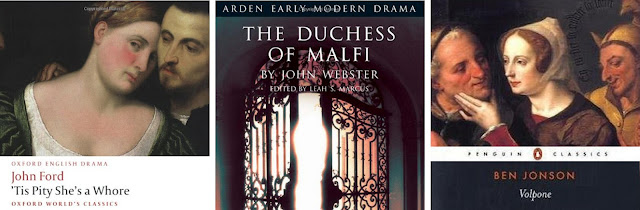
With the plays also being sold through their website and through the audio producers, perhaps even as a set containing cd/download and book.
The trick would be to produce the Shakespearean curiosities along with the other work. An experimental series of four or six to test the market and then on from there. A Shakespeare collaboration, a Marlowe, a Beaumont and Fletcher, perhaps a Webster. A tie-in with Arden for example, would mean these choices are already made.
Competition
Of the complete or near-complete Shakespeare works available only the ArkAngel production of The Two Noble Kinsman is already available, but the others listed above are under produced. Of the others, even the better known playwrights, Kit Marlowe or Ben Jonson’s greatest plays, some of them on school curriculums, have no unabridged audio productions available.
There are amateur crowd-sourced productions online if you know where to look, but not professional and not consistent. Shakespeare’s Globe has monthly series of this material called “Read or Dead” but as yet none of it is available outside their library’s archive. Modern productions of this material even on BBC radio is rare (most often the Drama on 3 slot of the kind already downloadable) and usually heavily abridged.
Conclusion
This could become a very exciting series for whichever company accepts the challenge, taking their work into new markets and creating a legacy of material which could have commercial potential for years to come.
One of its great joys, other than the rather epic cast list, is that it includes within its make up sections of Edward III, Thomas of Woodstock, The Famous Victories of Henry V and John Ford's Perkin Warbeck in what may be their only radio outings, providing useful context to the action within Shakespeare's more famous plays.
Finally we can understand Henry IV's fear that his son Hal, by loafing around with Falstaff is repeating the mistakes of his predecessors Edward II and Richard II (albeit without the homo-erotic subtext of their acolytes) and that Richard's "hollow crown" speech is a near synopsis of the action in Edward III, including the appearance of a "ghost".
Listening to these rarities reminded of a proposal I wrote a few months ago suggesting that an audio or radio company produce a line of full text adaptations of just these kinds of rarely produced early modern dramas so that an interested public might be able to experience the work which was around at the time Shakespeare wrote the dozen or so plays which are constant production.
Disclosure: I did send a version of this to a company but it wasn't something they were really interested in doing which was understandable since its not necessarily a sure fire winner and would need to be planned and executed careful if it's to work as a business proposition. I wouldn't know where to begin myself even. It probably needs an existing production infrastructure and some hope.
I know that some people aren't fans of audio but it offers two benefits. Firstly it's relatively cheap in comparison to video at least in production terms and from an artistic perspective since this would potentially be the only copy of the play available, the idea would be to follow ArkAngel's lead and produce something which emphasises the text.
Anyway, on with the proposal:
Audio Early Modern Drama: A Proposal.
Pitch
Lesser known plays by William Shakespeare and his contemporaries as audio productions.
Introduction
William Shakespeare is back in focus this year thanks to the Cultural Olympiad with a season of programmes on the BBC and the World Shakespeare Festival across a number of venues. But he’s largely receiving the lone genius treatment even though he was influenced by earlier playwrights, was part of a thriving theatre community collaborating with others and would go on to influence writers within just a few years.
Writers like John Fletcher, Francis Beaumont, Thomas Middleton, Philip Massinger, John Ford, John Webster and George Chapman were once household names, some of them collaborating with Shakespeare and succeeding him during his retirement and although some of their work is produced its not in the same bulk as Shakespeare and treated as something of a novelty by comparison.
Except that’s also true of some of Shakespeare’s own plays too especially in the late period, which ran rather further than the conclusion of The Tempest suggests. Collaborations which thanks to the latest techniques are becoming considered part of the canon, Sir Thomas More, Edward III, Arden of Faversham and Double Falsehood (or Cardenio) are again not accessibly available to watch or listen to outside of the theatre despite their high curiosity factor.
All which became abundantly clear last year when I was reviewing Arden Shakespeare’s own Early Modern Drama series and found myself unable to source recordings of these plays so that I could experience them in performance rather than simply as scripts. All are filled with extraordinary poetry but none of them can truly be understood or enjoyed without an actor’s intent behind the words and a directorial thought process interpreting the story and themes, especially by laypeople like me.
Proposal
That these plays be turned into audios on cd or for download, bringing together actors with the high production values. Advertised correctly these should draw a curious general audience, one which is already eagerly seeking out what material is available in their local theatre. But of course there would be students and academics wanting to access high quality recordings of these plays especially those for which there is either only a single option or none at all.
Logistics
The scripts are obviously already written. Editorial choices would be in which texts to produce and preparing those scripts. I’m obviously unaware of budgets, but a writer’s fee (since these are four hundred year old plays) could be ploughed into the cost of the pre-recording rehearsal time which must be required
The texts could be those already in circulation through academic publishers, a collaboration which could go as far as branding the releases to tie-in with the books already available allowing for cross promotion, perhaps even utilising the same artwork:

With the plays also being sold through their website and through the audio producers, perhaps even as a set containing cd/download and book.
The trick would be to produce the Shakespearean curiosities along with the other work. An experimental series of four or six to test the market and then on from there. A Shakespeare collaboration, a Marlowe, a Beaumont and Fletcher, perhaps a Webster. A tie-in with Arden for example, would mean these choices are already made.
Competition
Of the complete or near-complete Shakespeare works available only the ArkAngel production of The Two Noble Kinsman is already available, but the others listed above are under produced. Of the others, even the better known playwrights, Kit Marlowe or Ben Jonson’s greatest plays, some of them on school curriculums, have no unabridged audio productions available.
There are amateur crowd-sourced productions online if you know where to look, but not professional and not consistent. Shakespeare’s Globe has monthly series of this material called “Read or Dead” but as yet none of it is available outside their library’s archive. Modern productions of this material even on BBC radio is rare (most often the Drama on 3 slot of the kind already downloadable) and usually heavily abridged.
Conclusion
This could become a very exciting series for whichever company accepts the challenge, taking their work into new markets and creating a legacy of material which could have commercial potential for years to come.
Saturday, August 18, 2012
Shakespeare references in the Sight & Sound Greatest Films Poll #1

Twelfth Knight Bar in Vertigo. Next door to the Empire Hotel.
Friday, August 17, 2012
Shakespeare's Sonnets.

Framed by Goodwin popping up in some biographical locations sometimes with family members, the idea was to make the poems accessible to audience brought up on television who might find their existence on the page somewhat intimidating. While it was entertaining in its own way, the obvious set back was that the scenes were often at odds with the poet's original meaning and the readers and actors themselves had various levels of comfort in relation to how they should be speaking the words, contemporary poetry fairing better than most. The best interpretations were undoubtedly when the actor simply broke the forth wall and addressed the viewer forcing us to interpret the words ourselves.
That’s precisely the methodology at play in Shakespeare’s Sonnets, the more linear reproduction of the sonnet recordings created for the iPad app produced by Touch Press in association with Illuminations, Arden and Faber. Select “play all” from the menu screen and after Patrick Stewart reads the original title page and acknowledgements, each of the ensuing sonnets is read in turn directly to the viewer by a similar group of actors as the Goodwin project (from Jemma Redgrave to Dominic West with Stephen Fry between). Sonnet after sonnet, face after face appears and the sheer variety of the text and approaches to interpretation even within these limits becomes obvious, especially when Ben Crystal pops up for his original pronunciation of 141.
Shorn of gimmickry, an intimacy is created between actors and viewer which replicates the brief moments in televised plays when a soliloquy has to be addressed to camera. Some performers have a more actorly approach than others, with the younger players often favouring a straight reading over Fiona Shaw or Noma Dumezweni's attempts at providing an emotional context. RSC director John Barton classically utilised sonnets as exercises to help structure the text within performance and it’s certainly the case that actors who’ve been through Stratford provide the clearest readings. But some of the non-professionals are equally impressive, James Shapiro’s Sonnet 138 underpinned by an academic understanding.
Each of the readings is relatively fascinating in and of itself. They beed filmed in a variety of places, in contributors homes and offices, back and on stage at theatres. I imagine director John Wyver and his crew travelling the length and breadth of the country dropping in on the actors depending on their availability and it’d be interesting to know how they were selected. In the main they’re perfectly chosen, some having even appeared in similar sonnet related projects on audio, David Tennant for Naxos’s From Shakespeare With Love (in which he also read “Shall I compare thee …”), Sian Phillips and Fiona Shaw on EMI’s When Love Speaks (different choices).
Watching these sonnets in a three hour block isn’t the best way to consume them and admittedly I didn’t. They were created as part of the app and outside that context they become “just” Shakespeare’s words well read. Perhaps it’s possible for those of us without an iPad to create a low-fi version with this dvd as the cornerstone. The app includes Katherine Duncan-Jones’s notes from the Arden Shakespeare edition which you might have to hand. Fellow contributor Don Patterson has also produced a book on sonnets (and this lengthy article for The Guardian). There are various facsimiles of the 1609 edition of the sonnets at archive.org.
Apart from added interactivity, about the only element unavailable are the additional interviews with experts and given the dvd is more expensive than the app, it’s a shame room couldn’t have been found for those here. That’s not the only niggle. Each of the actors is given their own biography screen which also lists the sonnets their reading, but there’s no play all for these and after watching one of them the viewer’s kicked back to a list of actors rather than the screen they were working from which means they have to go off and find the actor again to see another of their contributions. There’s a similar problem with the numerical list too, which makes the process of wanting to see a sonnet again quickly less efficient. A subtitle option would have been a useful addition.
Otherwise, the presentation is clear and nicely replicates the design of the app judging by screenshots in the accompany booklet (which also includes the actor profiles from the dvd itself). Once you’re used to navigating the menus there’s a definitely an addictive quality to it, wanting to watch one more sonnet, or the same sonnet again. If nothing else, it’s a way of exploring the less well known poems, most of which are generally ignored the face of the mighty 116, 18, 2 and indeed Goodwin’s choices 129 and 29. Few writers can say that 103, read beautifully here by Kim Cattrall, doesn’t capture the desperation of facing something with near flawless qualities and being infected with an inability to write about it.
Shakespeare's Sonnets is out now. Review copy supplied.
Subscribe to:
Posts (Atom)