Showing posts with label hamlet. Show all posts

Saturday, July 02, 2016

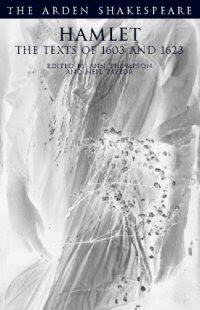
Hamlet: Revised Edition. (The Arden Shakespeare). Edited by Neil Taylor and Ann Thompson.

Books In an effort to acknowledge the passage of time and how even some of their Third Series publications might require some reconsideration, as scholarship begins on the Fourth Series, Arden presents this revised edition of Hamlet, first published in 2006 with some thirty extra pages inserted to present additional scholarship and further productions and publications.  For some reason, having gratefully received review copies of the plays for some years now, in my memory I'd already reviewed the earlier version and was all ready to simply link back to my opinion with some necessary amendations of that opinion.  But it appears not.  Right, then.

The Arden Hamlet was and is groundbreaking for presenting all three extant Hamlet texts, first Quarto, second Quarto and first Folio (ignoring later reprints) across two publications and treating them as separate entities worthy of study in and of themselves.  All three texts contain lines and scenes which don't appear in the others or in the case of the first Quarto whole sections which are simply different, some would argue incoherent and there's been much discussion as illustrated by the authors in their introduction as to exactly where they came from before they were published in this editions.

Previously, with the exception of facsimiles, editors have taken it upon themselves to try and create a "right" or "ideal" version of the play, attempting to reproduce "what Shakespeare intended".  This led them to either choose the second Quarto or Folio as their base text (and including variations at the end) or as was customary for years, and often still is, a conflation, drawing together all three texts, compiling a version which mixes together the three texts.  Before I became a fan, I assumed there was only ever one text of Hamlet, the conflated version, surely studied much in schools for many years and was amazed to find that simply wasn't what Shakespeare wrote.

Taylor and Thompson take the view that because can't really know the origin of the texts before they appeared in the relevant publications and that it's their job as scholarly publishers to present the texts in as readable editions as possible that they should, with the exception of modernising the text and "fixing" error in the original printing,  present them pretty much as is.  For more on the implications that has on the Q1 and F1 texts, see my original review of the accompanying volume containing those texts.  For all its textual "faults", Q1's scene structure has become pervasive as a signpost for directors seeking to the cut the text.

The evidence based approach pervades the publication, as the authors seeking to present the arguments of previous scholars whilst enunciating just how much assumption and hearsay has seeped into scholarship, the need to back-up shaky arguments transforming maybes into certainties.  We can't know exactly the relationship between the various texts whether they're successive rewrites, alternative versions for different venues and even if Shakespeare himself had a hand in their preparation or another hand.  But scholars across history have become lost up numerous blind alleys.

The structure of the book is standard Arden with the "eclectic" approach of the Third Series allowing the authors to choose the topic which mostly interests them.  Here that means that although some lip service is given to the psychoanalytic approach to Hamlet's character, the discussion focuses primarily, across the introduction and appendices, on the textual matters and discrepancies which then feeds into a production and publication history hinting towards a suggestion that the interpretation methodologies of editors, actors, authors and directors converge.

The decadal update extends these themes with the inevitable mismatch between four hundred and then ten years being concentrated on in similar number of pages.  The authors also bravely include criticism of their original publication, from the decision to treat Q1 with the same respect as the other versions to individual choices within the actual text.  Inevitably there's still an obvious cut off point, as the text doesn't noticed that Maxine Peake's performance was filmed for release and there's no mention of the Radio 4 Afternoon Drama production starring Jamie Parker.

Nevertheless, of all the Hamlet editions available this is the publication I'd recommend to anyone seeking a scholarly edition of the play and have on numerous occasions.  Reading appendix 2, which carefully unpicks the differences between the texts and the misapprehensions wrought on them across numerous publications was the first time I really became suspicious of scholarly motive and realised that there isn't one Hamlet.  There's what's in the original text and then the hundred of different versions since, on the page and on the stage.

Hamlet: Revised Edition. (The Arden Shakespeare). Edited by Neil Taylor and Ann Thompson is published by Bloomsbury. £8.99 paperback. ISBN: 9781472518385.  Review copy supplied.

Monday, April 14, 2014

Globe to Globe Hamlet Kickstarter Appeal.

In a bid to pull together more funding for the Globe to Globe tour, The Globe has begun a Kickstarter. Here's the widget:


They're trying to raise £200k. Click through for the pledge video which is worth watching anyway to offer some idea of the logistics of what's being attempted.  Two Hamlets, three Polonius's.

Wednesday, March 19, 2014

Radio 4's Hamlet will be in the Afternoon Drama slot.

Genuinely surprised. Here is Hamlet spread across the whole week in the prestigious 2:15pm slot in five parts (an act per day?) starting next Monday 24th March for five days, total duration about three and three-quarter hours which in audio terms is a mass of airtime allowing space for plenty of the play's textual real estate. For comparison, this is just shorter than the Branagh "full text" film and longer than his Renaissance Theatre production broadcast in 1992.

The programme page is here, with full cast list and clips of Jamie Parker talking about the role.  And here.

Notice that it's not listed as being part of the Afternoon Drama strand, which usually features new drama by living writers.  Will this affect its chances of being a downloadable podcast in the Drama of the Week?

Expect a review here in due course, then.

Friday, December 07, 2012

Shakespeare at the BBC: The BBC Television Shakespeare on YouTube.

At the beginning of this month, BBC Worldwide began uploading archive television to its YouTube channel which includes samples from the BBC Shakespeare collection.  So far there are seven plays, all complete:

As You Like It

The Tempest

Hamlet

Macbeth

Julius Caesar

The Merchant of Venice

Othello

The Wikipedia has a typically voluminous article with cast lists and background to the series. The rest of BBC Worldwide's uploads are here, whole series of documentaries and dramas including Terry Jones's Medieval Lives.

Tuesday, May 17, 2011

Hamlet (Classic Radio Theatre).


Fans of radio history will love the opening moments of this welcome release of John Tydeman’s long deleted Hamlet, as an RP voice from a man you can tell just from the tone of his voice is wearing DG announces that what we're about to hear is “a new stereophonic production” and that “the play will be presented in two parts with an intermission after approximately an hour and forty-minutes”. The listener is sent right back to the cold Halloween night in 1971 when this first broadcast just before seven o’clock, perhaps tucked up in front of the gas fire, the single source of heat in the house, ears glued to the radiogram as the ghostly tragedy unfolded.

The highlight is quite rightly Ronald Pickup as the Dane. The BBC’s publicity of the time suggested he was that generation’s Hamlet (source), and although that’s perhaps overstating things (there were a lot of them about in the early seventies) gives us a prince that flip-flap-flops between controlled sanity in public and genuine madness – sparked by the news of his father’s death – in private. He’s as pleasant as Cary Grant in North By Northwest and it’s this geniality, inconsistent with his usual personality, which attracts the curiosity of the other palace inhabitants, Pickup able to communicate in audio the mask which never slips in public.

The rest of the cast is filled out with a range of experienced stage and radio actors. Martin Jarvis’s Horatio has an unusual independence, loyal to Hamlet but leading his own life. The most disconcerting performance is from Robert Lang, the timbre of whose voice sounds almost but not exactly like Jacobi. Angela Pleasance (Donald’s daughter best known at the time for playing Catherine Howard in The Six Wives of Henry VIII) is an initially extremely aristocratic Ophelia whose tip into psychosis is chilling, her voice skipping restlessly through the listener's ears, breaking through indiscriminate emotions by the second.

Spreading a full length production of the second quarto across three cds, the crisp sound quality, a brilliant contrast from the earlier cassette version released in 1998, highlights the experimental nature of this early stereo which attempts to mimic the experience of being in a theatre rather than the more intimate atmosphere of later radio production in which the actor’s voice is pressed close to the speaker. The music is provided by Malcolm Clarke of the BBC Radiophonic Workshop, best known amongst some of us for his experimental scoring of Doctor Who episodes, and his electronic twang is well utilised to mimic the pipes of Fortinbras’s army.

Hamlet (Classic Radio Theatre) is published by AudioGo. RRP: £16.34 ISBN: 978-1408467251. Review copy supplied.

Sunday, July 18, 2010

30 Campbell Scott


Hamlet played by Campbell Scott.
Directed by Campbell Scott and Eric Simonson.

The Hallmark Hamlet. Though I see from looking at the website, the actual channel in the UK has now become the “home” of reruns and first runs of the likes of legal drama Damages and legal drama Law & Order, my actual experience of Hallmark productions are the fantasy and fairy tale adaptations and “true” life stories that still sometimes populate the post 3pm slot on (channel) Five.

That meant my usual pre-conceived notions going into Scott’s production (despite my love for his directorial debut Big Night) were skewed towards expecting to see what Hamlet would be like as a US tv movie and to large extent that’s what this is, with a mis-en-scene designed to fit very specifically within Hallmark’s house style as it was in 2000 and quite irritating minor-key piano noodling which litters the soundtrack.

The accompanying advertorial on the dvd also points to an attempt to make sure that it doesn’t run counter to the rest of Hallmark’s programming as each of the actors is wheeled out, given an voiceover explanation of their acting credentials and allowed a thirty second sound bite which generally consists of them explaining how exciting the play is and how accessible they’re trying to make it, including the original language which would seem like a prerequisite.

This documentary's hogwash dipped voiceover implores the viewer to enjoy “the immortal prose of William Shakespeare” (he did write some pretty good verse too) and refuses to give much in the way of background to the play with the exception of such wild speculation as “Hamlet, this literary masterpiece, scripted by William Shakespeare on the eve of his own father’s death” (which is interesting considering that the dating of the play still hasn’t been fixed).

Setting the story on the edge of New York at the beginning of the last century, the film itself is vibrant and often thrilling because Scott and co-director Eric Simonson make some strong choices with the text that seem designed to counter accusations that this will simply be an slightly inoffensive, orthodox version. As Roscoe Lee Browne chuckles in the fluffumentary, he told Scott that he wouldn’t ever play and old buffer like Polonius, only to be reassured by Scott that he still wouldn’t be.

First big decision: Scott’s Hamlet is mad. Not just mad, suicidal or at the very least self harming. Scott shifts “To Be…” as early as I’ve ever seen it – before the fishmonger (we’re unsure how much Polonius has observed) – but just after he’s seen slashing unsuccessfully into a vain (the scabs visible throughout the rest of the film). Sprawled on the floor, this Hamlet isn’t just rhetorically musing on the question for show, but genuinely considering his own mortality.

And because from the moment he learns of Claudius’s deeds until he’s shipped off to England, the prince loses not just his mirth but all of his senses, sometimes seen talking to himself even if a soliloquy isn’t forthcoming. When Hamlet asks Laertes’s pardon for the murder of his father before the duel, rather than simply blaming the fault on his feigned madness, he’s asking if he can be held responsible for Polonius’s death because he was really not in his right state of mind.

Second big decision:  Scott justifies this by turning up the supernatural quotient of the play to near Macbeth proportions. This Hamlet doesn’t just hear the matter of his father’s death, he feels it as the ghost brings about a hallucination, the prince experiencing the poisoning, blood flowing from his ears, a kind of tinnitus infusing the soundtrack. As he stalks the halls, the whisper of Hamlet Snr (“Remember, remember”) and that whine follow him about, demonstrating how he's now all but consumed by the experience.

And the ghost keeps reappearing; not just in Gertrude’s chamber, but holding Hamlet’s sword back as he’s about to off a praying Claudius and at the point of death. But of course there’s an ambiguity to these appearances; are these really new emergences of the figure or manifestations of Hamlet’s crumpled state of mind. We assume it must be the latter and then Claudius sees his brother in the face of a player during The Mousetrap and then we’re not so sure. It’s like an episode of Lost with royalty rather than polar bears.

As well as Scott’s layered performance, Blair Brown makes some sense of Gertrude’s woolly motivation towards the end by playing up her belief in her son seeming not entirely unhappy that Polonius is out of the picture (shock at the deed, not shock at the outcome) even if she’s weakened slightly by Scott’s decision (and I’ve not seen this before) to cut “There is a willow…” which whilst having the effect of strengthening the opening of the gravedigger scene does mean that Brown doesn’t have the chance to give her character’s one great moment of compassion.

Within her own breath of madness, Lisa Gay Hamilton’s Ophelia appears wearing her father’s jacket and gives an eerie, uncanny imitation of Roscoe Lee Browne’s Polonius that’s also rather breathtaking. But this is generally a good cast with only Roger Guenveur Smith’s passionless Laertes failing to convince, at no point seeming to be the rapscallion that his father would need to keep an eye on as he creates mayhem in Paris. If his whispery understated performance was a directorial choice, it would only make sense if Reynaldo had been cut. He wasn’t.

In total, then, not the first production of the play I'd show to someone, but an interesting interpretation.  Some elements, such as Ophelia seeing Hamlet joke about her father's corpse only really resonate if you're aware that in the original text the stage directions make it impossible.  But this does also feature an excellent version of The Mousetrap in which the players are dressed in what seems like the very Elizabethan period costume that a Hallmark audience coming to the play cold might have been expecting...

[Scott has given a rather good interview about this film but he doesn't give very much away.  Most of his choices, including casting African American actors in Polonius's family seem to be in the order of "It seemed like a good idea..." but without much of an underlying motivation.  He even says, "It's hard because people think there's an alternative agenda. And the fact is, there is none."  Nonetheless, a lot of thought has clear gone into how this version fits together, even if it has seeped in from previous stage productions Scott has been involved in.]

Wednesday, July 07, 2010

Hamlet (RSC Macmillan) Edited by Jonathan Bate and Eric Rasmussen.


Who's There?

Despite my praise for the RSC’s complete works project which led me to embarrassing editor Jonathan Bate at a lecture/booksigning when I told him about being “something of a fan”, I was initially a bit reticent about purchasing an individual edition of Hamlet on the assumption that it would simply reprint the material already available in the larger volume. But since I’m a completest and I very much liked the cover with its spade variation on the usual Yorrick’s skull or Ghost, Amazon were soon making a debit to my credit card.

Publication Data

Published 2008 which makes it, I think, the freshest edition of the text available, what with rivals reprinting older material with new covers. The third revised edition of the Arden third series was in 2005.

Introduction

As expected, and perhaps understandably, there is a sense of déjà vu. Much of the introduction replicates text from the complete works, as does the key facts, the text itself obviously and the Shakespeare biography at the back is an abbreviated rewrite of the general introduction. Yet, even if you already have those complete works (and if not, why not exactly, Asda now have copies of the paperback for just over twelve pounds) I would certainly recommend this individual volume, if you’re looking for a thoughtfully edited, brand new "player" rendition of the play.

Bate’s introduction is relatively short but plain speaking, interested in illuminating the doubling of Hamlet with other characters, Laertes, Fortinbras and Claudius who it’s suggested had comparable schooling. There’s a dichotomy at the heart of Hamlet’s character, Bate suggests, in that he’s capable of some horrible violence, but is unable to react when called upon to do so with pre-meditation because of his intellect, which is I suppose the opposite of Claudius who is capable but doesn’t want to be too bloody and wants to be surreptitious so relies on poison to do his work.

Unusually, the introduction then turns to the stage craft of the fight and that unlike the simple fencing epee of modern productions – notably the RSC with Tennant and Branagh’s film, productions would originally have featured a rapier and dagger which means that the fudge that usually occurs with Hamlet accidentally grabbing Laertes’s weapon should be more purposeful demonstrating a shift in personality. In order to be a worthy successor to his father, he would have to show the same ability to make big decisions like Hamlet Snr’s land grab and this would demonstrate that possibility.

The introduction then expands from the complete works original for a textual discussion related to hammering the play into shape for a coherent production and then a dip into the critical history which cunningly ignores all of the usual names for something rather more oddball. So instead of Bradley, there’s a smattering of Dr Johnson, Goethe, Schlegel, Showalter, Kierkegaard, Freud, Joyce and well, there’s a surprise at the end. What this selection from outside of the critical mainstream demonstrate is that like football, everyone who’s interested as an opinion on Hamlet’s mental state but no one is really sure.

About The Text

Does a good job of explaining the vision for this version of the text. This is, like the Oxford (which I'll be talking about in coming days or weeks) the First Folio in its purest form, with the Q2 additions at the back, “Now all occasions do offend me" and all (note nothing from Q1 which increases the Arden supplement’s value) the assumption being that the post-mortality edition of the play was the most up to date copy and as Shakespeare finally intended. Oddly, Q2 has still been used as guide for “corrections” however and some of the readings from the earlier printing have been transposed, not least sexton for sixteene in the gravedigger scene, which is still problematic despite theatrical tradition.

Hamlet in Performance: The RSC and Beyond

After a new scene-by-scene analysis some might say synopsis, we find a thorough stage history with some focus on the RSC. The main theme is continuity and the line which can be drawn from Burbage to Garrick to Macready, Irving, Barrymore, Gielgud, Olivier and take your pick from many of the faces I’ve looked at on this blog, though I like to think it shifts to Jacobi then Branagh then Tennant, which is unfair since it’s rather orthodox and leaves out the wilder excesses of Burton, Warner and Williamson.

What marks out the RSC’s contribution is its willingness to experiment and that’s demonstrated in the edition’s true innovation, a round table discussion between three practitioners who have produced the play for stage. Ron Daniels’s contribution is based on his so-called pyjama Hamlet with Mark Rylance in 1984; John Caird directed Simon Russell Beale for the National in 2000; Michael Boyd the artistic director of the RSC tackled the play in 2004 with Toby Stephens in 2004.

These few pages cover a lot of ground and you might have noticed me already quoting from it in my show reviews and are a demonstration that there’s no better people to talk about the play than those tasked with turning it into a piece of drama although there is some disagreement between the three as to how, for example, brutally the closet scene should be played, how abusive Hamlet should be to his mother, the extent to which he is suspicious of his motives.

How is it, my lord?

A thumping good edition all round then, striking the right note between helping the beginner and offering something new for the fan/scholar. Having taken over from the Penguin as the RSC’s text of choice, it is still very much a player’s edition. The notes at the bottom of each page are brief but pointed and the text is well spaced out and readable. I’d refer you to the complete works first if you’re looking for something with the same scholarly aims but with greater depth.

Hamlet (RSC Macmillan) Edited by Jonathan Bate and Eric Rasmussen. £6.99 paperback. ISBN: 9780230217874.

Monday, June 28, 2010

Hamlet (Spinebreakers). Edited by Dr. G B Harrison.


Who's There?

Spine Breakers from the Puffin Books imprint is an online book community for teenagers between the ages of thirteen and eighteen, with editorial control and content produced by people from within that age group. Penguin are now using the initiative to publicise some classic books, Pride and Prejudice, Dracula, Jane Eyre and Hamlet giving each the trappings of a modern novel with a day-glo cover and a zeitgeisty quote on this back, in this case, David Tennant saying that it’s “Probably the most famous play there’s ever been.”

Cover

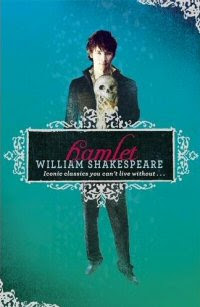
The motivation for choosing Hamlet (for which a review copy was supplied) is right there on the cover. Penguin are refreshingly taking the logical assumption from the first Folio as explained by Steve Roth in 'Hamlet: The Undiscovered Country' that based on evidence in the gravedigger scene, the Danish prince is a teenager, just sixteen years (and not thirty as theatrical tradition has it), which means that the play has a better chance of resonating with the target audience. So there he is, a fresh faced Justin Bieber lookalike, clutching Yorrik’s skull. The synopsis on the back emphasises this by describing Hamlet up-front as a “young prince”.

The Text

Open the cover, though, and after the title page we find a reprint of GB Harrison’s original Penguin edition from 1937 which I previously reviewed at this link under its other guise in the Penguin Popular Classic edition. Short of a whole new editorial, this is a fairly good choice because of its simple but detailed approach to Shakespeare’s biography and Elizabethan staging. In this context, the handy glossary at the back of the book also reads like the Urban Dictionary and included words which would be no less unusual in teen speak now: “drossy: scummy”, “fordo: destroy” and “milch: moist”.

How is it, my lord?

My few reservations about the text are carried over as well, if not moreso since in this context its more likely to find use in an educational context were the information being given to a student and what they believe could effect their exam marks. Plus, however lush the cover, this is still the repackaging of material which is available for five pounds less elsewhere. Nevertheless, the philosophy behind the Spine Breakers editions is to be applauded and I’m sure Harrison would be pleased to see his work still being used to help introduce Shakespeare to a new audience all of these years later.

Hamlet (Spinebreakers). Edited by Dr. G B Harrison. Published by Puffin Books. £6.99 paperback. ISBN: 9780141331836 (for which a review copy was supplied)

Thursday, June 24, 2010

Hamlet (Penguin Shakespeare). Introduction by Alan Singfield. Text edited by Professor T. J. B. Spencer.


Who's There?

There’s something rather legendary about The New Penguin Shakespeare editions of his plays (for which a review copy was supplied). In nearly all of the television documentaries I've seen across the years, when actors are projecting at each other in rehearsal rooms they’ve almost all had an RSC now NT endorsed Penguin paperback sitting tightly in their hands or folding over by the spine. They’re very tactile, with their soft covers and thin paper, which make it possible to roll them up like scrolls and toss lightly to one side when the words are finally flowing from memory.

Cover

Clare Melinsky is a British illustrator specialising in lino-cuts in colour and black and white following the style of traditional woodcuts. She's provided elements for all of the new series of Penguin Shakespeares and reproductions are available through her website, hand printed at the cost of £90-£120. As an aside Melinsky's recently been asked to produce covers for a new edition of the Harry Potter novels.

Publication Data

Penguin originally published a slender edition in the pre-post World War II (which still survives in reprint I reviewed last week). The New editions arrived in the 70s and 80s, with a simple rendering of the text, uncluttered by the footnotes of more academic additions – which is probably what made them so attractive to actors. The commentary was at the back, ready for consultation when a disagreement develops about the meaning of the words, or as a starting point for the director’s interpretation.

The Text

Those elements are continued in this 2005 edition and indeed the play is exactly the same text, account and commentary edited by Professor T. J. B. Spencer that is also in print as part of the four tragedies omnibus I wrote about the other day. With other publishers rushing out new versions of the text, it’s interesting that Penguin are happy to stand behind a version from three decades ago for their main edition, though perhaps after four hundred years it’s the reading of the play which is important less than textual matters.

General Introduction

And an excellent introduction this provides. A new General Introduction brings the scholarship of Shakespeare’s biography in line with research into the mid-part of the past decade, happy to emphasise his work as a collaborator early and later in life and in the ensuing chronology though Edward III and Sir Thomas More are mentioned (at least as far as to point out that they don’t feature in the Penguin edition), Arden of Faversham isn’t and Cardenio is stated as being lost without allusion to Double Falsehood.

What sets Stanley Welles’s general introduction apart from others I’ve read is its willingness to go beyond Shakespeare’s death. The Restoration period of adaptation and veneration is covered and then his critical development from Coleridge through Hazlet and Granville-Barker. Such matters are covered only briefly, but Welles refreshingly makes plain that Shakespeare did not write books but plays and for the proper sense of the characters to be understood they have to be seen in performance.

Introduction

Anne Bilson’s original play introduction is replaced now with far longer, more intellectual rigorous piece by Sinfield. But like Bilson, this new writer understands that readers may already have a wealth of criticism to hand, not least in the play’s commentary, and so decides to instead present their own individual impression of the text. Emerging from these dense pages is a writer who has a more holistic approach to criticism and who’s very willing to ignore or actively battle against orthodoxy.

Sinfield begins with arguments for and against Hamlet’s religious persuasion, and the extent to which that effects his ability to kill the king. Bilson went into similar areas, but Sinfield then cleverly turns it on its head by suggesting that actually Shakespeare doesn’t give enough evidence either way and may simply be relying on “us” or to put it more prosaically than he does, each individual audience member to decide with the young prince’s actions compare favourably or otherwise with our own world view, spiritual or otherwise.

He then turns that on its head by suggesting that actually, the “character” based approach to the play – as begun by A.C. Bradley – in which themes are developed through a character investigation, doesn’t work in Hamlet because the playwright seems to actively battle against making specific judgement in that way. Of course directors and actors must in order to make sense of a performance, but Sinfield argues that Shakespeare almost offers too many choices (which no doubt reflects the richness of the critical industry).

In other words, to attempt to apply a psychologically coherent expectation of character to Hamlet as we do with modern drama is a fools errand; whole books have been written about Gertrude’s attitude when in truth like many other characters (Angelo in Measure for Measure for one), after the closet scene it’s almost as though Shakespeare loses interest in her, like Ophelia she exists merely to demonstrate some aspect of Hamlet’s forward narrative motion rather than exist within her own being.

Play in Performance

A quick step through a mix of production history and dramatic choices, what to cut, how literal to make Elsinore, how to stage the Ghost and how casting choices effect characterisation. As a firm believer in Fortinbras and the political dimension, it’s shocking to me that all of that was cut well into the last century. Hamlet as a “simple” family drama can become a bit airless unless done well – Claudius the politician seems harder to kill just some murderer, underscoring the difficulty of Hamlet's mission.

Further Reading

A breezy look at the other editions available and some of the wilder excesses of criticism from across the decades which underscores the introduction’s reminder that by the play’s end because some it’s greatest mysteries, not least the origin and proper motivation of the Ghost are not explained, dozens of academics have felt the need to fill the gap in understanding. The tone is suitably mocking when required and the added context makes this rather more useful than the version from 1980.

How is it, my lord?

The newer Penguin edition will be perfect for someone intimidated by the nerdier excesses of the Arden or Oxford. My only suggestion, for future reprints, would be for the return of the original Bilson introduction alongside the Sinfield. Neither covers the same ground and though it would inevitably make the edition fatter, it feels important that these Penguins in particular should retain a sense of chronological critical continuity, especially considering their ongoing place within theatrical history.

Hamlet (Penguin Shakespeare). Introduction by Alan Singfield. Text edited by Professor T. J. B. Spencer is published by Penguin Books. £7.99 paperback. ISBN: 9780141013077.

Saturday, June 19, 2010

29 Anton Lesser


Hamlet played by Anton Lesser.
Directed by Neville Jason.

Since brevity is supposed to be the soul of wit, I will be brief. As well has having the budget classical music market sealed up, Naxos also have a list of drama audiobooks that covers most of the canon and that includes two different Hamlets – the early Gielgud (coming soon) and this 1997 recording with Anton Lesser in the title role. Lesser first professionally played the role on stage under Jonathan Miller in 1982 at the age of thirty (having previously attempted it at school at sixteen) for the Donmare Warehouse. The full story of that production is in Mary Zenet Maher’s Modern Hamlets and their soliloquies which does a good job of mythologizing their efforts.

With that in mind I was rather looking forward to this recording and indeed it starts out well enough with some unidentified classical music on the soundtrack which works as a dramatic score. But it doesn’t take too long to realise that director Neville Jason isn’t interested in providing a too radical interpretation of the text and within a few scenes a strange lethargy breaks in as the drama falls out of joint and I was left enjoying this and that small bit of business but unable to really become fully engrossed. By the time of The Mousetrap, I was actively disappointed.

But I’m willing to admit it doesn’t sound like it’s all the cast’s fault. Rather the cast all seem to be appearing in different versions of the play, as though in turning up for the recording, they’re doing the version of the character they may previously have offered on stage. Lesser certainly has that deliberately unlikeable adolescence and I certainly agree with the reviewer (quoted in Maker’s books) who said that it was the first time that they’d wondered by Claudius doesn’t simply off the boy too since we know he has the wherewithal. The answer is of course that then we’d only have half a play.

But generally, if indeed this was directed in the traditional sense, Jason – perhaps guided by Naxos – was most interested in producing a conventional reading of the full text, with a musty Polonius, panto Claudius and indeterminate Gertrude. Only Emma Fielding seems to break with tradition with an Ophelia who’s a very modern woman of the kind that appear in BBC nine o’clock dramas, quick witted and slightly naughty. When she agrees to her father’s request to stay away from Hamlet, she gives the impression that she’s only telling him what he wants hear, fully intending to raid the prince’s bedchamber again that night. Sadly, obviously, events conspire against her.

Friday, June 18, 2010

Hamlet (Penguin Popular Classics). Edited by Dr. G B Harrison.


Who's There?

The Penguin Popular Classics edition of Hamlet (for which a review copy was supplied) is something of a publishing classic as well as a cheap way of picking up the play. From the mid-30s onwards, Penguin pioneered the production of inexpensive copies of contemporary fiction, the familiar three band, two colour coded cover filling news stands which had previously only carried newspapers and magazines. Penguin Classics sprang out of that spirit, offering quality presentations of great literature from around the world at a relatively inexpensive price making them accessible to an audience outside of academia, in some cases, for the first time.

Open the florescent green cover of the Penguin Popular Classics and after the title page we find a reprint of Dr. GB Harrison’s original Penguin edition from 1937. Harrison was the general editor of the Penguin Shakespeare between 1937 and 1959 and one those old scholars who oscillated between action in both in both world wars (working for army intelligence) and years spent in academia, writing seminal books, in his case about the Elizabethan age. On my own shelf I have Harrison's Introducing Shakespeare, produced for the Pelican imprint at around the time of this Hamlet edition.

General Introduction

This edition opens with a succinct but surprisingly detailed biography of Shakespeare and his position in the theatrical life of the London from Henry VI to the ultimate publication of the plays, the tone of which suggests that as with most artists, even he was outpaced by youngsters like Ben Johnson with new ideas. That’s followed by a few pages on Elizabethan theatre emphasising the bareness of the staging, illustrated with the rather nice wood-engraving of the Globe Theatre by R.J. Beedham, the image of which will now be familiar to anyone whose visited the reconstruction.

Introduction

Those same sections appeared in all of the original Penguin Shakespeares edited by Harrison before he provided an individual essay describing the origins of each individual play. In Hamlet’s case that means a lengthy synopsis of what was believed at the time to be the source text Shakespeare would have used, Belleforest’s Histoires Tragiques (skipping over Belleforest's own source Saxo Grammaticus) and some consideration of the textual confusion between the three printings of the plays and the decisions Harrison therefore had to make in preparing the text.

The Text

Harrison notes that while the tradition is to conflate the texts (as happened later with Penguin’s New Shakespeare editions) or to employ the second Quarto with Folio corrections, this edition prefers the Folio with Q2 as the basis “correction obvious mis-readings by the Folio”. Having said that, Harrison has still followed the Theoboldian tradition of adding to the main text such Folio omissions, Q2 additions as Hamlet’s Act IV soliloquy “How all occasions do inform against me..” but with square brackets around them, which still suggests conflation through the back door to a purist like me.

Notes and Glossary

At the back of the book are notes and glossary sections with in some places lengthy expositions about the text, explaining contemporary references, offering commentary on the action and extrapolating the historical underpinnings which with contemporary eyes demonstrate the change in educational expectations. At one point Harrison says that “centre” means “the centre of the Earth which was regarded as the absolute centre of the universe” without mentioning Ptolemy or explaining why, something which would have to be done now.

How is it, my lord?

At £2 this is a bargain. However, I still have some reservations, not least that Hamlet scholarship has moved on in the seventy years since this volume was originally published. Some of Harrison’s conclusions, especially about biographical dating and the origins of Q1 have become antiquated. Perhaps a future edition might include a couple of pages putting the main text into some context or at the very least reprint the author’s note which appears on the back of Introducing Shakespeare, thereby underscoring the great contribution Harrison originally made to our national understanding of this play and its writer.

Hamlet (Penguin Popular Classics) edited by Dr J B Harrison is published by Penguin Classics. £2 paperback. ISBN: 9780140620580.

Tuesday, June 15, 2010

28 John Gielgud


Hamlet played by John Gielgud.
Directed by Michael Benthall *.

Listen to enough audio Hamlets in quick succession, as I have in this past week or so, despite the decades between recordings, and indeed despite the subtle differences in performance amongst the primary cast members, certain patterns, presumably due to theatrical tradition do emerge. Osric is usually effeminate. The Gravediggers mainly have outrageously rich regional accents, favouring cockney, sometimes welsh. Most often, when Fortinbras bids the soldiers shoot, they rarely do, the gunpowder replaced by a drum beast lest it damage the speakers.

So whenever something outrageously different happens, you really sit up and take notice. I’ll delve into the guts of this classic Old Vic production in a bit, but for a moment lets play with the packaging. Firstly, it has a narrator. John Rye appears throughout orientating the listener to the action to wit, the Gravedigger “Throws up bones and the occasional skull” (nice detail that) and listing the players in each given new scene “Meanwhile, Claudius and Laertes consult”.

The effect is rather like listening to some ancient recording of a radio commentary for a football match or if you’re that way inclined those cd releases of lost except on audio Doctor Who stories where a former companion fills in the gaps. Now and than Rye will even provide some extra context. In the early “council meeting” we’re advised that Hamlet is the “late king’s son. His claim to the succession has been overridden and he is not part of the council.” Between Acts One and Two we're told “Two months have passed.” That’s the first bit of excitement.

The second and indeed the one which led me to shout out happens at the top of Act 4, scene 5 when Rye intones, “Ophelia enters carrying a lute”. “A lute!” I shouted and having just read the recent Arden edition about the first Quarto and how the stage directions have impacted on later production, I shouted again “Q1’s lute!” which doesn’t sound syntactically possible, but it really is. Welcome to my world, right now. And sure enough Yvonne Mitchell’s otherwise fairly shrill Ophelia gives us a song or two which is close as the play gets to being a musical unless it's been recomposed by Ambrose Thomas.

A taping of the 1957 Old Vic Company production which is generally ignored in favour of the 40s recording done from the stage (the one featured in the Michael Almereyda film with Ethan Hawke and released by NAXOS). This is the version which is available on Spotify although the cassette I have sitting in front of me was released by Listening For Pleasure in 1977 and says misleadingly “playing time approx 2 hours” which it is give or take another couple of hours being a complete recording of an augmented Folio. Perhaps whoever did the art back then was under the impression it was an abridgement.

Either way, initially it seemed as though I was going to feel every one of those hours. The RP delivery kicks in within moments of the howling wind on the battlements and yet, even though this a production done for clarity rather than raw emotion (or perhaps because of it) the three and a half hours passed far more quickly than for the Renaissance Branagh. That left me an emotional wreck. This on the other hand left me noticing all kind of textual idiosyncrasies and seemed more like an intellectual journey.

There’s nothing wrong with that. I hadn’t considered before, for example, that no one actually tells Hamlet that Claudius is sending him to England even though he mentions it to his mother in the closet. Presumably the message has been passed in the meantime, but by whom, and when? Similarly, Claudius is very concerned about how his family’s trials seem to the general public. The initial reason he’s sending Hamlet to England is to convalesce and even after Polonius’s manslaughter, he’s keen to continue that impression:
I have sent to seek him, and to find the body.
How dangerous is it that this man goes loose!
Yet must not we put the strong law on him:
He's loved of the distracted multitude,
Who like not in their judgment, but their eyes;
And where tis so, the offender's scourge is weigh'd,
But never the offence. To bear all smooth and even,
This sudden sending him away must seem
Deliberate pause: diseases desperate grown
By desperate appliance are relieved,
Or not at all.
That’s the cult of celebrity right there, and the reason why VIPs seem to always receive less punishment in the eyes of the law. And this is a very regal family; the actor’s voices alone lay on the trappings of royalty and the impression of a once great household eating itself from within.

Gielgud’s performance does nothing to dissuade that. Having already played the part on a number of occasions since his debut at the Old Vic in 1929, he was already in his fifties at the time of this production (which was made when he’d just been engaged as leading man at the theatre) and the recognisable lispy antiquity has already begun to develop. If someone becomes synonymous with a role, does it change with each production or do the rest of the cast simply react to the star turning up to do their turn? Initially it seems as though he’s simply keen to go through the expected motions, the unhurried verbiage, the shaky trill during the set speeches, everything that’s expected of this Shakespearean who straddled across generations of different acting traditions.

He doesn’t even seem much madder after he’s met the Ghost than before and indeed he’s much the same figure even during the Fishmonger. Then, electrically, from almost nowhere, he finally bursts with passion during “Oh what a rogue and peasant slave” barking “Remorseless, treacherous, lecherous, kindless villain!
O, vengeance!” with breathtaking vigour. Gielgud’s been modulating his emotion. He knows that if he begins with despair (as both Branagh and Tennant do later) if you’re not careful, you have nowhere else to go. Best to save it and frighten the audience (or in this case listener) out of their wits.

I think in this case he's taken the same view of the character as John Caird (who directed the 2000 RSC Simon Russell Beale) who suggests in the recent RSC edition that purely on a script basis, Hamlet's the sanest person in Elsinore, and any actor that begins to act the madness is working against the text. As everyone about him finds themselves in mad situations and react madly too, Hamlet is rational and becomes saner and saner as the play progresses and Gielgud's performance almost proves that. Even when Hamlet kills Polonius it's a defensive manoeuvre. He doesn't kill Claudius because is moral code forbids it. Laertes says he would kill someone in a chapel in an instant.

As for to the rest of the cast, Peter Coke (best known as Paul Temple on the radio) gives an emotionally complex Laertes who’s genuinely touching as he watches his sister’s sanity fall away. As Horatio, Jack Gwillim (Poseidon in Clash of the Titans) presents the stand up bloke, good in a fight, loyal. But the most fun are John Woodvine and Derek New as a Rosencrantz and Guildenstern who are Claudius’s lapdogs from the start, tersely dealing with Hamlet without a hint of loyalty like they’ve walked in from a Le Carré novel, entirely impatient when Hamlet breaks off from their passage to England to have a chat with the Captain and obviously clear about what their mission is about. When Hamlet has them killed, for once, you share his lack of remorse . . .

* The box neglects to mention who the director is. Michael Benthall directed Gielgud in a number of plays at the Old Vic at the time so I'm *assuming* it was him, but if you know different please correct me.

Monday, June 14, 2010

27 Kenneth Branagh


Hamlet played by Kenneth Branagh.
Directed by Kenneth Branagh and Glyn Dearman.

When a radio production opens with the sound of Francisco pissing up a wall, giving his line “For this relief much thanks” a double meaning, you know you’re going to be listening to something rather special. A 1992 recording for Radio 3 by The Renaissance Theatre Company of a version of the 1988 staging, directed by Kenneth Branagh in conjunction with radio producer Glyn Dearman, this presents the full text and has one of the greatest casts I’ve seen outside of Branagh’s own film, including Derek Jacobi, Richard Briers, Judi Dench, Sophie Thompson, John Gieldgud, Michael Hordern, Michael Elphrick and one Emma Thompson.

Though this has similarities with that film, especially Branagh asking long term collaborator Patrick Doyle to offer some orchestration (though the music cues would not be carried over), Dr. Russell Jackson’s engagement as the text consultant and with some very cinematic audio design, this is by no means an audio animatic. With mostly a different cast and alternative thematic underpinnings, within moments it’s entirely possible to put the celluloid imagery to one side and simply allow this alternative version to wash over you or as happened in my case strike me in the guts. Audio productions rarely move me, yet by the end of these three and a half hours I was despondent, depressed and even teary. Job done, then, Mr Branagh.

Whereas in the film, Hamlet’s generally sane and regal and angry rather than even feigning madness, here we find a much more visceral presence apt to shift off into moments where he's entirely unhinged ("the conscience of the king" is a particular showcase). But there are moments of intimacy with the listener and in the booklet that accompanies the cassettes which includes interviews with all of the main players, Branagh says that he’s trying to create the impression of the prince thinking the set speeches. He achieves this by removing the background sound effects -- except during “To Be Or Not To Be…” in order to show that, as in the later film, he’s performing for Claudius and Polonius, secreted nearby.

Branagh takes the most relish and particular care during The Mousetrap. The extended text allows him to enunciate Hamlet’s disdain about how the visiting theatre company is being set aside in town in favour of the new fashion for child acting companies (a real issue in Shakespeare’s day). Michael Hordon’s Player King gives full richness to the text from Pyramous (bringing to mind his turns as Prospero). The whole duration of the dumb show is included with explanatory sound effects and audience reactions – though I wonder how clear this sequence would be with someone new to Hamlet. Either way this is one of the richest treatments of the players I've heard so far. Not least because ...

Emma Thompson is the Player Queen. In the booklet interview, she notes that usually the play within a play “is acted very hammily” which its inferred has the knock on effect of making it comical (perhaps to approach head-on boys playing girls as suggested by Shakepeare in the text), distracting us from what the scene is about. “Claudius" she says, "has to be touched and frightened by what he sees”. This is a rare occasion when the emotional truth of The Murder of Gonzago is fully explored and their arcane predicament almost becomes as compelling as the play outside the play, which means that the King's later confessional is all the more truthful.

This is a production replete with such excellent choices. Gieldgud’s Ghost, whose ancient voice suggests that he’s being broadcast live from purgatory, his disembodied monotone at odds with Branagh’s emotional reaction, Hamlet heard whimpering throughout. In the closet scenes, when Polonius cries out he actually sounds like Claudius making Hamlet’s mistake all the more plausible – usually we have to trust that the Prince just isn’t in his right mind which is why he’s stabbing someone who plainly doesn’t sounds like some old duffer. Doyle’s music plays at length between acts allowing the listener a moment to consider what they’ve just heard, the audio equivalent of the scene changes in the theatre.

The recording even makes its presence felt by appearing on four cassettes, eight sides, despite only being about half an hour longer than the ’77 Jacobi version. Listening to the two in quick succession as I did, its possible to hear the progression in technique, perhaps a small increase in psychological complexity, but now and then I did get a feeling of déjà vu as the Jacobi's influence asserted itself in a line reading (“The cup, the cup”) or playing of a scene (Laertes storming the castle, the rabble cascading through the speaks). But mostly this a chance to catch one of those watershed moments with three generations of Hamlet in one production this s a great theatrical event and a celebration of the play.

Sunday, June 13, 2010

26 Derek Jacobi

Jacobi closeup 16

Hamlet played by Derek Jacobi.
Directed by Toby Robertson.

I’m signed up to the local Freecycle service and a couple of years ago someone was giving away bags and bags of old theatre programmes and posters. I had thought before visiting that they would be for the local area but they turned out to be from the West End and outer London and to my great pleasure for this legendary Old Vic production of Hamlet with Derek Jacobi originated in 1977/8, put on tape in 1979 and released by Argo on cassette a couple of years later.

The programme itself is a treat, but you can see that for yourself because I’ve uploaded photos of the pages to flickr (albeit using my rubbish digital camera). There’s a celebratory feel, perhaps because this was seen as a triumphant return, with photographs of Hamlets from previous Old Vic productions stretching as far back as Ernest Milton in 1921 and a history of the theatre itself. The advertising too offers a microcosm of the life of theatre-goers in that period:

28/29

As with the recording of the RSC production with Tennant, reading the programme beforehand certainly put me in the right mood, helped by the fact that as with many of the programmes she gave me, the previous owner has written a short review of the show in the back along with a note about the audience. This was a return appearance after an international tour and her words suggest that some elements had changed in the meantime:
30th Jan 78

Performance dulled a little. Jacobi not quite as carefree (colourful?). Directorial difference only. Humour more masked. Ophelia back to traditional portrayal. Wymark the besotted girl, as opposed to Bertish the sophisticate. Not so interesting. Bertish added extra level to the play. […] Audience were more responsive. Picking up all the humour quickly. Small house but a relaxed audience.
Reading these contemporary professional reviews and the account from the book Modern Hamlets and their soliloquises reveals that the show had a messy stage history, beginning as a truncated version (the programme suggests the Folio text with cuts suggested by the first Quarto) with a much praised Ophelia in Suzanne Bertish and a clear indication that she and Hamlet were very much having a sexual relationship – it’s this version that Kenneth Branagh saw and convinced him that theatre was the life for him.

A few months later the production, retaining most of the same cast, was extended to a fuller length (reinstating amongst other things “How all occasions” according to director Tony Robertson), with Jane Wymark, who appears in this audio version, replacing Bertish and offering a much more subdued, chased version. My donor was obviously keen to compare and contrast and obviously preferred the earlier production which seems to be the reverse of the audience she was sitting with! Without a point of comparison I will at least propose that Wymark’s Ophelia is a bit traditional but not bland.

What is notable is how physical this audio production is. Though this obviously can't be a complete replication of the stage production, what we have here is a well rehearsed cast giving a performance rather than simply rehearse/reading from a script which often happens with audio productions. Care has been taken to place the characters within a definite space, with some scenes conducted some way from the microphone forcing them to offer theatrical projection making this a very visceral listen. Only during the soliloquies do the actors take advantage of the intimacy reducing their timbre of their voices to a whisper.

Perhaps its because of that Jacobi is a more passionate Hamlet than the man he became in the later 1980 BBC Shakespeare production, his voice shifting constantly between octaves as if to indicate the frequency of his madness (for he doesn't just fein madness, he nudges off the cliff) through sound alone. After discovering the reality of his father’s death, he offers a gutteral scream which made my tape player tremble and one can only imagine the physical power he must have had on stage. His Hamlet bawls as he drags away the guts of Polonius, well aware that his moral code is broken and that he's now no better than the man he despises.

Only in the late scenes, when Hamlet knows the moment has passed and there's little he can do does Jacobi rightly sober up, as if to indicate that he understands that he can no longer fight against the inevitable, “The readiness is all”. But by then the rest of the cast have shifted up a gear to join him. Timothy West’s Claudius (which is new to this audio replacing John Turner) is an impatient, irascible figure unable to keep his true emotions from cracking through the surface. If his treatment of Gertrude after the death of Polonius is any indication he must be horrible company.

Frequently with productions, especially on audio, a fatigue sets in during the latter stages, especially if I’m listening in one session, which is usual. Not so here. Even as Hamlet began to describe his relationship to Yorrick I began to question what I was hearing and for the first time I noticed – Horatio knows about the effect Polonius’s death has had on Ophelia – it is he who convinced Gertrude to meet Ophelia -- but has he told Hamlet? The Danish prince’s good, if melancholic humour just before the funeral suggests not, in which case, why now? I asked Metafilter and along with some of the criticism I've subsequently looked at, no one seems to have a definitive answer.

Also keeping my interest in these late stages are Laertes’s proper mob, the room suddenly filling with dozens of voices which is rare. Barbara Jefford’s regal Gertrude who appears to tell Hamlet what he needs to hear but breaks down just after he leaves her. And the other casting interests which include Trevor Martin as the Norwegian Captain, the older version of whom I saw in As You Like It at the Globe last year and one Oz Clarke, future wine critic, then actor, offering a rather good aristocratic Oscric neatly holding his own against Jacobi's sarcastic wit.

Given the historical elements of the programme there is one other notable moment. As I intimated, much of the play betrays the influence of the method and despite its age, none of these performances would be out of place now. Except for during The Mousetrap, when both actors revert to the style of an earlier age (which I’ve previous heard in the Paul Scofield starring version) of the emotional trill as if to demonstrate how far they’ve come. This proved to be an influential production (full story), and perhaps part of that is because it already understood its place within theatrical history.

Friday, June 11, 2010

25 Brad Yates


Hamlet played by Brad Yates.
Directed by Ned Rogers.

I’ve talked before about the methods that have been used to try and introduce Hamlet to audiences which might not necessarily have been in contact with the play or Shakespeare or even theatre before.  From my own experience, my preference would be to offer up a very good production – the RSC with Tennant, the Branagh film and throw the viewer right in.  But I appreciate that for some, three or four hours of blank verse can be daunting prospect so they want begin with something shorter and sharper to take the edge off.

That’s what Telemedia Productions had in mind in 1993 when they produced a small selection of tutorial videos covering four tragedies – Romeo and Juliet, Macbeth, Othello and Hamlet.  As they suggest on the inlay to the video “Everyone should be familiar with the timeless works of Williams Shakespeare.  Now with Understanding Shakespeare, everyone can!”  It’s a worthy mission, the only problem is that they pretty much fail.  In almost every respect.

The video is initially introduced by William Shakespeare, or a genial American accented lookalike:


Mister Shakespeare offers some random biographical particulars about himself (including a very detailed Curriculum Vitae for his father) then a short synopsis of Hamlet using stills from the ensuing dramatic reconstruction.  This is then followed by a shortened version of Act 1, Scene 1, the Ghost’s first visit after which Horatio, still in character steps forward and it become apparent that we’re about to watch a truncated version of the play with him filling in the gaps in the plot:


Then just as events are gaining some momentum, we cut to what looks like the old Play School studio and three slightly nervy Shakespearean scholars who with the aid of presenter/director/writer Ned Rogers (that's Ned Rogers) will it seems be offering commentary on the action rather like the pundits on Match of the Day:


If you've been counting you will have noticed that this video has the kind of redundancy seen in Submarine Command Systems, with three sets of presenters interjecting at various points to help tell the story as well as the video'd theatre and as events proceed the demarcation between their various departments slowly breaks down, with Horatio sometimes offering commentary and the experts providing a synopsis, to such a degree that it's a surprise that ACAS aren't called in.

The problem is that the experts rarely have a chance to say anything interesting.  A typical example is the agreement that Polonius advice to his son and daughter – which we’re not shown -- is a “throwaway scene”, though one admits that it is at least “setting him up as a duplicitous SOB”.  Much is made about the double revenge plot, contrasting Laertes’s approach with Hamlet’s, but Fortinbras, with his own motive for revenge is barely mentioned other than a veiled reference to “Norwegian ambassadors” very early on.

The commentary is also replete with the kinds of contradictions likely to confuse a newcomer.  Before the accidental murder of Polonius, we’re told that “Hamlet shows no remorse” yet afterwards, Horatio steps forward and says “Hamlet does regret the death he gave poor Polonius” (not forgetting that Gertrude says as much herself in the text). No mention is made to the various versions of the play other than to note that “Oh what a rogue and peasant slave am I…” only appears in one of them.  They’re clearly conscious about not trying hand too much baggage to the viewer, in which case, why bring it up at all?

If I was viewer new to play, I’m also not sure what I’d make of Horatio’s interjections anyway. He's sometimes silhouetted on set when Hamlet is supposed to be alone and it's only really inferred (which is never enough) that he wouldn’t ordinarily be eavesdropping.  Every now and then, I'm sure I can detect a certain passive aggressive restlessness from amongst the expects because Horatio's stealing some of their best linking material.  They certainly don't have a proper answer when Ned asks: “In terms of the play, The Mousetrap, it does trap the mouse doesn’t it?” I’m not sure how that educates anyone.

What of the production itself?  Events don’t begin well when Hamlet Snr arrives with his voice treated via a ring modular which makes him sound like a Cyberman.  The sets are minimal, the costumes mock Elizabethan.  All very old fashioned and shot for clarity rather than finesse.  Eventually everything settles down into a greatest hits collection which, as is often the way with these abbreviations, emphasises the soliloquies and most notable incidents with each of the main characters given their most prominent scenes.

For the purposes of this mission, I'll admit this is on the edge of being counted as a complete production, but since Brad Yates is quite good in the main role and I did feel as though we’d been through an experience together, it seems fair to give him some due prominence.  Yates has something of the Kevin Kline about him especially in the eyes, but perhaps not quite the fire.  When Eva Loseth’s Ophelia talks at the close of the nunnery scene of “the things I’ve seen” we can’t quite match the horror in her eyes with the preceding action.


Loseth is clearly the best actor in the piece.  In her few scenes, Ophelia comes across as a complete person.  In the aforementioned nunnery scenes she betrays a very controlled fear which breaks only when Hamlet has left and she is gifted the whole of her soliloquy.

Her later appearance in madness is suitably heartbreaking and I couldn’t keep my eyes off her and neither can the other actors who are generally only ok, but really raise their game in these brief moments.  I had hoped she’d gone on to have long and fruitful career, but despite some guest spots in the likes of Quantum Leap and Star Trek: Deep Space 9, she was last seen as Check out girl in Lakeview Terrace (2008).

I'm conscious I've been very harsh on a eighteen year old instructional video which had the best of intentions, . but I wonder about the kids and even adults for whom this was their first and perhaps even only experience of Shakespeare, quietly fulfilling any prejudices they may have and wonder if they know what they’re missing.

But perhaps there is just the chance that they saw the humanity in Yates and especially Loseth’s faces, some of the poetry touched their imagination, and decided to seek out a longer, better production to see if some of that emotional truth was be carried over.  But as the video closes with three good-byes, from Horatio, from the experts and from "Shakespeare" himself, it's really difficult to tell.

Thursday, June 10, 2010

24 Ronald Pickup


Hamlet played by Ronald Pickup.
Directed by John Tydeman.

On sale in many good and some bad charity shops and ebay a lot, this BBC Radio Collection release with Ronald Pickup in the title role is something of a mystery. It must have been broadcast on Radio’s Three or Four at some point in the 1980s – © 1988 BBC Enterprises Ltd is written on the back of the inlay – but after hunting about online I can find little else. Inside it’s revealed to be one of four contemporaneous releases along with Sir Alec Guinness as Lear, Denis Quilley as Macbeth and Paul Scofield as Othello. Either there was a season or Enterprises were consolidating material from the archive.

As is often the case with radio productions this has clear straight-shooting storytelling which adapts a full length copy of the second quarto, but what I’d like to know is if this was created directly for radio or adapted from a stage production and when. Given that the music is provided by Malcolm Clarke of the BBC Radiophonic Workshop, my instinct is that it’s a radio premiere. Clarke is best known amongst some of us for his experimental scoring of Doctor Who episodes, especially the random noise of The Sea Devils. He’s not called upon to do anything special, though the pipes of Fortinbras’s army do have an electronic twang.

Pickup (presumably in consultation with the director John Tydeman) gives us a Hamlet that flip-flap-flops between controlled sanity in public and genuine madness – sparked by the news of his father’s death – in private. It's this weird (for him) geniality that cause’s Claudius to draw Rosencrantz and Guildenstern to Elsinore and when they arrive, though the prince coaxes from them that there’s was not a spontaneous visit, it's not until very late in the play that he begins to treat them with much malice (just before he orders their death). He’s as pleasant as Cary Grant in North By Northwest and perhaps even moreso at the end when he knows all hope is lost.

The cast is filled out with a range of experienced stage and radio actors. Martin Jarvis’s Horatio has an unusual independence, loyal to Hamlet but leading his own life. The most disconcerting performance is from Robert Lang, the timbre of whose voice sounds almost but not exactly like Derek Jacobi. Angela Pleasance (Donald’s daughter best known at the time for playing Catherine Howard in The Six Wives of Henry VIII) is an initially extremely aristocratic Ophelia whose tip into madness is chilling, her voice skipping restlessly through the listener's ears, breaking through indiscriminate emotions by the second.

Something I did notice for the first time during the equally unsettling ghost sequence (underscored by Clarke using what sounds like an exterior space ship engine from the Troughton era) is how Hamlet Snr is under no illusions about his wife. Amongst other things he says:
"Let not the royal bed of Denmark be
A couch for luxury and damned incest.
But, howsoever thou pursuest this act,
Taint not thy mind, nor let thy soul contrive
Against thy mother aught: leave her to heaven
And to those thorns that in her bosom lodge,
To prick and sting her.
Gertrude was already cuckolding him before his murder, in marrying his brother she’s essentially continuing the "slight" but Hamlet Snr still admonishes Hamlet against hating her and not revenge against her directly because fate will do the work for him, the (sometimes deadly in real life) thorns perhaps prophesying her poisoning.

23 Updated. 12-Rating.

You might remember I said I would contact the BBFC in relation to the 12-rating given to the blu-ray of the RSC production with David Tennant. Much to my delight they've replied:
Ordinarily, very strong language would not be permitted in a '12' rated work. However, with HAMLET, it was recognised that the well-known wordplay upon the phrase "country matters" said by Hamlet to Ophelia would be familiar to most viewers. Emphasis is often given to the first syllable of the first word (as in this case), and the conversation between Hamlet and Ophelia carries a double meaning.

HAMLET is obviously widely known and studied, and the text and numerous theatrical productions of it - as was this one - are available to all ages. Some versions of the play have been rated 'U' or 'PG'; however, it was felt the deliberate emphasis given to the first syllable in this version warranted a '12' and would not confound public expectations at this category. Our Consumer Advice also gave warning of the potential offence that some viewers may take to the wordplay.

Such comic wordplay on very strong language is not unprecedented in '12' rated works, eg THE LOVE GURU and a episode of ARRESTED DEVELOPMENT.
Which is about what I surmised and absolutely understandable. Again, I say, amazing. Not just for the RSC risking it, but for the BBFC to give it this level of care and attention.

Wednesday, June 09, 2010

Hamlet: The Texts Of 1603 And 1623 (The Arden Shakespeare). Edited by Neil Taylor and Ann Thompson.


As part of a more inclusive approach introduced in the third series of The Arden Shakespeare is this fine publication of the first quarto (Q1) and first folio (F1) of Hamlet to accompany their more formal version which relies on the second (Q2). The folio hasn’t entirely been out of circulation, but this Q1 is a valuable addition, a rare occasion to read a carefully edited version of the actual text rather than the discussion of it. The cover acknowledges its unusual nature with a negative version of the image that appears on the 1604 text.

Though initially thought to be an early first draft, Q1 is now generally believed to be the misremembering of earlier production of the play by the actor who played Marcellus also doubling some of the other smaller roles. It’s most accurate in and around their appearances (perhaps because as was the practice then that the players would only be given the sections they were in) but elsewhere strays from the other versions considerably, generally toward the climax which is most heavily truncated.

In the play’s most famous speech becomes “To Be Or Not To Be, - ay, there’s the point” and is spoken definitively to Ofelia (as she is here) at the opening of the nunnery scene rather than as a soliloquy and appears very early in Act II. The three scenes covering Hamlet’s period abroad are replaced with a short extra covert moment between Horatio and Gertrude covering much the same ground and the text is almost half as long as Q2. Polonius and Reynaldo even find themselves given their character names from the earlier Ur-Hamlet – Corambis and Montano.

Given its adjunctive nature, with the exception of a brief discussion of the philosophical choices that underpin this edition, such textual analysis is developed in footnotes and left to the main edition. Instead, the introduction by editors Ann Thompson and Neil Taylor offers an extensive and fascinating production history of Q1 from some early eighteenth century attempts through to recent rehearsed readings at the RSC and Globe and beyond, describing the challenges involved in presenting this unfamiliar text.

How is it, my lord?

As Thompson and Taylor authoritatively demonstrate, Q1 is no longer dismissed out of hand. A Red Shift production at the turn of this century chose to emphasise these differences by showing Claudius “rehearsing” those speeches which were most jumbled emphasising those passages with the most clarity. Actors and directors are relishishing the chance to look at the play from a different perspective, turning the textual deficiencies to their advantage.

Hamlet: The Texts Of 1603 And 1623 (The Arden Shakespeare) edited by Neil Taylor and Ann Thompson is published by Methuen Drama. £12.99 paperback. ISBN: 9781904271802.

Tuesday, June 08, 2010

23 David Tennant

tennant

Hamlet played by David Tennant.
Directed by Gregory Doran.

When I first heard about this production, I almost exploded. Already some way into this project, the idea that the then star of my favourite franchise would be appearing in my first or second favourite Shakespeare play (yes, still osculating with Measure for Measure) was almost too heady to contemplate. Yet somehow, because of this and that, fear and finances, I missed David Tennant tramping about the Courtyard stage, and regretted it ever since. So when it was announced that the production would be filmed for the BBC, I was elated, yet still because of the usual family related responsibilities on Boxing Day and then realising that I’d like to see it first on blu-ray (it sparkles!) that I only finally sat before it yesterday afternoon. As expected, I squeed. A lot. Do not expect this to be a deep textual analysis. If you'd like to read a deep textual analysis, there's a very good one here.

I do at least have a programme for the stage production. When I visited Stratford last year, the wonderful staff at the RSC made a special arrangement to have one delivered to the venue within a couple of days for me to buy so that I didn’t have to mess about with mail order. It’s a wonderful thing; I read the booklet just before watching the blu-ray and though it obviously wasn’t a substitute for the real theatrical experience, it certainly helped to increase my anticipation if not participation. In a change from what seems like the usual format of short essays about various aspects of the play, this is has a production scrapbook (now available for download) which outlines the work of the director and the various production department such as costume and stage management.

Apparently, to help her get into character, director Gregory Doran took actress Mariah Gale to the spot in Stratford where in 1579 a girl called Katherine Hamlet died in similar circumstances to Ophelia. They found that no girl attempting to pick flowers at that river bank could leave without having been scraped and being covered cuts and bruises. Her dress would be dirty. Which is why in the production Gale looks as though she’s been through a war. Similarly we discover that even with the understudy process, the play can’t be interpreted and rehearsed twice and since one actor can’t mimic the work of another, it’s not simply the person stepping up – as Edward Bennett did when Tennant hurt himself during the West End run -- who’s flying by the seat of their pants. The rest of the company must react on the hoof to the changes being wrought.

But to the point: Tennant is extraordinary, the reviews did not overplay his achievement. It is impossible for me to watch this consummation without five years of his performance in Doctor Who jangling about my head and indeed, it’s my impression that his approach to extrapolating Hamlet’s feigned madness is to tap into his Doctorish tendencies, the gurning, the rapid diction, his entire physical presence springing and elasticising about the rest of the household, rubbing the back of his neck as he offers a long drawn out thoughtful “Weeeelll…”, his accent almost but not quite the same as the terrestrial John Smith figure the timelord became in the story Human Nature. This was photographed just weeks after he left his role as the timelord (June 2009), and its perhaps fitting given the context that the ghost of the tenth Doctors still hangs in the air.

Arguably he is even more compelling during those moments when these tendencies are in check, when the sober version of the character is to the fore. This is most clearly apparent in the opening wake as we see the weight of his father’s death across his sagging shoulders and right through to the apparition’s appearance. There follows a compellingly lucid moment, as he addresses us through the lense, his eyes piercing like a sword, when we watch him first take the decision to become “mad” and then after a jump cut change his entire attitude. He, if you’ll pardon the expression, regenerates.

To an extent, Tennant is so strong, he threatens to overpower everything else. This might have been less likely on stage (especially at the Courtyard were actors are easily obscured) and whilst I’m willing to admit that it could simply be caused by this fanboy’s obsession, a huge percentage of Gregory Doran’s “film” (this was shot with digital cameras) is in close-up and does seem to favour Tennant above the other actors. Despite its three hour running time, this Hamlet is by no means an ensemble piece. The prince seems to spend to time at all in England with no mention of pirates, no letter sent home, which curtails Horatio’s part somewhat (he is indeed more like Hamlet’s “companion” than in independent figure).

None of which should be seen as a criticism – perhaps aware that the star power will be bringing in an audience less aware of the play’s intricacies, Doran’s has rightly decided to keep the story relatively linear. His Frankenstein-like text is mainly F, but as is the fashion, some of the structuring, notable the placement of “To Be or Not To Be” favours Q1. Fortinbras was apparently originally cut when he was preparing the original stage script yet was reinstated during rehearsals because the actors believe that the play works best with this extra political angle. Nevertheless, that presence is still minimal on-screen; we are gifted with the meeting between Hamlet and Fortinbras’s Captain from Q2 (and the ensuing soliloquy) however he’s missing from the finale which chooses to cut away just before the Norwegian prince storms Elsinore.

Doran has also decided to enunciate Claudius’s "reconciliatory" speech about how the “common theme / Is death of fathers”. Patrick Stewart plays both Hamlet Snr and Claudius, the former retaining a very real, very physical presence in the murder exposition. Oliver Ford Davies’s Polonius is permitted to dominate the first half of the running time. He's clearly loved and shares a good relationship with his children, who complete his authoritative advice for Laertes, having probably heard it already dozens of times. Even in the scenes were Claudius appears, when Tennant isn’t in the ascendancy, Davies’s deft performance has the focus in a way which I’ve rarely seen before.

Until he’s shot. Then Stewart’s Claudius emerges and it becomes immediately apparent through the crook in the actor's lips, that the new king is of the kind to sit back and watch a game play out amongst his subjects. From the opening scenes of the play, Doran cuts away to footage of the action from he perspective of a CCtv camera – he’s very interested in surveillance culture and that was demonstrated by a set of two way mirrors in the stage production (perhaps influenced by the great hall in Branagh’s film). At first it seems tricksy and irritating because we aren’t sure who is watching, and that’s especially true in the nunnery scene when it become the trigger for Hamlet turning on his former girlfriend. Later, after The Mousetrap, the prince reaches up and angrily pulls it from the ceiling, wires and all. “Now I am alone” he says.

In these closing stages, it’s almost as though in this production Claudius has been aware of Hamlet’s “performance” and of the visitation of the ghost from the beginning because, its inferred, he’s been watching this CCtv footage. When he rises and approaches Hamlet with the lamp during The Mousetrap it’s as though he’s saying “You haven’t beaten me yet!” (at which point Hamlet too realises he’s being spied upon leading to his later vandalism). When the king rises after Hamlet fails to run him through on the way to Gertrude’s chamber, even if the prince’s speech appeared as voice over, his uncle clearly knew of his presence and was quietly willing him to send him to heaven. He grins broadly, manically even, during Ophelia’s funeral, enjoying the spectacle. If this Hamlet is feigning madness, this Claudius is just psychotic.

The setting is a modern stately home that brings to mind Thomas Vinterberg’s Danish Dogme film, Festen. Interiors are mainly shot on a single set inspired by the stage version, columns and mirrors and ebony fittings intact. There are a number of exteriors, including some atmospheric tunnels and Doran makes good use of silhouettes and shadows. Despite the dinner jackets and silk dresses, this is clearly the royal family and Claudius and Gertrude are regal figures ahead of rest of the household. When Polonius describes to his boss Hamlet’s treatment of his daughter, Ophelia stands somewhat in awe and there’s a lovely moment when Gertrude approaches and falters over the girl’s name because this is probably the longest time they’ve spent in the same room together.

Despite all of that, the infamous “one thing”, I’ll be remembering this production for is the 12-rating. A glance at the back of the box reveals that the show “contains one use of very strong language and moderate sex references”. Given that this was first broadcast between four and seven on Boxing Day I couldn't quite understand what could lead them to this conclusion, especially considering that this isn't some eccentric modern adaptation. It didn’t take long for me to realise that it has to do with country matters or rather “cunt-ry matters” as Tennant’s stress pattern has it during the run up to The Mousetrap, which let's agree, amazing. The BBFC website doesn’t confirm that this is the one use. I have been in touch and will update this entry should a reply be forthcoming.*

Illuminations, the production company behind this television adaptation blogged their way through filming, though I’ve so far studiously ignored this diary and the BBC's official website (spoilers!) which is why this review probably just impacts on the surface. But I suspect I’ll be returning to this production again. Given my fan gene, I’m very much aware that because I was focusing on Tennant, I didn’t pay enough attention to Penny Downie’s Gertrude. As yet I haven’t quite decide how much she knows, when she knows it and how much of a performance this version of the queen is giving for her husband at the end. But it’s a measure of the complexity of this production that I’m desperate to find out.

* The BBFC have offered this full and frank reply.

Tuesday, November 24, 2009

'Hamlet' by John Marsden.


There’s something a tradition of turning out prose adaptations of Hamlet and it’s only right to investigate these singular interpretations along with the productions of Shakespeare’s text. The author’s analysis of the characters can take full advantage of the novel’s form, removing perhaps the artifice of the soliloquy by spelling out the internal dialogue which Shakespeare hints at when an actor would other stand up-stage and address the audience (or not depending upon the director). There’s also even more room for experimentation, since a reader will more than likely already be familiar with the story even as they turn to the first page leaving room for the writer to offer a different approach to the story.

John Marsden’s novel retells the story as a kind of Elsinore 90210, injecting some of the adolescent longings and leanings which Shakespeare only hints at. Following the same evidence that Steve Roth points to that Hamlet, Horatio and their peers are all of post-pubescent age, he reinforces within them the beating heart of young passion, to the extent that because they’re still becoming used to the changes in their own bodies, they’re emotionally ill equipped to deal with the encroaching requirements of being part of the royal family, and Hamlet in particular with the responsibilities of avenging his fathers death. We visit them during some eye-wideningly sensual moments, in which we become voyeurs, not of the wider psychological motivations of the characters as literary criticism might have it, but something far more intimate, graphic and primal.

Marsden also shifts about Shakespeare’s narrative, placing the discovery of Hamlet Snr’s Ghost up front before the throne room scene, for example, giving the impression of memories, of Horatio perhaps trying remember the order of events and getting it slightly wrong. As the novel progresses, these details seem to snap back into focus and as such the novel becomes less interesting, more like a straight prose retelling of the story. But the book continues to be worth reading (even with a skipping eye), for Marsden’s keen ability to express the details of the Elsinore court, particular the usually forgotten staff from the servants to the cooks who he renders with the kind of Dickensian minutiae that even filmed productions rarely achieve.

Hamlet by John Marsden is published by Candlewick Press. £10.31. ISBN: 076364451X.