Showing posts with label criticism. Show all posts

Wednesday, March 23, 2011

Hamlet (Writers and their Work) by Ann Thompson & Neil Taylor.


“There is no stable entity called Hamlet”, the authors proclaim at the top of chapter six of their discussion and once again I found myself nodding along. Well of course there isn’t. Apart from the three extant texts (Q1, Q2 & F1), there’s the various conflations from multiple editors, the Garrick adaptation, the Devenant playbook, not to mention the thousands of versions of the play which are created by each director whenever they’re foolhardy enough to agree to the job rather than do something fun like a comedy (“The cuts! I can’t believe the cuts!”).

With that in mind, the whole process of literary criticism is in itself a fools errand as is reading most of it since every proclamation must be read and absorbed on the understanding that the writer has themselves had to choose which version of the text to comment on. As Thompson and Taylor note, theatre producers are desperate to give audiences as little Hamlet as they can, publishers the exact opposite. With that in mind, this short discussion spends its pagination surveying the multiplicity of available criticism unpicking traditions left and right.

The result de-constructs Hamlet's academia with much the same zeal as Charlie Brooker when eviscerating of modern news production. The recent inflated tendency to characterise King Lear as the great Shakespearean tragedy is punctured by noting how many of Hamlet’s lines have entered the national consciousness and how many iconic images, notably the prince holding Yorrick’s skull immediately define the play in ways that aren’t possible with Lear. But the inclination of critics to sacrifice simply clarifying the surface meaning of the words and pictures in favour of a kind of thematic archaeology is equally skewered.

Every chapter provides an excellent survey of the present critical state of the art (for better or worse) and still manages to find something new. A prime example is the chapter on Hamlet and Gender which shows how tradition has rather clouded the positions of Gertrude and Ophelia within the fabric of the play, how the histrionics so often attributed to the latter in performance aren't actually in the text.  Some of the more memorable Ophelias have underplayed her desperation making the tragedy of her psychological breakdown all the more upsetting (Claire Jones at the Unity, Lisa Gay Hamilton in the Hallmark film).

It’s impossible to agree with everything. Comparing Daniel Day Lewis at the National unfavourably with Mel Gibson on film seems unfair since the former didn’t have the benefit of Zeffrelli selecting his best takes. But that minor detail isn’t enough to stop me from recommending this text to everyone with an interest. At the back of the book there are a series of images from ancient productions which includes the court scenes as rendered by William Poel in 1881 at Liverpool's St. George’s Hall in what looks like the Concert Room. I wondered if they considered that the same space would be used for a similar purpose over a hundred years later.

Hamlet (Writers and their Work) by Ann Thompson & Neil Taylor is published by Northcote House Publisher's Ltd.. £10.99. ISBN: 978-0746311417. Review copy supplied.

Sunday, August 08, 2010

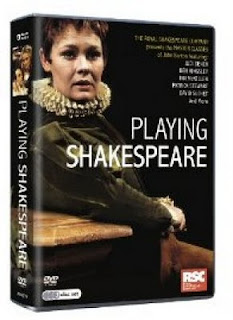
Playing Shakespeare.


New to Region 2 dvd, Playing Shakespeare is the Channel 4 series from the 1980s in which, across nine episodes, renowned theatre director John Barton workshops with a group of actors from the Royal Shakespeare Company various aspects of communicating the canon to an audience. It’s an astonishing piece of television which is essential viewing for actors, anyone with a passing interest in Shakespeare and even, I would say, the stage in general and has a quality of thought and presentation which seems quite alien in these times when television assumes the viewer’s ignorance then works backwards.

At the very least it’s important because it captures a moment in cultural history when a range of what are now household names were still perhaps best known for their theatre work. Younger versions of amongst others Sinead Cusack, Sheila Hancock, Ben Kingsley, Jane Lapotaire, Ian McKellan, Mike Gwilym, David Suchet, Roger Rees, Lisa Harrow, Michael Williams, Patrick Stewart and Judi Dench all appear, an unprecedented line-up united because they’d previous been directed or advised by Barton, all apparently still learning their craft and having great fun simply working the text outside the pressures of a real production.

Barton’s contention, which he describes as the two traditions approach, is that actors should take to heart Hamlet’s advice to the players, totemically repeated throughout the series, “Speak the speech I pray you as I pronounced it to you, trippingly on the tongue” and find a middle presentational ground between Stanislavskian naturalism and the Elizabethan tradition. An actor should consider each phrase and clause carefully so that it seems naturally to be the only thing a character would say in that situation. He’s fighting against the tendency in some actors to simply provide the general sense of Shakespearean dialogue, sapping its spontaneity.

Barton also seems well aware that his televisual approach, a kind of loose rehearsal in front of cameras does have an inherently artificial quality. Certainly there are moments when some actors are trying create a moment of spontaneity which almost always looks like what it is -- a feed question or line so that Barton can move on to the next bit as an actor approaching from the side "John, can I just ask you ...?" But he confronts it by playing the famous Footlights clip of Fry & Laurie rehearsing several meanings of the word "time" then having much the same discussion with his own actors in a more thoughtful tone, to demonstrate that however well parodied his approach might be, it's still extremely useful.

In my review of the book shaped transcripts of these episodes, my main concern was that Barton’s thesis could only be properly illuminated once we we’re able to hear and compare the changes brought by the actors when Barton’s direction and suggestion is assimilated. Sure enough, in the episode when Dench and Pasco work a section of Twelfth Night, we can now see their performance subtlety develop across readings, Dench’s Viola becoming much stronger, Pasco's Orsino more reflective. Sometimes these manipulations have obviously been worked out in advance for illustrative purposes but all of them demonstrate that a performance is a collusion between actor, director and Shakespeare himself.

That’s especially true in the episode dedicated to investigating the differing interpretations of Shylock from David Suchet and Patrick Stewart. Barton directed them both in acclaimed productions and it allows him to also demonstrate that no matter how many suggestions the director gives, the final decisions should be left to the actor. Stewart employs an aristocratic approach against Suchet’s near stereotype but both have strong justifications for their choice, the former the need to assimilation the latter to emphasise their heritage as a way of shielding him from cultural influences, both available in the text. Shakespeare has gives the actor choices.

Not least in the matter of pauses. Barton notes and the actors express that Shakespeare communicates great meaning in the instants when the actor and so character isn’t speaking when their either considering what to say next or indeed waiting for the reaction of their rival or potential lover to their curse or oaths. In speeches too. As Michael Pennington exquisitely reveals, all of Hamlet’s big soliloquies become entirely legible when the commas are emphasised and Shakespeare even offers a hint in “To be..” when he says the results of death “Must give us pause.” Pennington’s contributions are the strongest Hamlet contingent, though Barbara Leigh-Hunt gives a wonderfully restrained Gertrude for “There is a willow…” to illustrate how the greatest melancholia can be communicated through restraint.

Even for those of us who are less interested in the technical aspects of acting, the series is worth seeing for the powerful moments in which the various actors tackle these famous speeches. Patrick Stewart’s Titus consoling himself when all seems lost. Sheila Hancock’s heartbreaking Mistress Quickly on hearing of Falstaff’s death. Lisa Harrow’s horror as Innogen in discovering a headless body. Ian McKellan’s late appearance as Shallow, his pipes whistling in their sound prefiguring Gandalf the Grey. On more than one occasion my reaction was much the same as the bewildered Hamlet on seeing the Player King weep for Hecuba, summoning great emotional depth seemingly from nowhere. Astounding.

With all of the talk of looking to the detail of the text, it’s impossible to also gain some fascination from the chance to see these actors in such unvarnished circumstances, without any of the barriers that are thrown up in their appearances on chat shows. Williams stepping through the shadows at the back of the set looking for a lighter (many of the actors are chainsmokers) or Dench fidgeting with a plastic cup which she quickly realises is making too much noise and hides under her chair. Roger Rees and Mike Gwilym are inveterate flirts, Lisa Harrow entirely receptive. The gentle rivalry between Stewart, Suchet, Kingsley and McKellen.

Look closer still and Playing Shakespeare even contains moments of genuine poignancy. Donald Sindon fighting his natural tendency to over egg within a television studio, keenly aware that his style is at odds with the more naturalist work of the others. Peggy Ashcroft’s nostalgic reaction to hearing a recording of herself playing Viola thirty years earlier, the memories of another time flooding back to her. Dench and Williams’s marital affection, during the segment in which the actors work a longer section of Twelfth Night, the latter with just a few lines but patiently following his cues. And who should be in the studio audience, her acting career stretching in front of her?


Helena Bonham-Carter didn’t apparently receive any formal training as an actress. By the end of that decade she would be playing Ophelia on film and Olivia in Twelfth Night five years after that. If John Barton’s Playing Shakespeare was part of her informal training, she was off to a flying start.

Playing Shakespeare is available from Acorn Media UK. Review copy supplied.

Sunday, December 13, 2009

'The Mystery of Hamlet: A Solution' by Myron Stagman.


In Douglas Adams’s The Hitchhiker’s Guide To The Galaxy, a race of hyper-intelligent, pan dimensional beings create Deep Thought, a city-sized super computer, to find the ultimate answer to life, the universe and everything. After seven and a half million years, the massive computant presents the irrelevant answer “forty-two” on the basis that for all their hyper-intelligence, the pan dimensional beings didn’t really define what the question was going to be. Which is rather my approach to the question Myron Stagman considers in The Mystery of Hamlet: A Solution – why does Hamlet take up to four hours stage time and up to six months narrative duration to kill Claudius? Stagman suggests it’s the “single most famous and controversial issue in Literature”. I'm not so sure.

My prejudice against this line of literary criticism is that if you set aside the play’s literary merit and whatever secret codes Shakespeare (or "playful beguiler" as the cover has it) may have layered into the text and simply treat it as a piece of drama dealing with human emotion, there is no question. Hamlet, an aristocratic prince and scholar (and depending upon which text you're reading a teenager), has been tasked by the ghost of his father to murder his uncle, and though his immediate reaction might be to speak of revenge, a very human reaction, of course he dithers when faced with the reality of process. Instead he fains madness and does everything he can to get Claudius to expose himself and it’s only after, in a fit of oppressed anger, he kills Polonius, that he finds that he has that murderous ability within him.

In which case I’m probably not the best audience for Stagman’s book which spends its time seeking connections between symbols and words and treats the play as a puzzle book that Shakespeare has offered up to be solved like Kit Williams’s Masquerade. There’s no argument that Shakespeare uses metaphor and analogy, but just I’m not sure that the dramatist has deliberately obscured the meaning of his story as Stagman seems to be suggesting, that, for example, ”the time is out of joint” was his way of indicating Hamlet’s reluctance to ram a sword into Claudius’s heart. It would be wrong to spoil the solution. To paraphrase Stagman's analogy when considering the approach of other critics to his problem, it would be like giving away who the killer is in the review of an Agatha Christie mystery. Except to say that if it’s not exactly “forty-two”, I can't completely agree with him.

The book is also oddly structured, opening with forty pages of quotes from other plays to demonstrate the various aspects of “the greatness of Shakespeare” then continues with three shortened versions of the play in varying degrees of detail. Someone picking up this book should already have this material to hand and though Stagman’s enthusiasm infectious as he points out his favourite speeches and lines there’s an element of the Derren Brown magical tv event about the way he’s effectively teasing us with other treats before revealing the final illusion. The summary of his argument appears first in over eight pages then fifty, some of the text repeated with quotes and evidence. Just one quarter of the book really deals with Stagman’s analysis and then feels rushed as though he’s as desperate for us to come to the solution as quickly as he does.

Part of the author's solution is determined by his assumption that “the story takes place in Denmark during the Viking period, 8th to 11th century AD” in approximately 1000 because in the text England is paying tribute to Denmark and he spends most of the book describing him as a “Viking prince”. Shakespeare doesn’t specifically give a period in the work, and though the source legend is from that period, and I’m more persuaded by Steve Roth’s argument that Shakespeare meant for his audience to see the play as happening in contemporary Europe. The text is laced with such assumptions even when the textual evidence seems shaky or open to dramatic choice, such as the exact relationship between Claudius and Gertrude. It’s difficult to concur with a argument when you disagree with the interpretation of the individual data.

The Mystery of Hamlet: A Solution by Myron Stagman is published by Cambridge Scholars Publishing. £34.99 . ISBN: 978-1443814409.

A sample of the book is available here.

Thursday, December 10, 2009

'Playing Shakespeare' by John Barton.


Co-founder of the Royal Shakespeare Company, John Barton was, with Trevor Nunn and Peter Hall, one of the legendary theatre directors whose work and acting collaborations in the mid twentieth century would effect the course of Shakespeare on stage in successive decades. His biography includes a range of landmark production through the sixties and seventies (including the 1969 Twelfth Night with Judi Dench as Viola, and the 1970 A Midsummer Night's Dream with Patrick Stewart as Oberon), and with his abilities in helping actors through workshops, his presence and influence are felt even further.

In 1984, Channel 4 commissioned Playing Shakespeare, a television series based on such workshops and during twelve sessions, Barton and range of actors including Peggy Ashcroft, Sinead Cusack, Judi Dench, Sheila Hancock, Ben Kingsley, Jane Lapotaire, Ian McKellan, Roger Rees, Donald Sinden, Patrick Stewart, David Suchet, Michael Williams and range of other (most still yet to feel the breeze of international fame) worked speeches and scenes and sonnets within a rehearsal situation before a studio audience. Unseen for years, the series has been available on dvd.

The book of the series, Playing Shakespeare, recently reprinted, is a transcript of the sessions, augmented by Barton to clarify material that might not be quite so apparent in the transfer from video to page, and augmented with extra material which had to be cut from the television series for time (and commercials). First published in 1984, Barton still stands behind the material and so rather than updating the text, has been tucked in the back featuring new interviews with Stewart, McKellan, Dench and Lapotaire considering what has changed in Shakespearean theatre between now and then.

Barton's wisdom begins with Hamlet’s “speak the speech” dialogue from Act III in which he reminds the players to project the words naturally and with some truth and not to simply “mouth it as many of our players do” otherwise he might as well get the town crier to do the work. The director’s thesis is that though the characters and themes of the plays are important, it’s vital that the text should be communicated with the utmost accuracy otherwise the audience will not be able to make sense of the story and even the language can seem overwhelming, Shakespeare gives clues throughout as so how it should be spoken.

To this end, throughout these sessions, Barton purposefully ignores what the plays are about and gives minimal direction in terms of the characters. Instead he pulls apart the syntax of the words, the stress patterns, noting when antithesis is being employed and monosyllables demonstrating that though there is poetry in Shakespeare, the playwright is just as interested in pointing the actor towards the emotion he is conveying, which unavoidable, through a handy bit of circular logic, leads the actor to understand to internalise the character they are playing.

In the session on speeches, Barton explains quite correctly that the great soliloquys are about the actor communicating their mood to the audience, something too often forgotten when Hamlet strolls onto the stage then looks at the ceiling. As Barton notes on the dvd (and I hadn’t realised this and neither by the looks of things had Jane Lapataire who's sitting next to him), “To Be Or Not To Be” is not only a series of questions, but also the only soliloquy in the whole of Shakespeare without a personal pronoun immediately externalising the choice that Hamlet has to make.

A set text amongst actors, Playing Shakespeare best serves the layman in its general discussions of acting and Shakespeare’s use of language. The sessions considering what Barton calls the “two traditions” of Elizabethan and modern acting, the use of sonnets as rehearsal pieces, the discussion of different approaches to playing Shylock with Stewart and Suchet and an extended interview with McKellan about the challenges of producing contemporary Shakespeare (well contemporary in 1984) can't help but illuminate our viewing experience.

These probably work best because they’re far more discussional rather than going about the business of working the text. But the book can sometimes be a frustrating experience because though Barton’s intelligence is undimmed, as he acknowledges himself, a few of the sessions hinge on the audience hearing the modifications an actor is making to a speech, and obviously that is lost on the page. Yet it's worth persevering because every now and then you're bound to find a new way of thinking about a character. The section on irony and Richard II has led me to rethink my reaction to the play.

Though the chat with Ian McKellen on the dvd largely reiterates what was said in the text and Judi Dench offers some funny anecdotes about the recording of Playing Shakespeare, Hamlet casts a shadow over the retrospective interviews. Barton has Lapataire workshop “To Be Or Not To Be”, which in isolation she turns from the insecure musings of a teenager into the morbid fears of an older woman and the interview and Patrick Stewart, recorded in the midst of his run as Claudius in the RSC Hamlet, demonstrates, through each their opening lines, the differences between Hamlet’s uncle, the ghost and Macbeth helping to confirm the logic of Barton’s thinking that all you need to know about a character is in the sound of their words.

Playing Shakespeare by John Barton is published by Methuen Drama. £18.99. ISBN: 978-0713687736.

Wednesday, October 07, 2009

'Hamlet: The Undiscovered Country' by Steve Roth.


Someone asked me, not too long ago, how much literary criticism I’d read on the subject of Hamlet, then raised some wonderfully cartoony eyebrows when I told him that I hadn’t. “But” he must have thought “You write that blog…” The problem with much of the criticism that’s been published in the past couple of centuries (at least from what I’ve seen) is that orthodoxy has led to stagnation and too often writers tie themselves in knots quoting from and disproving what has gone before instead of contributing something truly innovative on the subject. Plus it’s usually impenetrable and oppressive to the point of becoming unreadable.

Which makes Steve Roth’s Hamlet: The Undiscovered Country (of which the author was good enough to send me a copy) a rare pleasure because it’s very readable and manages to illuminate at least two aspects of the play that hadn’t occurred, at least to me, to the point that it makes me wonder if theatre has been doing the play a disservice for the past four hundred years. Roth’s persuasive central thesis which for some reason isn’t mentioned on the cover (making the book seem from the outside like just a general survey of the play) is that Hamlet is a teenager, just sixteen years old and that the time scheme of the play spans the six month period from September 1601 and February 1602.

Roth was influenced by L.C. Knight’s 1933 essay, “How Many Children Had Lady Macbeth?”, the setting up of a literary mystery based upon a tiny inference then shaking the whole of the text to see the extent to which it might yield an answer. Using a forensically detailed linguistic analysis of the text and it has to be admitted some disapproval of previous critics, Roth presents a range of evidence from quotes to background material, and does so in narrative style as he talks us through the steps he took and the brainwaves he enjoyed in working towards his answer.

The opening chapter regarding Hamlet’s age is available at the book’s promotional website along with a wealth of background evidential material. It seems only proper to let you read the chapter yourself and enjoy the eureka moment (assuming that, like me, you’re not a textual scholar). Whilst it’s true that “sexton” does refer to “officer charged with the maintenance of its buildings and/or the surrounding graveyard” [wiki] sixteen does seem like a better fit – and indeed Shakespeare always substituted words to create double meaning – his intention could have been to imply both.

If you assume that Hamlet is indeed just sixteen as the text of the First Folio suggests, as Roth goes on to demonstrate in the remainder of the book, all kinds of curious elements of the play begin to fall into place. Hamlet’s somewhat petulant behaviour becomes perfectly natural when we realise that we’re watching the story of a teenager on the edge of adulthood, that it’s a good old fashioned coming of age tale, a tragic teen drama with the cast predominantly made up of youngsters playing Ophelia, Laertes, Horatio, Rosencrantz and Guildenstern.

I love this. I also love that the gravedigger, far from the being the pensioner that turns up in most productions could in fact be “just” thirty years old, and Gertrude too, which as Roth notes means that she’s still of child bearing age and able to produce an heir to the throne to cement Claudius’s rights, simultaneously removing Hamlet from the accession (and explaining why he wasn't given the crown to begin with). It shows that even when a director thinks they’re stripping away the political dimension by cutting Fortinbras, it’s all still there even if it's refocusing on Elsinore’s court rather than the whole of Europe. This is not just a domestic drama.

In the appendixes, Roth does address why Shakespeare seems to wait until so late in the play to address the characters age. I simply assume now that at time of production, those casting the play would simply have been aware of the playwright’s intentions or the audience would have been aware of the artifice through some other means, something which didn’t filter through in the printing of the text and have been lost since. There is evidence that mature actors like Burbage played the role at the time but like the casting of boys for girls it's simply something else that the audience has to suspend their belief for.

Of course that doesn’t mean that in more realistic times when boys are boys and girls are girls that the various productions of the play in which adults walk around saying these lines are wrong. They’re following the orthodox version of the play in which the gravedigger is talking about his length of service and the prince is thirty years old (even if it also means that he’s a mature student). It’s simply part of whatever overall interpretation they’ve constructed and it certainly has more legitimacy than when Romeo & Juliet are portrayed by thirtysomethings even though Shakespeare isn’t as vague about their age.

The chronological discovery is equally fascinating, though it be would be wrong of me here to give all of that away. Suffice to say that Roth once again shows Shakespeare’s words to be a multi-faceted, clever writer, potentially layering into the play biographical commemorations. There’s an interactive version of his findings on the website, and again when you realise that the play takes place over six months, that far from dithering, Hamlet is playing the long-con, which only fails because of his hot-headed accidental manslaughter of Polonius. If this book gains the large audience it deserves, perhaps we’ll sometime see a film, which, after the Ghost scene features the caption “Two Months Later. Tuesday 5th January 1602.”

Hamlet: The Undiscovered Country by Steve Roth is published by Open House Books. £9.95. ISBN: 978-0970470201.

[Update! 8/10/2009 Writer Steve Roth has been in touch with a corrective: "Knight's "How Many Children..." is actually rather a sendup and denunciation of the kind of extrapolation that I engage in to some (?) extent. "Twere to consider to curiously, to consider so..." I do like to think that Knights would have found a decent dose of value in the book, even so..."]

Sunday, July 19, 2009

'The BBC Shakespeare Plays' by Susan Willis.


In 1975 when BBC producer Cedric Messina was working on a drama at Glamis Castle, he decided that it would be the perfect location for a production of Shakespeare’s As You Like It. Thinking about it some more, he wondered why he should stop there? Why not film all of the plays in the canon (thirty-seven at that point, Two Noble Kinsmen and Edward III not having been admitted yet), some jolly good Shakespeare, for broadcast on television? The BBC liked that idea. And eventually so did the American co-producers, oilmen and bankers (the likes of Exxon and Morgan Bank who wanted to be seen to be very interested in culture). A big event, an epic undertaking, televising the canon was a chance for the BBC to thump it’s chest and shout “This is what we do!” (with a little help from some friends).

As Susan Willis explains in The BBC Shakespeare Plays: Making The Televised Canon, a celebration of Messina's undertaking, the Americans having stipulated that it shouldn’t be too radical, so none of that modern dress malarkey, the producer would see his original vision be revised and revised, and ultimately completed six years later, having gone through three producers with three different visions, a panoply of directors (some television veterans new to Shakespeare, some Shakespeare veterans new to Shakespeare) though Messina got his wish to film As You Like It at the castle and surrounds and later taking Henry VIII on location to the actual historical palaces, everything else was shot in the studio, engaging some of the greatest theatre actors of all time and whoever was popular on television.

As anyone lucky enough to own the dvd boxset will know, the results are something of a mixed bag. In her investigation, Willis (associate professor of English at Auburn University at Montgomery) notes (and I agree with her) that those plays which are less well know, Measure for Measure or Pericles or All’s Well That Ends Well are the best served out of the lot because the directors didn’t feel constrained by what has gone before, whereas Romeo and Juliet, huddled then in the shadow of the recent Zeffrelli movie doesn’t do anything new. The crowning achievement is probably Henry VI – Richard III in which director Jane Howell through an ensemble cast doubling roles, on a single set resembling an adventure playground, portrays this history as the games of school boys play-acting; in isolation it’s as entertaining as I, Claudius, with just as many wild performances and narrative meanders.

Writing just a few years after the final broadcast, Willis clearly has a great admiration for the series. Beyond the history, she offers a forensic analysis of some of the series’s auteurs, Jonathan Miller, Elijah Moshinsky and Howell demonstrating how they turned the constraints into benefits by taking full advantage of the televisual medium to emphasise the meaning of a scene through the mis-en-scene or stylising the sets to thematically underscore the motivations of a character. She carefully manages to keep such analysis with the production, only ever broadly venturing into the text when its absolutely necessary usually when describing cuts made or scene changes.

The book closes with some gossipy production diaries for Troilus and Cressida, Titus Andronicus and The Comedy of Errors, contrasting different directing styles and showing how the BBC’s production methods of the time constrained their artistic decisions (familiar to anyone who’s watched the documentaries on Doctor Who dvds – the 10pm shutdown effected high art too). It's the kind of thing which would be of use to anyone with an interest in this period of television or theatre history and has some wonderful moments were the diva gene in some actors takes full bloom, their competitive streak, but unfortunately more often than not, Willis refuses to name names, though a close analysis of the cast list would probably offer a few ideas.

If there’s a problem, having concentrated on her favourites, Willis rather dumps everyone else into a single chapter, though the writer does somewhat justify that choice by explaining what she thought went wrong with, for example, As You Like It. It’s the nature of these things that I’m bound to disagree with her on a great many things but her observations are correct more often than not, especially in relation to Richard Griffith’s Falstaff dozing his way through a The Merry Wives of Windsor (working against a wonderful Judy Davis and Ben Kinglsey), and particularly about the fiery chemistry between Tim Pigott-Smith as Angelo and Kate Nelligan as Isabella in Measure for Measure, an early triumph and one of the reasons I became interested in Shakespeare, which was the aim the project, to get the disaffected interested so it succeeded in that.

Monday, July 13, 2009

'Soul of the Age' by Jonathan Bate.


Up until recently, it was generally accepted that William Shakespeare’s final play was The Tempest; there was some historic evidence, not least that it was the first play to appear in the Folio that was published just after his death and how best to commemorate a genius than with their latest, perhaps last work. There’s also the romantic notion that Prospero’s final speech isn’t simply concluding the play but the writer’s career, one final humble exclamation to his audience before retirement:

“[..] Now I want
Spirits to enforce, art to enchant;
And my ending is despair,
Unless I be relieved by prayer,
Which pierces so, that it assaults
Mercy itself, and frees all faults.
As you from crimes would pardon'd be,
Let your indulgence set me free.”

Sadly, as Jonathan Bate’s brilliant biography, Soul of the Age, demonstrates, Shakespeare’s retirement was a myth. He continued working right through to his death, his hand potentially seen all over the place, his final work most probably the collaboration with upcoming playwright John Fletcher, Two Noble Kinsmen. After all, the man died at the age of fifty-two. He was wealthy, he didn’t need to work, but like similarly successful artists across the years, the impulse to create overwhelmed the potential for leisure.

Bate’s motive here (just as it was in the RSC complete works completed simultaneously) is mythbusting, though he comes not bury Shakespeare but to praise him. Taking Jacques’s seven ages of man speech from As You Like It as a backbone (“All The World’s A Stage…”), he traces through Shakespeare’s life extrapolating him onto those ages, but rather than offering a straight biography, he instead charts his external world, his historical context, gathering the collective miscellany of experiences he must have had in order to write the plays, poems and sonnets.

For example: many biographies give short shrift to his school days; they aren’t well documented and often there’s a preference to motor on to the juicy gossip, his marriage to Anne Hathaway and thence to London. Instead, Bate, using what evidence is available and applying a curriculum from a similar school, conducts a forensic year on year investigation into how Shakespeare may have been educated listing the books he must have studied and then, and here’s where it gets interesting, demonstrates how that learning blossoms within the plays, notably Plutarch (Anthony & Cleopatra, Coriolanus).

From there he sets about attempting to construct the personal library Shakespeare must have kept, suggesting books he must have read in translation and in their own language providing yet more examples from the texts, even to the point of suggesting which edition of the bible he would have had to hand, the heavily annotated Genova. The point he returns to again and again, is that far from the words and ideas popping into the bard’s mind, he was instead a literary magpie, grabbing snatches of language and ideas and themes and slotting them in to fit his own aims.

In other words, he was a writer. The effect should be to decrease our appreciation of the man and his work because it slowly becomes apparent that his original thought was rather less and the legend suggests. But curiously it simply increases our appreciation because though Shakespeare would often take old plays and texts and rewrite them, hammering in all of these allusions, the taste with which this was accomplished and the psychological, thematic and dramatic depth that shimmers through them is breathtaking.

And so Bate continues, explaining how the court scenes will have been influenced by his own brushes with Stratford law in cases related to land rights and how sexual scandal, which appears to have been rife in town, bubbles under in the likes of Measure for Measure. We’re given a thorough description of his contemporaries, his rivals and friends and so the circumstance in which many of the plays would have been written or revived, forever underscoring that though Shakespeare was the greatest writer of most times, he was also a businessman.

Though the cover suggests that it’s from the popular history genre, Bate never shies away from intellectual rigour; in places it reads like one of Stephen Fry’s deviations on QI, as he enjoys the opportunity to demonstrate the depth of his knowledge and simply lets fact after fact spill out on top of one another. Sometimes that can lead the text into areas that are difficult to pursue without a strong knowledge of the text (most impenetrably in a passage about The Tempest which I read twice and still couldn’t quite follow).

But turn a few pages and there’s something new; a useful discussion of the sonnets which, simply by unfurling the publication history (posthumous, exploitative) untangles the idea that in their present form they tell a biographical story of the artist’s amorous extra-marital entanglements, suggesting that there may have been more than one boy, who the dark lady might be and that in any case that these poems may not have been expressing Shakespeare’s own feelings but those of a fictional construct no more realistic than Romeo, Juliet, Hamlet or Falstaff ...

Tuesday, June 09, 2009

'Shakespeare Made Fit' by Sandra Clarke.


Much as I love Shakespeare, I do get impatient with him sometimes. Well, not him exactly but the way that he’s being presented in repertory, or more precisely that of the thirty-eight (or so) plays in the canon, only about fifteen are regularly production. Rarely do the likes of The Two Gentlemen of Verona, All’s Well That Ends Well, King John, Cymbeline or particularly since it’s my favourite, Measure for Measure, see the inside of the playhouse. Critically they’re all perceived to have faults, or are generally unknown to audiences, so the playhouses tend to stick to the core repertory because that’s what the people want. Which is fine to a point, but those of us with adventurous tastes, it’s a bit disappointing when the only choice is yet another production of King Lear or Romeo & Juliet. What we need is to find a way of presenting the most popular plays which would attract the more seasoned/fatigued/picky theatre goer.

Sandra Clark’s book Shakespeare Made Fit offers another choice. In the restoration period, just after the theatres reopened in 1660 after the Civil War, to fill the gap in product, theatres were given license to produce Shakespeare. The catch was that by law, the versions put on could in general only be revisions and rewrites. So Troilus and Cressida became a tragedy, Romeo and Juliet lived, Measure for Measure and Much Ado were conflated and as Clark describes in her introduction: “Macbeth was done as a semi-opera with witches in flying machines”. Dozens and dozens of works by famous and infamous writers of the time and audiences flocked to them as texts which by then, to them, had become somewhat archaic were given a new lease of life.

Clark selects five examples providing commentary and a reproduction of the text: John Lacy’s Sauny the Scot, a contemporary retelling of The Taming of the Shrew giving the writer/actor a central role commenting on the action; The Tempest by John Drden and William Davenant prefiguring the text to become a comedy of manners; Dryden’s All For Love retelling the final hours in the lives of Anthony and Cleopatra; Nahum Tate’s notorious Lear in which the King lived to see his daughter married and Colley Cibber’s Richard III which drew from Shakespeare’s other histories to try and put the King’s machinations into some kind of historical context (an idea later borrowed by Olivier in making his film version of Shakespeare’s original).

These adaptations have had their fair share of criticism over the years with respected critics like Dover Wilson using words like “dismemberment” and “vandalism” when referring to them. In the commentary, Clark herself painstakingly notes the imperfections, especially in Lear which keeps large chunks of Shakespeare’s text whilst dropping in the material which changes the tone of the story, noting that in places it reads like two different plays mashed together. The deletion of “Now is the winter of our discontent …” from Richard III is hard to take, especially since the replacement, “Now are out Brows bound with Victorious wreaths …” is so pedestrian.

But, as Clark also points out, what these critics failed to notice, is that these adaptation do not destroy the original, they’re merely variations on a theme, just like the numerous films which have been turned out, and in many cases aren't half bad. True, some of these adaptations, especially Tate’s Lear, were the only versions in production for quite some time, but eventually they were superseded again, the Bard’s poetry fighting back and rediscovered. Many of them can stand separate from their sources, in much the same way that Shakespeare’s rarely criticised for rewriting and modifying some earlier version of Hamlet. I think by now you can work out what I’m about to say in the closing paragraph.

Why not put these adaptations back into production? On the page, it’s impossible to get the flavour of what these plays must have been like in the theatre, but there must have been something pretty entertaining about them if they stayed in theatres for so long. I’d love see how the happy conclusion to Lear worked in theatre and it would provide audiences who are less familiar with the originals an opportunity to see why Shakespeare’s work worked so well, his moral ambiguity and imaginative leaps set against the more linear line of thought here. If a theatre wanted to be really creative and the production team were up to it, original and adaptation could run simultaneously for that purpose. Seems a shame to let this part of our theatrical history sit and gather dust.

Monday, February 18, 2008

'Playing Bit Parts in Shakespeare' by M.M. Mahood


What’s perhaps unique about Hamlet amongst all of Shakespeare’s plays is that despite very much having a central role, the preponderance of smaller roles means that should the director choose to, it can appear as much of an ensemble piece as some of the comedy or history plays. Most stagings however, especially in the theatre, to bring the play down to a ‘manageable’ length, generally cut many of these parts, either handing off some of their dialogue to other characters or omitting their contributions entirely.

Mahmood’s book doesn’t feature a chapter dedicated to the play, but a general thesis does emerge from the few examples included that a director cuts there ‘bit parts’ at his peril and that despite appearances many of them carry rather more narrative or thematic resonance than they’re given credit for. In other words, Hamlet doesn’t really work as ghost story unless Barnado's fear introduces some much needed atmosphere up front.

The most interesting discussion is in relation to Fortinbras. I can’t think of a production I’ve loved which hasn’t included the Norwegian’s presence; as Mahood notes, without Fortinbras it becomes a different play -- a family drama, almost a claustrophobic chamber piece lacking the grand arena of international politics and ironic ticking clock of the impending invasion at the close. I also think you lose extra emotional drag that both of these sons are dealing with the choices of their father with Fortinbras arguably holding the better hand.

The role Osric plays in the final scene is also looked at, and in particular whether he’s the fop he’s most commonly portrayed as. Quite rightly, the author – with help from the likes of Dover Wilson suggests that he could be as duplicitous as Claudius, since its under his guidance that Hamlet agrees to the duel and it’s as sword master that the poisoned weapon makes it into Laertes hands. I’m not so sure – I’ve always thought that Hamlet fights because he’s recognised that he’s reached the end game and this will hasten the inevitable – to think otherwise weakens him somehow.