"Hamlet is, of course, the Genesis of the Daleks of Shakespeare - the one that is so canonically the best as to render further discussion oddly superfluous. Like Genesis of the Daleks, it has more than enough oomph to live up to its billing, and yet its status seems oddly out of proportion. Sure, it’s very good, but it’s tough to argue that it’s head and shoulders above King Lear or Othello. But Hamlet is nevertheless the prestige piece - the big one, if you will. Tennant, for his part, is very good at the role. The same skill that makes him a good Doctor - his ability to insert an unusually high volume of decisions into his reading of a given scene - helps him just as well in Shakespeare. He can deliver Shakespearean dialogue at speed in a way that makes the content of the lines clear. This is no mean feat - Shakespeare is brilliant, but the fact that the language is not normal conversational English makes it difficult to pick up on things at conversational speed. Being able to add, in effect, a second channel of communication through gesture and tone of voice helps in a big way. And it’s not particularly distinct from how Tennant is capable of having dialogue about, say, Z-neutrino energy and using it to deliver actual information instead of the patent nonsense that it actually is."As I said in my original review, what's interesting about Tennant plays the role is that when he's feigning madness he seems to very consciously go full Time Lord, all of the Tenth Doctor's various ticks in full effect which makes the contrast with the darker, more internalised prince all the starker.

Showing posts with label royal shakespeare company. Show all posts
Showing posts with label royal shakespeare company. Show all posts
Friday, January 24, 2014
"Hamlet is, of course, the Genesis of the Daleks of Shakespeare."
Philip Sandifer is writing about the history of Doctor Who within a historical and somewhat literary criticism context which sometimes includes material which is influenced or tangentially connected to the television science fiction franchise. This week he's covered David Tennant in Hamlet at the RSC in 2008:

Wednesday, November 20, 2013
William Shakespeare & Others: Collaborative Plays. Edited by Jonathan Bate and Eric Rasmussen.
 Oh the apocrypha, the elusive teasing Shakespeare apocrypha, plays which somewhere along the line, either because a publisher ambiguously slapped some initials on a title page or wedged new texts into a reprint of the Folio edition and may, or is most often the case, may not contain the words of one of literature’s great geniuses. Or the anonymous plays which critical and theatrical tradition has been suggested to have a glancing connection with him. Or the works, solidly attributed to someone else, but which may still contain his hand in later additions. It’s got to the point where you can’t definitely say how many plays are in Shakespeare’s canon any more.
Which is the point of the multiple authored William Shakespeare & Others: Collaborative Plays. Having produced their sumptuous “complete works” a few years ago based on the First Folio, the RSC in a companion volume, turns its attention towards everything else, the list of plays that show signs of Shakespeare attention, in a couple of speeches, odd scenes or through later adaptation, once again highlighting that he wasn’t a man who worked alone and utilising centuries of literary criticism attempts an arbitration as to what should be considered canonical and what has been simple wishful thinking and then producing properly edited versions of those considered worthy enough.
Jonathan Bates’s general introduction introduces the concept of Shakespeare’s canon and then offers a brief history of the apocrypha which is in general the result of the good faith of critics desperate to increase Shakespeare’s canon and printers who in bad faith and greed were desperate to do the same. Literary criticism has changed markedly over time. In the past, whole texts would be dismissed as being unworthy of Shakespeare with little regard for outside evidence especially if they were collaborative and only relatively recently has the “problem” been considered more scientifically or dispassionately, with a more evidentiary approach to these works relying heavily on biographical knowledge and textual comparison.
The majority of the volume contains the selected plays and there are a few surprises or at least seem so until Will Sharpe’s section on Authorship and Attribution explains some of their workings out. The proof copy I was sent to review only contains Arden of Faversham, The Spanish Tragedy and Sir Thomas Moore, all of which are now pretty much assumed to have had Shakespeare’s hand in them somehow, however minimally and all are treated with the same care and attention in the complete works with an introduction covering the play’s themes and key facts boxes containing a synopsis, summary of authorship, creation date, sources and publication history followed by textual notes.
But undoubtedly the most compelling section of the volume is Sharpe’s as the methodology of textual analysis is investigated before explanations are given for the inclusion of each of the plays in the volume, with justifications for omissions included as an epilogue. In what must have been a superhuman task, the writer must have read through dozens of volumes, acres of print as forces for an against passages and plays fought with each other across time, usually directly criticising each other’s ignorance about what constitutes Shakespeare and whether a play under consideration fits within their criteria. Speeches, lines, even individual words have been scrutinised to the point where the dramatic elements of these dramas almost becomes beside the point.
Of those chosen, some plays feel like a given: Arden of Faversham, Edward III, Sir Thomas Moore and most lately The Spanish Tragedy 1602 and Double Falsehood. Locrine with its teasing W.S. on its printed title page is included because there simply isn’t enough evidence that those initials don’t mean William Shakespeare. Thomas Lord Cromwell is utilised as an example of the collaborative nature of theatre companies, Shakespeare possibly having been in the room when it was written. The London Prodigal and A Yorkshire Tragedy are both atypical but contain passages of a literary complexity, which might betray his presence. The new outlier is Mucedorus which computer analysis has thrust into the limelight after years of dismissal.
Between the lines, the background theme, and this is especially true of the omitted plays, is that once a work, especially an anonymous work, has been thrown out of Shakespeare’s orbit, there’s little appetite in discovering who the author actually might be, which is another example of the inbuilt snobbery which overhangs Shakespeare’s contemporaries whose work has become eclipsed by Shakespeare across the years. No serious textual analysis has been done on Thomas Lord Cromwell other than to disprove Shakespeare’s involvement and though it’s not widely considered to be a “great” play, it could be an important part of another author’s story, but because the world’s not interested in other author’s stories, we might not ever know.
This is frustrating. If there’s a greatest theme to the book it is that Shakespeare should never be viewed in isolation and that, because he did collaborate with is contemporaries, it’s important to pay attention to the great worth of those contemporaries. The shift in complexity in his plays in the Jacobian period wasn’t some whim but a reaction to the changing tastes of the market with the likes of Measure for Measure his attempt to create his own version of the city dramas being produced by Dekker, Fletcher, Jonson and the rest. But their work is so little produced (because of a self-perpetuating disinterest) that someone approaching these aspects of Shakespeare’s career for the first time will find them someone alien (as I did at school).
The volume ends with Peter Kirwan interviewing theatre professionals about the challenges of producing these plays and the extent to which Shakespeare’s potential authorship effects their work. For the most part the answer is simply that it doesn’t, that it’s about serving the story and characters and themes and that it’s generally left to the marketing department to decide on the extent to which they want to highlight the connection. But there is some recognition that they’re pioneers because most of the audience will be seeing these plays for the first time unaware of the story and characters and themes. Perhaps the best legacy for this volume would be for that to change.
William Shakespeare & Others: Collaborative Plays. Edited by Jonathan Bate and Eric Rasmussen. Published by Palgrave Macmillan. RRP: £25.00. ISBN-13: 978-1137271440. Out now. Review copy supplied.
Saturday, June 08, 2013
Alexis Denisof on playing Fortinbras in the RSC production of Hamlet with Mark Rylance.
During a roundtable for Much Ado About Nothing. I'm assuming this is the famous pajama production. The rest of them are here.
Tuesday, March 19, 2013
More on the new Hamlet at the RSC.
The RSC has uploaded some videos related to their new production. Firstly, here's Jonathan Slinger talking about the role:
And some audience reaction:
"Absolutely stunning. Absolutely amazing."
And some audience reaction:
"Absolutely stunning. Absolutely amazing."
Tuesday, March 12, 2013
Jonathan Slinger on Hamlet.
Jonathan Slinger talks to Lyn Gardener at The Guardian about his upcoming appearance at the RSC:
"This is the quote that's going to hang me," he says, "but I'm going to try to achieve what people say is impossible. I want to make him a psychologically understandable Hamlet. I do honestly think that's what Shakespeare wrote: a very complex person. And I'm in a slightly win-win situation: if I achieve it, then amazing. And if I don't – and depending to what degree I don't – the worst that people will say is that it was a wholly unreasonable ambition because nobody has ever done it. It will just serve as further proof to those who say it's impossible."Glancing across at my sidebar, I'd wonder if a few of his predecessors would take issue with that.
Thursday, July 19, 2012
Shakespeare Uncovered:
David Tennant on Hamlet

The story so far: Shakespeare Uncovered is a series of six introductions to plays introduced by leading actors and directors produced in association with the Globe theatre. The highlights have included Joely Richardson magically covered in snow during her first visit to the recreation of Shakespeare’s playhouse and discovering during Trevor Nunn’s exposition on The Tempest that there’s a recreation of Blackfriars in Staunton, Virginia. Less appealing is Sir Derek Jacobi’s ten minute detor into authorship madness during an otherwise informative introduction to Richard II and Ethan Hawke subtly damaging a First Folio by stroking his finger across a page and knocking out an existing burn mark leaving a hole, the text on the next page now clearly visible.
Now we reach David Tennant on Hamlet and although I’m biased the best of the episodes. Focusing on Hamlet’s struggle with his mission and his own mortality, David gallops through the story from the ramparts to “the rest is silence” aided by a number of fellow actors, academics and as he wanders about in the bridging cutaways the architecture of Stratford-upon-Avon and the Southbank, struggling with the question of why the play is still considered the pinnacle of English literature, the one secular text which continues to enthral and inform us as much as holy texts if not more so. But again, I would say that, I’m biased. Yet as Ben Whishaw notes for six months after playing Hamlet in 2004 he found himself applying all of life’s big questions and presumably some of the small ones to the play, recalling the text over and over. I do that too.
Utilising a synopsis of the play as a spine for observation is a fairly typical approach (cf, Imagine ... Being Hamlet and Playing the Dane, the inspiration for this blog), questioning the action at key points, with contributors providing their experiences of playing the part or analysing them. Because Hamlet is so thematically rich the producers have had to make similar decisions to a company producing the play so the focus is very much on the domestic elements, with little to nothing on the politics of Elsinore and Denmark, the succession. Fortinbras is cut. Lost too are Rosencrantz and Guidenstern other than the fact of their existence so nothing on the implications of their murder. “England” is generally glossed over. This is all about Hamlet’s personal j-word and those who’ve chosen to follow him.
All of which is perfectly understandable actually since entire books have been written about all of them, and there’s just an hour to play about with. It’s natural that you’d want to concentrate on the icons, whilst hinting at what lies beyond, the feigned madness, the implications of the willow scene that sort of thing. That’s especially true of the section shot at the Novell Theatre in which Michael Dobson offers a potted history of the closet scene which glanced towards Freud and also explains how Hamlet’s sometimes inappropriate attitude to his mother developed. Some productions almost treat the action in two discrete sections but as David notes there’s something very uneasy about Hamlet being so obsessed with Gertrude’s sex life with Polonius’s cadaver close by.
There are some unexpected inclusions. As with some of the other episodes, David was given the opportunity to see original copies of the text, in this case at the British Library and crucially all three versions including their copy of Q1 (one of only two in the world), comparing and contrasting the different versions of the big speeches and stage directions, discussing with curator of Early British Literature, Tim Pye the source of this earlier version. It’s worth noting that one of the potential weaknesses of the documentary is when David rhetorically asks who created this extraordinary character and where he came, we're not told about the Ur-Hamlet or Saxo Grammaticus but (admittedly touchingly) Shakespeare’s family and the death of Hamnet, which was also an influence on Twelfth Night in a very similar sequence in the Joely Richardson episode, one of the few occasions when the original source of a piece hasn’t been expounded upon.
Indeed, David has an impressively full participation, the episode’s presentation echoing his earlier presenter led episode of Doctor Who Confidential, “Do You Remember the First Time?” in which like this, he shared his affection for a much loved character whilst wearing a brown jacket. Then he visited the hallowed ground of Studio 8 of television centre, here it’s King Edwards Grammar Schoo, Shakespeare's school. Then he interviewed fellow fans like Steven Moffat and here we see him joshing over old reviews with David Warner and comparing approaches to the character with Jude Law. At least in terms of the language of television, my favourite interview might be with Simon Russell Beale who (like Whishaw) has appeared in nearly all of the episodes in interviews clearly shot all together and so it seems here until David asks a follow up question and camera whip-pans in his direction. Beale himself almost startled to suddenly have his fellow actor sitting there.
Like that Confidential, this features dozens of illustrative clips though interestingly limited to Olivier directing himself, Zeffirelli directing Gibson and understandably Doran directing Tennant. An early trip through the RSC shop with David indicates other versions are available, but these three are interesting choices in that they’re not traditional renderings of the text, Olivier adding some, Zeffirelli deleting practically everything and Doran shuffling the order of the scenes. Odd that we should have the Warner interview but not the clips of his RSC appearance seen elsewhere. As with the other episodes, the emphasis instead is on newly filmed sections performed by the Globe’s cast with Jack Farthing (pictured below) cutting a youthful, lonely figure in a near empty theatre during “To Be Or Not To Be..” and Tom Lawrence later a teary Horatio as his prince dies.

As well as David greeting Andrei Tchaikovsky's skull again (pictured) the most poignant section for me is right at the very end, when he’s pondering what the part means to him and startling it resonates with comments he made when he left Doctor Who. Indeed just for a moment (thanks to a reference to filming), I wondered which role he’s actually talking about:
"In the end, there’s just no other character like him. […] I remember on the last day of filming thinking, “I’m so proud to have done that. I’m so pleased that’s something I got to do. And now I will never go there again.” And there was a huge relief to that. It was like having a weight lifted off your shoulders. And then, where are we now? Three years on… I do find myself, I catch myself, slightly fantasising about doing it again, going back there and seeing what that would feel like. But … that way madness quite literally lies.”Fiftieth anniversary next year then.
[Assuming I haven't spoiled it too much for you, David Tennant on Hamlet is available on the iPlayer until 26th July.]
Saturday, June 16, 2012
Kenneth Branagh knighted.
The Queen's birthday honours were released at midnight and Hamlet interest includes a knighthood for Ken now Sir Kenneth Charles Branagh. Also from the cast of his film version of Hamlet, Kate Winslet receives a CBE.
Other Shakespearean actors include Jean Marsh who's now an OBE and Amanda Redman, MBE.
At the Royal Shakespeare Company, outgoing artistic director Michael Boyd is knighted and Victoria Heywood, executive director is granted a CBE.
That's about all I can spot. The full lists are posted on The Guardian's website.
Other Shakespearean actors include Jean Marsh who's now an OBE and Amanda Redman, MBE.
At the Royal Shakespeare Company, outgoing artistic director Michael Boyd is knighted and Victoria Heywood, executive director is granted a CBE.
That's about all I can spot. The full lists are posted on The Guardian's website.
Wednesday, July 07, 2010
Hamlet (RSC Macmillan) Edited by Jonathan Bate and Eric Rasmussen.

Who's There?
Despite my praise for the RSC’s complete works project which led me to embarrassing editor Jonathan Bate at a lecture/booksigning when I told him about being “something of a fan”, I was initially a bit reticent about purchasing an individual edition of Hamlet on the assumption that it would simply reprint the material already available in the larger volume. But since I’m a completest and I very much liked the cover with its spade variation on the usual Yorrick’s skull or Ghost, Amazon were soon making a debit to my credit card.
Publication Data
Published 2008 which makes it, I think, the freshest edition of the text available, what with rivals reprinting older material with new covers. The third revised edition of the Arden third series was in 2005.
Introduction
As expected, and perhaps understandably, there is a sense of déjà vu. Much of the introduction replicates text from the complete works, as does the key facts, the text itself obviously and the Shakespeare biography at the back is an abbreviated rewrite of the general introduction. Yet, even if you already have those complete works (and if not, why not exactly, Asda now have copies of the paperback for just over twelve pounds) I would certainly recommend this individual volume, if you’re looking for a thoughtfully edited, brand new "player" rendition of the play.
Bate’s introduction is relatively short but plain speaking, interested in illuminating the doubling of Hamlet with other characters, Laertes, Fortinbras and Claudius who it’s suggested had comparable schooling. There’s a dichotomy at the heart of Hamlet’s character, Bate suggests, in that he’s capable of some horrible violence, but is unable to react when called upon to do so with pre-meditation because of his intellect, which is I suppose the opposite of Claudius who is capable but doesn’t want to be too bloody and wants to be surreptitious so relies on poison to do his work.
Unusually, the introduction then turns to the stage craft of the fight and that unlike the simple fencing epee of modern productions – notably the RSC with Tennant and Branagh’s film, productions would originally have featured a rapier and dagger which means that the fudge that usually occurs with Hamlet accidentally grabbing Laertes’s weapon should be more purposeful demonstrating a shift in personality. In order to be a worthy successor to his father, he would have to show the same ability to make big decisions like Hamlet Snr’s land grab and this would demonstrate that possibility.
The introduction then expands from the complete works original for a textual discussion related to hammering the play into shape for a coherent production and then a dip into the critical history which cunningly ignores all of the usual names for something rather more oddball. So instead of Bradley, there’s a smattering of Dr Johnson, Goethe, Schlegel, Showalter, Kierkegaard, Freud, Joyce and well, there’s a surprise at the end. What this selection from outside of the critical mainstream demonstrate is that like football, everyone who’s interested as an opinion on Hamlet’s mental state but no one is really sure.
About The Text
Does a good job of explaining the vision for this version of the text. This is, like the Oxford (which I'll be talking about in coming days or weeks) the First Folio in its purest form, with the Q2 additions at the back, “Now all occasions do offend me" and all (note nothing from Q1 which increases the Arden supplement’s value) the assumption being that the post-mortality edition of the play was the most up to date copy and as Shakespeare finally intended. Oddly, Q2 has still been used as guide for “corrections” however and some of the readings from the earlier printing have been transposed, not least sexton for sixteene in the gravedigger scene, which is still problematic despite theatrical tradition.
Hamlet in Performance: The RSC and Beyond
After a new scene-by-scene analysis some might say synopsis, we find a thorough stage history with some focus on the RSC. The main theme is continuity and the line which can be drawn from Burbage to Garrick to Macready, Irving, Barrymore, Gielgud, Olivier and take your pick from many of the faces I’ve looked at on this blog, though I like to think it shifts to Jacobi then Branagh then Tennant, which is unfair since it’s rather orthodox and leaves out the wilder excesses of Burton, Warner and Williamson.
What marks out the RSC’s contribution is its willingness to experiment and that’s demonstrated in the edition’s true innovation, a round table discussion between three practitioners who have produced the play for stage. Ron Daniels’s contribution is based on his so-called pyjama Hamlet with Mark Rylance in 1984; John Caird directed Simon Russell Beale for the National in 2000; Michael Boyd the artistic director of the RSC tackled the play in 2004 with Toby Stephens in 2004.
These few pages cover a lot of ground and you might have noticed me already quoting from it in my show reviews and are a demonstration that there’s no better people to talk about the play than those tasked with turning it into a piece of drama although there is some disagreement between the three as to how, for example, brutally the closet scene should be played, how abusive Hamlet should be to his mother, the extent to which he is suspicious of his motives.
How is it, my lord?
A thumping good edition all round then, striking the right note between helping the beginner and offering something new for the fan/scholar. Having taken over from the Penguin as the RSC’s text of choice, it is still very much a player’s edition. The notes at the bottom of each page are brief but pointed and the text is well spaced out and readable. I’d refer you to the complete works first if you’re looking for something with the same scholarly aims but with greater depth.
Hamlet (RSC Macmillan) Edited by Jonathan Bate and Eric Rasmussen. £6.99 paperback. ISBN: 9780230217874.
Thursday, June 10, 2010
23 Updated. 12-Rating.
You might remember I said I would contact the BBFC in relation to the 12-rating given to the blu-ray of the RSC production with David Tennant. Much to my delight they've replied:
Ordinarily, very strong language would not be permitted in a '12' rated work. However, with HAMLET, it was recognised that the well-known wordplay upon the phrase "country matters" said by Hamlet to Ophelia would be familiar to most viewers. Emphasis is often given to the first syllable of the first word (as in this case), and the conversation between Hamlet and Ophelia carries a double meaning.Which is about what I surmised and absolutely understandable. Again, I say, amazing. Not just for the RSC risking it, but for the BBFC to give it this level of care and attention.
HAMLET is obviously widely known and studied, and the text and numerous theatrical productions of it - as was this one - are available to all ages. Some versions of the play have been rated 'U' or 'PG'; however, it was felt the deliberate emphasis given to the first syllable in this version warranted a '12' and would not confound public expectations at this category. Our Consumer Advice also gave warning of the potential offence that some viewers may take to the wordplay.
Such comic wordplay on very strong language is not unprecedented in '12' rated works, eg THE LOVE GURU and a episode of ARRESTED DEVELOPMENT.
Tuesday, June 08, 2010
23 David Tennant

Hamlet played by David Tennant.
Directed by Gregory Doran.
When I first heard about this production, I almost exploded. Already some way into this project, the idea that the then star of my favourite franchise would be appearing in my first or second favourite Shakespeare play (yes, still osculating with Measure for Measure) was almost too heady to contemplate. Yet somehow, because of this and that, fear and finances, I missed David Tennant tramping about the Courtyard stage, and regretted it ever since. So when it was announced that the production would be filmed for the BBC, I was elated, yet still because of the usual family related responsibilities on Boxing Day and then realising that I’d like to see it first on blu-ray (it sparkles!) that I only finally sat before it yesterday afternoon. As expected, I squeed. A lot. Do not expect this to be a deep textual analysis. If you'd like to read a deep textual analysis, there's a very good one here.
I do at least have a programme for the stage production. When I visited Stratford last year, the wonderful staff at the RSC made a special arrangement to have one delivered to the venue within a couple of days for me to buy so that I didn’t have to mess about with mail order. It’s a wonderful thing; I read the booklet just before watching the blu-ray and though it obviously wasn’t a substitute for the real theatrical experience, it certainly helped to increase my anticipation if not participation. In a change from what seems like the usual format of short essays about various aspects of the play, this is has a production scrapbook (now available for download) which outlines the work of the director and the various production department such as costume and stage management.
Apparently, to help her get into character, director Gregory Doran took actress Mariah Gale to the spot in Stratford where in 1579 a girl called Katherine Hamlet died in similar circumstances to Ophelia. They found that no girl attempting to pick flowers at that river bank could leave without having been scraped and being covered cuts and bruises. Her dress would be dirty. Which is why in the production Gale looks as though she’s been through a war. Similarly we discover that even with the understudy process, the play can’t be interpreted and rehearsed twice and since one actor can’t mimic the work of another, it’s not simply the person stepping up – as Edward Bennett did when Tennant hurt himself during the West End run -- who’s flying by the seat of their pants. The rest of the company must react on the hoof to the changes being wrought.
But to the point: Tennant is extraordinary, the reviews did not overplay his achievement. It is impossible for me to watch this consummation without five years of his performance in Doctor Who jangling about my head and indeed, it’s my impression that his approach to extrapolating Hamlet’s feigned madness is to tap into his Doctorish tendencies, the gurning, the rapid diction, his entire physical presence springing and elasticising about the rest of the household, rubbing the back of his neck as he offers a long drawn out thoughtful “Weeeelll…”, his accent almost but not quite the same as the terrestrial John Smith figure the timelord became in the story Human Nature. This was photographed just weeks after he left his role as the timelord (June 2009), and its perhaps fitting given the context that the ghost of the tenth Doctors still hangs in the air.
Arguably he is even more compelling during those moments when these tendencies are in check, when the sober version of the character is to the fore. This is most clearly apparent in the opening wake as we see the weight of his father’s death across his sagging shoulders and right through to the apparition’s appearance. There follows a compellingly lucid moment, as he addresses us through the lense, his eyes piercing like a sword, when we watch him first take the decision to become “mad” and then after a jump cut change his entire attitude. He, if you’ll pardon the expression, regenerates.
To an extent, Tennant is so strong, he threatens to overpower everything else. This might have been less likely on stage (especially at the Courtyard were actors are easily obscured) and whilst I’m willing to admit that it could simply be caused by this fanboy’s obsession, a huge percentage of Gregory Doran’s “film” (this was shot with digital cameras) is in close-up and does seem to favour Tennant above the other actors. Despite its three hour running time, this Hamlet is by no means an ensemble piece. The prince seems to spend to time at all in England with no mention of pirates, no letter sent home, which curtails Horatio’s part somewhat (he is indeed more like Hamlet’s “companion” than in independent figure).
None of which should be seen as a criticism – perhaps aware that the star power will be bringing in an audience less aware of the play’s intricacies, Doran’s has rightly decided to keep the story relatively linear. His Frankenstein-like text is mainly F, but as is the fashion, some of the structuring, notable the placement of “To Be or Not To Be” favours Q1. Fortinbras was apparently originally cut when he was preparing the original stage script yet was reinstated during rehearsals because the actors believe that the play works best with this extra political angle. Nevertheless, that presence is still minimal on-screen; we are gifted with the meeting between Hamlet and Fortinbras’s Captain from Q2 (and the ensuing soliloquy) however he’s missing from the finale which chooses to cut away just before the Norwegian prince storms Elsinore.
Doran has also decided to enunciate Claudius’s "reconciliatory" speech about how the “common theme / Is death of fathers”. Patrick Stewart plays both Hamlet Snr and Claudius, the former retaining a very real, very physical presence in the murder exposition. Oliver Ford Davies’s Polonius is permitted to dominate the first half of the running time. He's clearly loved and shares a good relationship with his children, who complete his authoritative advice for Laertes, having probably heard it already dozens of times. Even in the scenes were Claudius appears, when Tennant isn’t in the ascendancy, Davies’s deft performance has the focus in a way which I’ve rarely seen before.
Until he’s shot. Then Stewart’s Claudius emerges and it becomes immediately apparent through the crook in the actor's lips, that the new king is of the kind to sit back and watch a game play out amongst his subjects. From the opening scenes of the play, Doran cuts away to footage of the action from he perspective of a CCtv camera – he’s very interested in surveillance culture and that was demonstrated by a set of two way mirrors in the stage production (perhaps influenced by the great hall in Branagh’s film). At first it seems tricksy and irritating because we aren’t sure who is watching, and that’s especially true in the nunnery scene when it become the trigger for Hamlet turning on his former girlfriend. Later, after The Mousetrap, the prince reaches up and angrily pulls it from the ceiling, wires and all. “Now I am alone” he says.
In these closing stages, it’s almost as though in this production Claudius has been aware of Hamlet’s “performance” and of the visitation of the ghost from the beginning because, its inferred, he’s been watching this CCtv footage. When he rises and approaches Hamlet with the lamp during The Mousetrap it’s as though he’s saying “You haven’t beaten me yet!” (at which point Hamlet too realises he’s being spied upon leading to his later vandalism). When the king rises after Hamlet fails to run him through on the way to Gertrude’s chamber, even if the prince’s speech appeared as voice over, his uncle clearly knew of his presence and was quietly willing him to send him to heaven. He grins broadly, manically even, during Ophelia’s funeral, enjoying the spectacle. If this Hamlet is feigning madness, this Claudius is just psychotic.
The setting is a modern stately home that brings to mind Thomas Vinterberg’s Danish Dogme film, Festen. Interiors are mainly shot on a single set inspired by the stage version, columns and mirrors and ebony fittings intact. There are a number of exteriors, including some atmospheric tunnels and Doran makes good use of silhouettes and shadows. Despite the dinner jackets and silk dresses, this is clearly the royal family and Claudius and Gertrude are regal figures ahead of rest of the household. When Polonius describes to his boss Hamlet’s treatment of his daughter, Ophelia stands somewhat in awe and there’s a lovely moment when Gertrude approaches and falters over the girl’s name because this is probably the longest time they’ve spent in the same room together.
Despite all of that, the infamous “one thing”, I’ll be remembering this production for is the 12-rating. A glance at the back of the box reveals that the show “contains one use of very strong language and moderate sex references”. Given that this was first broadcast between four and seven on Boxing Day I couldn't quite understand what could lead them to this conclusion, especially considering that this isn't some eccentric modern adaptation. It didn’t take long for me to realise that it has to do with country matters or rather “cunt-ry matters” as Tennant’s stress pattern has it during the run up to The Mousetrap, which let's agree, amazing. The BBFC website doesn’t confirm that this is the one use. I have been in touch and will update this entry should a reply be forthcoming.*
Illuminations, the production company behind this television adaptation blogged their way through filming, though I’ve so far studiously ignored this diary and the BBC's official website (spoilers!) which is why this review probably just impacts on the surface. But I suspect I’ll be returning to this production again. Given my fan gene, I’m very much aware that because I was focusing on Tennant, I didn’t pay enough attention to Penny Downie’s Gertrude. As yet I haven’t quite decide how much she knows, when she knows it and how much of a performance this version of the queen is giving for her husband at the end. But it’s a measure of the complexity of this production that I’m desperate to find out.
* The BBFC have offered this full and frank reply.
Thursday, December 10, 2009
'Playing Shakespeare' by John Barton.

Co-founder of the Royal Shakespeare Company, John Barton was, with Trevor Nunn and Peter Hall, one of the legendary theatre directors whose work and acting collaborations in the mid twentieth century would effect the course of Shakespeare on stage in successive decades. His biography includes a range of landmark production through the sixties and seventies (including the 1969 Twelfth Night with Judi Dench as Viola, and the 1970 A Midsummer Night's Dream with Patrick Stewart as Oberon), and with his abilities in helping actors through workshops, his presence and influence are felt even further.
In 1984, Channel 4 commissioned Playing Shakespeare, a television series based on such workshops and during twelve sessions, Barton and range of actors including Peggy Ashcroft, Sinead Cusack, Judi Dench, Sheila Hancock, Ben Kingsley, Jane Lapotaire, Ian McKellan, Roger Rees, Donald Sinden, Patrick Stewart, David Suchet, Michael Williams and range of other (most still yet to feel the breeze of international fame) worked speeches and scenes and sonnets within a rehearsal situation before a studio audience. Unseen for years, the series has been available on dvd.
The book of the series, Playing Shakespeare, recently reprinted, is a transcript of the sessions, augmented by Barton to clarify material that might not be quite so apparent in the transfer from video to page, and augmented with extra material which had to be cut from the television series for time (and commercials). First published in 1984, Barton still stands behind the material and so rather than updating the text, has been tucked in the back featuring new interviews with Stewart, McKellan, Dench and Lapotaire considering what has changed in Shakespearean theatre between now and then.
Barton's wisdom begins with Hamlet’s “speak the speech” dialogue from Act III in which he reminds the players to project the words naturally and with some truth and not to simply “mouth it as many of our players do” otherwise he might as well get the town crier to do the work. The director’s thesis is that though the characters and themes of the plays are important, it’s vital that the text should be communicated with the utmost accuracy otherwise the audience will not be able to make sense of the story and even the language can seem overwhelming, Shakespeare gives clues throughout as so how it should be spoken.
To this end, throughout these sessions, Barton purposefully ignores what the plays are about and gives minimal direction in terms of the characters. Instead he pulls apart the syntax of the words, the stress patterns, noting when antithesis is being employed and monosyllables demonstrating that though there is poetry in Shakespeare, the playwright is just as interested in pointing the actor towards the emotion he is conveying, which unavoidable, through a handy bit of circular logic, leads the actor to understand to internalise the character they are playing.
In the session on speeches, Barton explains quite correctly that the great soliloquys are about the actor communicating their mood to the audience, something too often forgotten when Hamlet strolls onto the stage then looks at the ceiling. As Barton notes on the dvd (and I hadn’t realised this and neither by the looks of things had Jane Lapataire who's sitting next to him), “To Be Or Not To Be” is not only a series of questions, but also the only soliloquy in the whole of Shakespeare without a personal pronoun immediately externalising the choice that Hamlet has to make.
A set text amongst actors, Playing Shakespeare best serves the layman in its general discussions of acting and Shakespeare’s use of language. The sessions considering what Barton calls the “two traditions” of Elizabethan and modern acting, the use of sonnets as rehearsal pieces, the discussion of different approaches to playing Shylock with Stewart and Suchet and an extended interview with McKellan about the challenges of producing contemporary Shakespeare (well contemporary in 1984) can't help but illuminate our viewing experience.
These probably work best because they’re far more discussional rather than going about the business of working the text. But the book can sometimes be a frustrating experience because though Barton’s intelligence is undimmed, as he acknowledges himself, a few of the sessions hinge on the audience hearing the modifications an actor is making to a speech, and obviously that is lost on the page. Yet it's worth persevering because every now and then you're bound to find a new way of thinking about a character. The section on irony and Richard II has led me to rethink my reaction to the play.
Though the chat with Ian McKellen on the dvd largely reiterates what was said in the text and Judi Dench offers some funny anecdotes about the recording of Playing Shakespeare, Hamlet casts a shadow over the retrospective interviews. Barton has Lapataire workshop “To Be Or Not To Be”, which in isolation she turns from the insecure musings of a teenager into the morbid fears of an older woman and the interview and Patrick Stewart, recorded in the midst of his run as Claudius in the RSC Hamlet, demonstrates, through each their opening lines, the differences between Hamlet’s uncle, the ghost and Macbeth helping to confirm the logic of Barton’s thinking that all you need to know about a character is in the sound of their words.
Playing Shakespeare by John Barton is published by Methuen Drama. £18.99. ISBN: 978-0713687736.
Friday, November 13, 2009
Saturday, October 31, 2009
David Tennant on Hamlet
David Tennant only ever gave one interview about his time in Hamlet. Here it is:
"Even if you read a play once you have preconceptions and notions about it. It's hard to be specific about things, because things are so gradual, and also talking about it now at the end of a run, it's quite difficult to work out where you were at the beginning, especially with a play like this that changes from night to night. I do remember being surprised, because I had always assumed that Hamlet and his father had a slightly distant relationship, that his father was a slightly distant patrician, quite a bellicose figure with whom Hamlet didn't really identify. But whilst I do think that they are very different, I remember that once we actually started playing those scenes, there was a sense of the bond that they had and a sense of that paternal connection, and I was quite taken aback by that."I'm going to save reading this properly until I've seen the film. I don't want to preconceptions. Even productions of four hundred year old plays can have spoilers, I think, even if it's just spoiling the interpretation [via].
Friday, September 25, 2009
dvd cover for the RSC production
The thrillingly evocative dvd cover for the RSC production has been released:
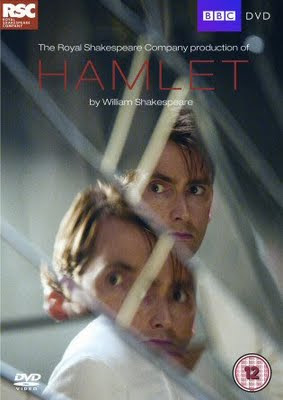
I love this. Usually it's Hamlet and the skull (see top right for what I was expecting) or the washed out face of the actor. This cuts straight to one of the symbolic heart of the play, the fracturing of Hamlet's personality and how he has to split himself into pieces in order to survive (the irony being that it doesn't work). Plus, look at that certificate. I'm hoping for a particularly bloody duel at the end.
The DVD is now available for pre-order direct from the RSC.

I love this. Usually it's Hamlet and the skull (see top right for what I was expecting) or the washed out face of the actor. This cuts straight to one of the symbolic heart of the play, the fracturing of Hamlet's personality and how he has to split himself into pieces in order to survive (the irony being that it doesn't work). Plus, look at that certificate. I'm hoping for a particularly bloody duel at the end.
The DVD is now available for pre-order direct from the RSC.
Tuesday, June 30, 2009
The Royal Shakespeare Company

There’s not much to do in the evening in Stratford if you’re free and single or if you’re in melancholic mood, alone. Actually, there were flyers all over the place for this music concert or that am-dram production with the odd thing on at the Civic Hall. Just not the week I was there. When I asked at the tourist information centre for some ideas, all they could suggest was a ghost tour though since that was being run by the people who also own what could be the very worst tourist attraction I’ve ever visited, Tudor World, (more on which another time) I was suspicious.
So on the evenings when I wasn’t seeing a performance, I still somehow managed to find myself at the Royal Shakespeare Company. The main venues are closed for refurbishment, but on Tuesday and Thursday after dinner, I sat on the grass nearby reading a book or listening to some Shakespeare on cd about as relaxed as I’ve been in years. One of my last experiences of Stratford was sitting in the shadow of The Swan listening to David Tennant read Shall I Compare Thee To Summer’s Day? and trying to work out what I’d need to do to move there and wistfully wondering how I could woo the girl with long flowing red who was passing by that I was certain must be an actress (not being David Tennant a definite handicap).
The other nights were something else entirely. The RSC have the monopoly on theatres but at present, the only auditorium open is The Courtyard, formerly The Other Place, a giant multi-level space patterned after The Globe (or if you’re local to me, the Everyman with balconies). My heart was pounding on the Monday as I walked the road up to the theatre for the first time, my hands quivered as I handed my bag into the cloakroom, I stuttered when asking to buy a programme. Walking into the auditorium, I caught the scent of the place, a fragrant mixture of paint and wood. “It smells like a theatre doesn’t it?” I said to usher. “That’s because it is a theatre.” He replied dryly, though I could tell he knew what I meant. I think.
Despite visiting the birthplace and other houses and where the man was buried, I only really became sentimental that night. I’ve idolised that theatre and its rolling companies for so many years that I couldn’t believe I was actually sharing their air, watching a performance by them and just ten hours after the leaving of Liverpool. During a rather fabulous song and dance number in the Bohemia section I was on the brink of tears. Isn’t that silly? I suspect I could have been watching any production of any play, and I still would have had a lump in my throat. Is this what happens when real Beatles fans step into the faux-Cavern for the first time?
The Winter’s Tale hasn’t previously been one of my favourite plays though I know that has had a lot to do with the assemblages I’ve had to endure, samples being the BBC tv version from the 1980s which looked to have been filmed on the set of a Blue Peter Christmas Special and featured some of the country’s very worst child actors and an all male production which also swapped the masculine/feminine assignments to provide some rather butch women and fey men. Director David Farr turns the opening half of the play, everything leading up to the abandonment of the child on the beach into a brooding noirish tragedy then sharply contrasts it with the jolly pastoral scene in the second half, like splicing Peter Brook’s Bermanesque film of King Lear with Branagh’s Much Ado About Nothing, with its lashings of hey-nonny-nonny.
My problem with Julie Bailey’s Julius Caesar is that she allows the multimedia backdrop, depicting locals and battles, to dominate the action so much that there’s not much space for the actors to develop their roles, which also means the opening hour drags horribly and only gains momentum with the murder of Caesar though that’s largely because the text forces it to accelerate. Sam Troughton’s Brutus has just the right measure of confused passion, but John Mackay’s Cassius is too understated; it’s a delicious character, the embodiment of the serpentine devil from Milton’s Paradise Lost but here he became a kind of Peter Mandelson figure but without the impression that the quiet man could be a complete bastard given half the chance. It goes without saying that Greg Hicks is amazing in both productions as men betrayed by a perception of who their friends really are.
But with the shadow of temporal distance I can tell it’s not a perfect place to see a play, which might have stoked my prejudices. The seats are very close together which means if you’re sitting next to a fidgeter as I was on the Monday, you’re perennially distracted by someone periodically tickling you. Even after I’d moved to somewhere else in the circle after the interval, I was stuck in a place which despite offering an amazing view of the land was also behind a prop ladder. On the Wednesday during Julius Caesar, the staging meant that if an actor stood in front of my ground level corner seat the entire rest of the stage was blocked, the show briefly turning into radio as you could only imagine what was happening behind Sam Troughton’s arse.
Acoustically it’s suspect too – often the surrounding talkers were more audible than the actors which wasn’t at all fun during Caesar when I found I’d also bought a seat in the middle of a coach party who clearly didn’t have too much of an interest in Shakespeare or the play and spent most of the show commenting on everything or passing wisecracks around during some of the more dramatic scenes. Example: in the climactic battle scenes, one of the characters, having been stabbed in the back, is clawing for life across the stage, dragging himself ever closer to the audience desperately looking for our help.
Idiot One: [Inaudable.]
Idiot Two sitting in front: WHAT?
Idiot One leaning forward: HE’S COMING TO GET YOU! HAA HAA HAA!
Idiot Two: YES! HAAHAAHAAHAA!
Meanwhile, the poor actor is clearly out of breath but trying not to show it. I’m sure I could see him looking balefully in our direction out of the corner of his eye.
And I still managed to have get wrench through my throat because of the proximity to the actors. That seat was also right next to the runways which largely brought the performers onto the stage from the foyer and often they’d hesitate before joining the main action, perhaps even kneeling and I can’t imagine how disconcerting it must be to have someone like me eyeballing them from just inches away, close enough for them to spit on me. In Empire Magazine a couple of months ago, Sam Mendes was asked if he’d consider using 3D cinema and he said he already had. It was called theatre. Now I can see what he meant. At the opening of the second half, the remains of a solider were parades on and our section were drenched in fake blood and I’m convinced I also had the liquid contents of half the cast on my top by the end of the evening too.
That’s one t-shirt I’ll not be washing soon.
Walking away that evening I was overtaken in the street by actress Noma Dumezweni who'd played Paulina in The Winter's Tale and Calphurnia in Julius Caesar and who my fan gene had identified as playing UNIT Captain Erisa Magambo in Doctor Who at Easter and had demonstrated here that she has rather more range than when she was simply barking orders at Lee Evans. She looked to be in determined mood and it took only a fraction of a second to decide to not to chase after her looking for an autograph. It seemed wrong, an invasion. Like it would spoil the mood. So I let her go, and simply let the romance of the evening envelop me, knowing that these had been some of the best evenings of my young life.
Saturday, January 24, 2009
'William Shakespeare: Complete Works' edited by Jonathan Bate and Eric Rasmussen

One of the great myths perpetuated about the audience reaction in the original Globe Theatre is that the groundlings, the peasants standing just in front of the stage were like a modern football terrace, shouting loudly through the action, cheering and jeering with equal measure, the gentry sitting in the rafters taking in the linguistic and artistic brilliance of the verse and the allegorical details of the storytelling. In fact, as Jonathan Bate’s sublime general introduction to William Shakespeare: Complete Works explains those groundings would look up in silence awed by the sounds and language they were hearing, oh so otherworldly whilst it was the apparent nobility who would be criticizing and analyzing the quality of the words.
Lord knows what they would make of this edition of the canon, the so-called First Folio edited for the first time since its fourth edition over three centuries ago. The first edition was published posthumously by two of his friends as a way of commemorating the work of their friend. It’s on its shoulders that the legacy sits, fulfilling Ben Johnson’s famous expectation from his introduction that ‘he was not of an age, but for all time’ and were it not for their endeavor there are a raft of plays which we simply wouldn’t have in any form (and indeed there are couple which have been lost because they weren’t included).
There have been reprints and facsimiles in the meantime but what Bate, Eric Rasmussen and their team of editors have set out to do is present a modernised version of that original text as close as possible to what Shakespeare intended, correcting the work of the sometimes flaky printers and offering finally a sense of the state the plays were in at the time of his death. As they note, it’s impossible to have a definitive version of any play since like many play writes he would be rewriting and correcting throughout the life of the work which, along with poor handling of publication during his lifetime, some of the plays particularly King Lear and Hamlet appear with varying structures and lengths.
The plays that were included in the Folios are presented in a single column with fidelity to the acts and scenes but ignoring the locations and most of the stage directions which have been added to some editions in more recent years. The five act structure was an invention that occurred during Shakespeare’s time when productions moved inside to intimate locations and time was required to relight the candles and so those plays in which these were a later addition also include a note as to were the original breaks were. Since this is a complete works, those plays which didn’t make the cut way back when – the collaborations Two Noble Kinsmen and Pericles are supplemented at the end followed by the poems and sonnets, all given the same care and attention.
Despite appearing as it should at the front of the book, the centrepiece is the general introduction which even to this fan is a revelation. Most of the dozens of biographies I’ve read or watched cover the main points of his life: son of a glove maker, decent schooling, goes to London, acts, writes, becomes a theatre owner, acts, writes some more with the backing of the Queen then King, goes into semi-retirement, maybe has a few too many to drink and dies, with plagues, theatres closures, a family and potential mistresses or boys weaving in and out. Bate includes some of this, but spends much of his time teasing out exactly what it was like for Shakespeare starting out in the business and working his way up to celebrity and unlike most of those other life stories, isn’t afraid to diminish some of the idolatry.
Comparison is made, for example, with the Hollywood scripting process, in which more often than not the text is passed amongst many hands often to the point of not resembling the original intent at all. In Shakespeare’s day it wasn’t unknown for plays already in the reparatory to be passed to some new writer in the company for a sprucing up and indeed there’s an implication here that some of his earlier plays are really just that. What set Shakespeare apart is that it was fairly rare for an actor to be carrying out this work and with an ability which would eventually lead to him authoring his own work. The aging writers of the original plays were none to happy with that actor who would presume to improve their work (especially since they wouldn’t profit from it) and even published a pamphlet to say so.
This then naturally flows into one of the best arguments I’ve seen about lone authorship; I’ve always found the suggestions that some other person could have written Shakespeare’s plays a bit specious, especially since much of it seems to stem from his ‘background’, even though the education he had as a boy filled with Latin and the like was probably far more complex than you’d find in some universities these days. As Bate notes the overwhelming evidence is that Shakespeare has to have written the plays simply because there were too many people watching him and as the number of eyewitness sources increases there would have to be a massive conspiracy at foot simply designed to cheat future scholars. It’s not unknown for people to be fronts to other writers (as portrayed in relation to the Hollywood black list in the Woody Allen film The Front) but how would it have worked in the collaborations in which the two writers must have spoken about the work and indeed rewritten each other?
Each of the plays is prefaced with a similar introduction, crucially considering a range of topics but often concentrating on a single aspect of the work rather than futily trying to create a rounded picture (there’s the excellent Rough Guide available for that kind of thing). That completes the impression that this is as much an authored as edited book, which offers the viewpoints of two scholars more interested in presenting a cohesive vision than a confusion in completeness. Although an extract from Sir Thomas Moore is here, they don’t include the newly canonised (by some) Edward III because they’re not convinced by the evidence that Shakespeare was a co-author and Arden of Faversham is similarly only given lip-service. Such material is available elsewhere (including the excellent website which accompanies the book) and would muddy what is being accomplished here – a modern edition of one of, if not the greatest book in the English language.
Even as an object this is special. It comes in a box and though the pages are thin, they’re sturdy. There's an amazing selection of stills of various RSC productions contrasting the different approaches. The impression is of a family bible but instead of the word of a god this is drama from the mind of one man (plus his sources and collaborators). You can’t help yourself – you just have to sit and hold it, turning the pages watching the verse pass by. The cover eskews the usual clichés of a late painting of the man or of Elizabethan London to tastefully give the impression of the original publication may have looked. On the shelf, nestled next to countless other complete works I’ve collected, it stands out, definitive and authoritative in contrast to the brown and black of the others. I’ll glance up at the yellow of the cover and as you might a nice car or stereo and wonder how I could possibly own it. If you don’t have a complete works in the house, this is the one to have.
Wednesday, August 06, 2008
New Tennant in Elsinore
Have any members of the press used that headline this morning? Anyone? Either way, to save some work, here's a link to Outpost Gallifrey's round-up of reviews for David Tennant's Hamlet. Overwhelmingly positive, especially from Michael Billington of The Guardian, whose piece reads like a more articulate version of a post from this very blog. He doesn't, for example, like the cuts:
"Tennant is an active, athletic, immensely engaging Hamlet. If there is any quality I miss, it is the character's philosophical nature, and here he is not helped by the production. Following the First Quarto, Doran places "To be or not to be" before rather than after the arrival of the players: perfectly logical, except that there is something magnificently wayward about the Folio sequence in which Hamlet, having decided to test Claudius's guilt, launches into an unexpected meditation on human existence. [...] Unforgivably, Doran also cuts the lines where Hamlet says to Horatio, "Since no man knows of aught he leaves, what is't to leave betimes? Let be." Thus Tennant loses some of the most beautiful lines in all literature about acceptance of one's fate."Nothing on the state of Fortinbras though.
Thursday, July 31, 2008
"there is no such thing as Shakespeare's Hamlet ... there are as many Hamlets as there are melancholies"
Some obligatory posts from The Guardian related to David Tennant's Hamlet. Some photos & Michael Billington picks his ten best including some screen versions in with the stage.
Sunday, June 08, 2008
Interview: David Tennant talks Hamlet.
TV David Tennant appeared on The Andrew Marr show this morning to talk about playing Hamlet amongst other things and here's a transcript. Believe me, it was as excruciating to watch as it is to read:
"ANDREW MARR: Yeah. You're, you're a Shakespearian actor, have been for some time. But Hamlet is the big one.You can see the weird chemistry for the next on the BBC's iPlayer if you're in the UK. Spot the moment also when Marr, having called Doctor Who fans Trekkies he forgets the name of The Doctor's current assistant. [via]
DAVID TENNANT: I suppose. I'm trying not to look at it that way at the moment. Just another play isn't it Andrew?
ANDREW MARR: You're going to, well you're going to bring - yeah except you - and just another audience will be a, probably the RSC will get audiences it doesn't normally have for its productions because you're doing Hamlet I would have thought. Lots of Trekkies in there ... Who'ees, Who'ees.
DAVID TENNANT: Well there will be Trekkies cos we've got Patrick Stewart in the cast as well. But I don't know. I think, I mean I think Ian McKellan was there last year doing King Lear.
ANDREW MARR: Yes.
DAVID TENNANT: So I guess he probably has an audience from ..
ANDREW MARR: Yes.
DAVID TENNANT: .. Lord of the Rings that maybe ..
ANDREW MARR: But it's, I mean every, I mean, I mean people will be watching to see - I've got an Olivier, a little clip of Olivier's Hamlet which is ..
DAVID TENNANT: Oh right.
ANDREW MARR: .. yeah let's just have a quick look at that.
VT: Olivier in Hamlet.
[editor's note: which by the way amounted to a photograph and audio from the film of Larry saying 'To be or not to be, That is the question."]
DAVID TENNANT: I'll do it like that then.
ANDREW MARR: You'll do it like that?
DAVID TENNANT: Yeah.
ANDREW MARR: So we've got it sorted?
DAVID TENNANT: Yeah, that's fine.
Tuesday, September 04, 2007
What? Whaaat? 2
Continued from here. One of the reasons for the break is because David Tennant is due to give us his Hamlet for the Royal Shakespeare Company next year which is a really interesting and exciting piece of casting especially in relation to this blog. The lead actor of my favourite television series appearing in what's probably my favourite Shakespeare play. I'll have to start saving now...
Subscribe to:
Posts (Atom)