"Kenneth Branagh and Alex Kingston to star in new BBC Radio 3 drama of Antony And Cleopatra for Shakespeare’s Birthday: Sunday 20 April
"Actors Kenneth Branagh and Alex Kingston will be cast as Shakespeare’s Antony and Cleopatra in a special production directed by BBC Radio drama’s Alison Hindell for BBC Radio 3 to mark the 450th anniversary of Shakespeare’s birth.
"Commenting on the announcement, Kenneth Branagh said: "I'm so happy to be teamed again with Alison Hindell, whose brilliant production of Life And Fate was one of the great pleasures of my work in radio. I'm also excited to be reunited with Alex Kingston after our hugely rewarding partnership in Macbeth on stage. To play another pair of Shakespeare's great couples, and for a personally beloved medium, is a privilege."

Showing posts with label kenneth branagh. Show all posts
Showing posts with label kenneth branagh. Show all posts
Thursday, January 30, 2014
Kenneth and Alex.
From the BBC's press office:

Thursday, July 18, 2013
Kenneth Branagh answers question about a blu-ray of his In The Bleak Midwinter.
Ken did a Q&A at The Guardian today so inevitably I asked the question:
Elsewhere, Hamlet is mentioned:
"Any plans for a UK blu-ray release of his In The Bleak Midwinter? I watch it every Christmas."Ken answered!
"I would love Bleak Midwinter to be out on blu-ray but for reasons I don’t fully understand there are rights issues involved. It somehow got a little bit complicated. But there is a bit of a cult following for it, I’m very glad to say. I would like it to happen, for those who like it to become a Christmas perennial."Oh swiz. On the upside, perhaps it'll nudge him into asking his people "What is the problem? What are these rights issues?" My guess is it's because although the film was made by Castle Rock which is now owned by Warner Bros, it was distributed on VHS in the UK by Columbia Tristar which is currently owned by Sony, who may still have the home rights. But it's odd, because A Few Good Men (also Castle Rock) is in the same situation, but has been released by Sony on BD in the UK. Perhaps it's just that Sony can't be bothered?
Elsewhere, Hamlet is mentioned:
Kishiwadaboy asked:That sort of thing.
"What is your favourite scene/outtake which didn't make it into the final cut of one of your films?"
KB replied:
"A very familiar paraphrase occurred when I tried to give Charlton Heston a note when he played the player king in Hamlet, I talked to him about the line "Anon he finds him striking too short at Greeks" which unfortunately I repeated "Anon he finds him striking at two short Greeks". Mr Heston was clever enough to spot my stupidity, the paraphrase was left on the cutting floor room."
Saturday, June 16, 2012
Kenneth Branagh knighted.
The Queen's birthday honours were released at midnight and Hamlet interest includes a knighthood for Ken now Sir Kenneth Charles Branagh. Also from the cast of his film version of Hamlet, Kate Winslet receives a CBE.
Other Shakespearean actors include Jean Marsh who's now an OBE and Amanda Redman, MBE.
At the Royal Shakespeare Company, outgoing artistic director Michael Boyd is knighted and Victoria Heywood, executive director is granted a CBE.
That's about all I can spot. The full lists are posted on The Guardian's website.
Other Shakespearean actors include Jean Marsh who's now an OBE and Amanda Redman, MBE.
At the Royal Shakespeare Company, outgoing artistic director Michael Boyd is knighted and Victoria Heywood, executive director is granted a CBE.
That's about all I can spot. The full lists are posted on The Guardian's website.
Monday, February 21, 2011
Sir Derek Jacobi on npr
Jacobi talks about directing Ken Branagh and what makes for a good Hamlet:
"Hamlet, to me, is the big personality part in the canon. He can be played any which way - tall, short, fat, thin, male, female - there have been very successful actresses who've played at Hamlet. It all depends on the personality, the sound, the charisma, the look of whoever's being Hamlet. The great thing about Hamlet is that you don't play his character, you play the situations in which he finds himself. You put yourself into those situations with those words, with those lines in the situations and that becomes your Hamlet."Audio and transcript available.
Monday, June 14, 2010
27 Kenneth Branagh

Hamlet played by Kenneth Branagh.
Directed by Kenneth Branagh and Glyn Dearman.
When a radio production opens with the sound of Francisco pissing up a wall, giving his line “For this relief much thanks” a double meaning, you know you’re going to be listening to something rather special. A 1992 recording for Radio 3 by The Renaissance Theatre Company of a version of the 1988 staging, directed by Kenneth Branagh in conjunction with radio producer Glyn Dearman, this presents the full text and has one of the greatest casts I’ve seen outside of Branagh’s own film, including Derek Jacobi, Richard Briers, Judi Dench, Sophie Thompson, John Gieldgud, Michael Hordern, Michael Elphrick and one Emma Thompson.
Though this has similarities with that film, especially Branagh asking long term collaborator Patrick Doyle to offer some orchestration (though the music cues would not be carried over), Dr. Russell Jackson’s engagement as the text consultant and with some very cinematic audio design, this is by no means an audio animatic. With mostly a different cast and alternative thematic underpinnings, within moments it’s entirely possible to put the celluloid imagery to one side and simply allow this alternative version to wash over you or as happened in my case strike me in the guts. Audio productions rarely move me, yet by the end of these three and a half hours I was despondent, depressed and even teary. Job done, then, Mr Branagh.
Whereas in the film, Hamlet’s generally sane and regal and angry rather than even feigning madness, here we find a much more visceral presence apt to shift off into moments where he's entirely unhinged ("the conscience of the king" is a particular showcase). But there are moments of intimacy with the listener and in the booklet that accompanies the cassettes which includes interviews with all of the main players, Branagh says that he’s trying to create the impression of the prince thinking the set speeches. He achieves this by removing the background sound effects -- except during “To Be Or Not To Be…” in order to show that, as in the later film, he’s performing for Claudius and Polonius, secreted nearby.
Branagh takes the most relish and particular care during The Mousetrap. The extended text allows him to enunciate Hamlet’s disdain about how the visiting theatre company is being set aside in town in favour of the new fashion for child acting companies (a real issue in Shakespeare’s day). Michael Hordon’s Player King gives full richness to the text from Pyramous (bringing to mind his turns as Prospero). The whole duration of the dumb show is included with explanatory sound effects and audience reactions – though I wonder how clear this sequence would be with someone new to Hamlet. Either way this is one of the richest treatments of the players I've heard so far. Not least because ...
Emma Thompson is the Player Queen. In the booklet interview, she notes that usually the play within a play “is acted very hammily” which its inferred has the knock on effect of making it comical (perhaps to approach head-on boys playing girls as suggested by Shakepeare in the text), distracting us from what the scene is about. “Claudius" she says, "has to be touched and frightened by what he sees”. This is a rare occasion when the emotional truth of The Murder of Gonzago is fully explored and their arcane predicament almost becomes as compelling as the play outside the play, which means that the King's later confessional is all the more truthful.
This is a production replete with such excellent choices. Gieldgud’s Ghost, whose ancient voice suggests that he’s being broadcast live from purgatory, his disembodied monotone at odds with Branagh’s emotional reaction, Hamlet heard whimpering throughout. In the closet scenes, when Polonius cries out he actually sounds like Claudius making Hamlet’s mistake all the more plausible – usually we have to trust that the Prince just isn’t in his right mind which is why he’s stabbing someone who plainly doesn’t sounds like some old duffer. Doyle’s music plays at length between acts allowing the listener a moment to consider what they’ve just heard, the audio equivalent of the scene changes in the theatre.
The recording even makes its presence felt by appearing on four cassettes, eight sides, despite only being about half an hour longer than the ’77 Jacobi version. Listening to the two in quick succession as I did, its possible to hear the progression in technique, perhaps a small increase in psychological complexity, but now and then I did get a feeling of déjà vu as the Jacobi's influence asserted itself in a line reading (“The cup, the cup”) or playing of a scene (Laertes storming the castle, the rabble cascading through the speaks). But mostly this a chance to catch one of those watershed moments with three generations of Hamlet in one production this s a great theatrical event and a celebration of the play.
Saturday, October 24, 2009
22 Kenneth Branagh

Hamlet played by Kenneth Branagh
Directed by Kenneth Branagh
One of my favourite moments in Hamlet as directed by Mr Kenneth Branagh is the reintroduction of Rosencrantz and Guildenstern, Timothy Spall and Reese Dinsdale, hanging from the side of a steam engine as it sweeps through the Elsinore snow to be greeted by their friend at the platform. For two characters usually at the bottom of the casting pecking order and whose entrance is too often treated less importantly than most others, it’s an expression of the film’s inclusiveness. It says, this film doesn’t just have a script that includes nearly every scrap of coherent text knocking about in which all of the characters are cast as though their the most important figure in the story, but each and every one of them will be rendered in a way which is more memorable than you’ve ever seen before.
I love Branagh’s Hamlet. It’s not just my favourite Hamlet film adaptation, it’s one of my favourite films period. I was already excited by the prospect on its release in 1996; having enjoyed both Henry V and Much Ado About Nothing and adored In The Bleak Midwinter and was so desperate to see it I travelled out to Manchester (a far rarer occurrence then) on the week of release even though the print was going to be moving to Liverpool within seven days. Sitting amongst the small audience in screen five of the now closed Odeon on Oxford Road I was in rapture from start to finish, so much so I almost forgot to eat the chocolate bread I’d taken along for refreshment (we ate some weird foods in the 1990s). It was in those four hours I fell in love with the play.
Which means I’m hardly in a position of offer the usually objective first-impression style review. I’ve seen the film many times since and even own a copy in the Video-CD format (were it’s spread across five whole discs). I suspect many of the prejudices I have about the play (the importance of including Fortinbras whatever the cost etc) were born out of my love for this film. It’s secretly been the yardstick against which I’ve compared all of these productions and watching it again for the purposes of the project (I’ve deliberately stayed away since I began writing this blog), I simply couldn’t find anything wrong with it. I tried, lord knows I did. But look – Ophelia’s in a straight jacket. How cool is that?
I was all prepared to even slam Branagh’s performance having seen or heard twenty other men and one girl say the same words. But I can’t. He’s brilliant. There’s no discussion here about whether the prince is mad. He’s sane. Deliberately so from the moment he first appears in the throne room to the duel. He knows he’s gone a bit too far now and then – the killing of Polonius – but everything is an act. And by eradicating that ambiguity, Branagh creates a skein of tension as thick as an undercover spy thriller as we hope and pray he won’t be found out until he’s able to reap revenge on his step-father.
And it's not just Ken. There’s not a bum performance here. Not one. And in casting, the director seems to have deliberately commemorated different levels and eras of acting. There are obvious contingents from Liverpool and Hollywood, from the RSC old and new. His usual repertory of actors are all there too, many carried over from In The Bleak Midwinter, but none of it is incongruous and over and over we see performers that would not share a scene anywhere else. Look it’s Richard Briers giving Gérard Depardieu orders. Simon Russell Beale joking around with Billy Crystal. Perdita Weeks standing next to Charlton Heston.
On the dvd commentary, Branagh jokes that it’s become known as the eternity version and whilst it's true that at nearly four hours it can be an effort to sit down and watch the thing, the time snaps by and the viewer is rewarded with as clear an interpretation of the story as they’re ever likely to see. Nowhere else have witnessed the clarity with which Hamlet’s feigned madness is attributed to Polonius’s banning of Ophelia from seeing him been inscribed with such clarity. By seeing all of the political machinations we can interpret that once Claudius was a sympathetic figure who may have killed his brother to save the kingdom, the marriage to Gertude a way of suturing the throne rather than simply a power grab.
It’s all there. Indeed, there’s almost an overload of ideas. Most productions get by on a couple of good suggestions, whatever can be squeezed in by the director in the rehearsal period or shooting or recording schedule. Here, in every scene, every character has an angle, every line is laced with meaning. Tiny touches. Polonius dies with a smile on his face and somehow continues to be an active participant in the bedchamber even as the rest Hamlet’s encounter with his mother. It’s perfectly clear from the off during To Be Or Not Be that Hamlet knows he’s being watched, with Claudius and his chief counsellor almost filling in for the audience. The friendship between Hamlet and Horatio with the latter almost his madness valve, pointing out when the former has gone too far.
There have been criticisms too of the interpolations; the flashbacks to Hamlet and Ophelia’s relationship before the play (which indeed could be her imagination but I don’t like to think so) including the tender moment post coitus when he speaks dialogue which is otherwise reported by letter. It re-engineers the meaning of the play, “they” say, applies ideas not Shakespeare’s own. Well, firstly, they’re less obtrusive than in Olivier’s version which in the main are generally illustrative and secondy isn’t the play’s meaning up for grabs? Doesn’t every director present an interpretation? Cut the opening battlements scenes and you can imply the ghost, revenge and all that really are just figments of Hamlet’s imagination, that he has been sent mad with grief and that his father died of natural causes.
The film’s also extraordinarily beautiful. Shooting on 70mm, Alex Thomson creates vistas about the exterior location on Blenheim Palace, making full use of the period detailing, underscoring the grand old royalty of the Hamlets. On the commentary, Branagh suggests that the best way to see the film would be projected onto an IMAX screen and he’s quite correct. Seems a tragedy that likes of Transformers 2’s 35mm print is blown up to that size, only really serving to increase the incoherence of the editing, whilst a piece with stately shots that repay extended scrutiny were until the dvd release left to languish on VHS. The clarity of the image helps to weight the actors performance, as even the tenderest of gestures, such as Winslet’s slight holding of Branaghs hand at the end of the throne room scene are magnified.
In those extras, Branagh is keen to point out that the film would not have seen a shiny disc had it no been for the internet campaign. It’s lovely, unstarry gesture, and a recognition that the afterlife of some films, even what seem like big studio productions rest in the hands of the viewers. The tragedy is, that while Hamlet’s out there now (and long enough to be relatively cheap to buy), In The Bleak Midwinter, the comedy he made just before hand about putting on a production of the play in a church (my review here) still hasn’t appeared. That’s a disaster. What do we think it would take for Warner Bros, the current rights holders, to give that the release it deserves too?
Wednesday, May 09, 2007
Branagh Hamlet coming to DVD
This will please some regular readers. Movie Web have news that a Region One dvd release is coming in August -- and on two discs which means that the bit-rate should be high enough to do justice to the 70mm photography. The details are as follows:
For the really interested, it's also appearing as part of a boxset, The Shakespeare Collection with Max Reinhardt's A Midsummer Night's Dream (with James Cagney as Bottom!), Larry Olivier's Othello and MGM's Romeo and Juliet - none of which have anything in common other than the obvious and that their rights are now owned by Warner Brothers. Still excellent value at just under sixty dollars. [via]
Hamlet 2-Disc Special Edition (1996):The extras aren't of the order of Lord of the Rings but with over four hours to chat, Ken and Russell will probably cover much of the ground. The 'To Be On Camera' featurette is the same one that appeared on its own tape accompanying the film on its original vhs release and although it is alright, it's not a patch on any of the BBC documentaries that turned up around the cinema release. Perhaps when the UK release drifts around they might appear as exclusive items. The package has a reasonable price of $19.97 which'll probably double in region two.
- Running Time: 242 minutes
- Color
- Rating: PG-13
- Audio: Soundtrack remastered in Dolby Digital 5.1
- Subtitles: English, French and Spanish subtitles. (feature film only)
In this first-ever full-text film of Shakespeare's greatest work, nominated for 4 Academy Awards®, the power surges through every scene. The timeless tale of murder, corruption and revenge is reset in an opulent 19th-century world, using sprawling Blenheim Palace as Elsinore with much of the action staged in shimmering mirrored and gold-filled interiors. The luminous cast includes actor/director Kenneth Branagh, Kate Winslet, Derek Jacobi, Julie Christie, Robin Williams, Jack Lemmon, Billy Crystal and Charlton Heston.
The excitement of the Bard's words and Branagh's adventurous filmmaking style lift the story from its often shadowy ambience to fully-lit pageantry and rage. Mick LaSalle of the San Francisco Chronicle said, "In the 80 years that works of world literature have been adapted for the screen, few filmmakers have attempted so much and with such success."
DVD Features:
- Introduction by director/star Kenneth Branagh
- Commentary by Kenneth Branagh and Shakespeare scholar Russell Jackson
- Featurette To Be on Camera: A History with Hamlet
- 1996 Cannes Film Festival promo
For the really interested, it's also appearing as part of a boxset, The Shakespeare Collection with Max Reinhardt's A Midsummer Night's Dream (with James Cagney as Bottom!), Larry Olivier's Othello and MGM's Romeo and Juliet - none of which have anything in common other than the obvious and that their rights are now owned by Warner Brothers. Still excellent value at just under sixty dollars. [via]
Monday, December 25, 2006
In The Bleak Midwinter (1995)
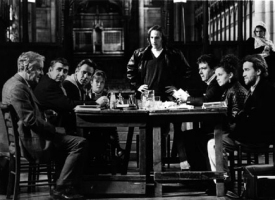
Hamlet played by Joe Harper
Directed by Joe Harper
It's December 1995, I'm at university the first time around and I live very close to the one cinema I would say that I ever really loved, The Hyde Park Picture House in Leeds. In The Bleak Midwinter turned up pretty much unheralded but I'd read about it in Empire Magazine who gave it a sparkling review and having loved everything else Kenneth Branagh had directed (yes, even Dead Again) and being someway into a lifelong appreciation of Shakespeare I knew had to go and see it..
The Hyde Park was the kind of cinema in which any film could potentially be packed out because the audience tended to go see whatever was on. I took my tall friend Dave with me, even though he wasn't sure if it was his kind of thing - in black and white and about theatre - and we sat at the back of the balcony because there was more legroom.
I'd like to be able to give you a long flowing description of the experience of seeing it for the first time but I really can't. I remember being enchanted and laughing a lot and feeling very Christmassy afterwards and Dave saying that it wasn't what he was expecting and that he really enjoyed it but other than that I'd say that it just made me more excited about seeing Branagh's Hamlet the following year, this almost being a rehearsal for that.
It wasn't until the following Christmas, when I was given the video that I really fell for the film. There was certainly the nostalgia factor - I'd left university by then and it reminded me of a good night out at a place that I wouldn't necessarily be able to go back to with someone I hadn't seen in months. But it was also that it somehow managed to distill everything I felt about Shakespeare into an hour and a half and was also brilliantly funny and touching.
The following year, in 1997, I watched it around Christmas time again while I was wrapping my presents. And again in '98 and since then it's become part of the ritual. When I say that I watch it every Christmas, I really do. Which seems like the definition of a favourite film. Each viewing it means more or less to me than the year before depending on what else is happening in life. Last year I was at university again nd it just fitted into the many hundreds of other films I seemed to be watching. This year I noticed that the main character mentions in his opening monologue that he's thirty-three and I realised that I'd be the same age as him next time I see it.
Perhaps I should provide some background because I know that this isn't a film many people have heard of (it's not even available on dvd). In The Bleak Midwinter (or A Midwinter's Tale as it's called in the US) features Branagh and Shakespeare stalwart Michael Maloney as Joe an out of work actor who decides to produce Hamlet at Christmas time in a disused church in his sister's home village of Hope. With him are a group of actors, some in the offseason from seaside shows, all with their own neuroses and the film charts the rehearsal process and the production. It very much follows the structure and style of the Hollywood backstage films from the heyday of the studio system, except with obvious nods and influences from sources as diverse as Woody Allen, Ealing comedies and silent cinema.
Branagh says that it isn't autobiographical, but when Joe describes his passion for the play, that he saw it when he was fifteen and it changed his life that's exactly what the director has said about seeing Jacobi at the RSC all those years ago. His motivation for making the epic film version of the play later mirrors one of Joe's needs here - to try and make something which has a reputation for being musty and boring and making it exciting for a new generation, essentially dragging out of slow amateur schoolroom readings.
Having tried acting and been around a few actors I can absolutely say that the film captures the brilliance and pain of the art, the fact that it can boil down to bringing the deep seated emotional crap that you try to suppress up to the surface in order to entertain others. But what is really clever, is that having suggested from the opening that all of the characters are pretentious and affected and everything everyone expects actors to be - John Session's raving queen and Richard Briers grumpy old man, for example, in a series of carefully chosen two-handers he carefully peels away the surface and reveals them to be perfectly normal people like us, absolutely aware of the mask they're otherwise wearing to get by in the profession.
I think the film was derided at the time as another opportunity for Ken to give his chums something to do, but I thought it was unfair, particularly since it allows them to reproduce the fragile chemistry that any short term group dynamic has but also because many of them are producing what I think are career best performances. People like John Sessions or Celia Imrie, so often stuck playing grotesques and eccentrics are brilliant here when demonstrating the serious side of their all too camp exteriors. Gerard Horan, latterly typecast as policeman is beautifully touching as Carnforth the man with the drink problem. To be honest the only weak link is Jennifer Saunders with her mad American accent who looks like she's charged in from a Comic Strip skit, but there no doubt she's fulfilling the role of the big producer redolent of the genre.
The film is composed rather like a something from earlier in that century - most of the action plays out in medium or wide shots in deep focus with the actors moving into the foreground and back again creating the effect of seeing characters on a theatre stage - there are very few close ups and they only appear late in the film as the group is fractured and the infighting and arguments have begun in earnest. There are montage sequences, such as the audition process and the costuming but Branagh uses a series of jump cuts and juxtapositions to move the story forward.
Branagh employs lighting akin to film noir which fits the mood of the play in production and there are some lovely compositions as the actors walk in and out of silhouette.
Noir is also implied in the costumes that are finally selected for the production within the film which have a kind of 40s gangster style - and there's a spectacular use of a machine gun which accentuates that idea which I don't want to give away. There's also very little music. The film opens with Noel Coward singing 'Why Must The Show Go On' and ends with a plucked instrumental version of the titular Christmas carol. It's a brave stylistic choice but it gives room for the actor's performances to provide the emotional core and make the one musical moment from inside their story - when Nina (Julia Sawalha) sings Ophelia's lament - all the more heartbreaking.
It has dated slightly. One of the jokes hinges on Mighty Morphin Power Rangers which to be honest seemed out of the date at the time although the target audience will at least have heard of it - I'm not sure what the equivalent now would be - probably Xbox or Wii. Also, when Nicholas Farrell's Tom is auditioning for Laertes, he goes into a wild digression about how relevant Hamlet it and mentions that it's like Bosnia. That would be Iraq now I suppose. One element that hasn't aged is the crucial plot point of the filming of a giant sci-fi trilogy that could be the new Star Wars, especially since we've actually had a new Star Wars trilogy (coindentally featuring Celia Imrie as a fighter pilot) and since and everything seems to be about pre-planned franchises and series now.
Some other things I noticed watching it again the other night - the (uncredited) puppet theatre girl in the audition scene is Katy Carmichael who played Twist in the sitcom Spaced. The brilliance of the acronym LCA - Less Crap Acting. Joan Collins as Joe's agent gives probably her best performance since classic Star Trek's City of the Edge of Forever. That Maloney is the best Doctor Who we never had and is completely wasted playing the range of wackos always seems to now in tv dramas - this is the man who stole Juliet Stevenson from Alan Rickman in Truly Madly Deeply after all.
Stylistically different to anything else what Branagh has directed but still with that love of theatre and theatrics, it touches me each year and even with the darkness, somehow manages to put me in the Christmas mood. There is a scene in which people talk about what makes their life worth living and someone mentions Brief Encounter and offers to buy someone as a present. Do yourself a favour and hunt a copy of this down in time for next Christmas because if you're a reader of this blog I really think you'll enjoy it.
Friday, February 10, 2006
Branagh Hamlet dvd may be out in 2006 after all
"Our commitment to releasing HAMLET is 100% but remastering and production schedules may force a delay. It will be out within the next 12 months -- we must be able to have the time necessary to release it properly. We do hope you understand. Please be patient. It will be worth the wait." -- Ronnee Sass, Executive Director of Publicity for Warner Home Video
Friday, February 03, 2006
Branagh Hamlet DVD Campaign
Regular reader Nathan has just sent this email he's recieved ...
Hello everyone,
I am writing to let you know that the 2006 DVD Release of Hamlet may be in jeopardy. I spoke with Mr. Branagh's assistant who shared some potentially disappointing news. She explained that last month Warner was very excited about the project and spoke with Ken about his ideas for additional content for the DVD release; however, last week, they
received an email stating that the release may be moved back until January 2008!!!
As a result, I am writing to let you know, that once again, on Valentine's Day we are going to let Warner Bros. know how many of us have been awaiting this DVD release and that a 2008 release date is NOT acceptable.
Be sure to visit the website http://www.kenbranagh.com on Tuesday, February 14th to send your email to the "powers that be" at Warner Bros. This year's letter urges them not to delay the release and emphasizes the fact that this is indeed the 10th Anniversary of the film. Also, it recommends a High-Definition release of the film because Hamlet is one of only seven films in the past 10 years to be filmed in 70mm format and thereby making it a perfect candidate for an HD-DVD release.
Thanks for all of your support!
Mark Cassello
www.kenbranagh.com
This has been on and off the release schedule for years. I've a VHS and a V-CD copy and they're fine, but don't really demonstrate the clarity of the photography. It's a real shame -- I absolutely suggest that we take action on the 14th ...
Hello everyone,
I am writing to let you know that the 2006 DVD Release of Hamlet may be in jeopardy. I spoke with Mr. Branagh's assistant who shared some potentially disappointing news. She explained that last month Warner was very excited about the project and spoke with Ken about his ideas for additional content for the DVD release; however, last week, they
received an email stating that the release may be moved back until January 2008!!!
As a result, I am writing to let you know, that once again, on Valentine's Day we are going to let Warner Bros. know how many of us have been awaiting this DVD release and that a 2008 release date is NOT acceptable.
Be sure to visit the website http://www.kenbranagh.com on Tuesday, February 14th to send your email to the "powers that be" at Warner Bros. This year's letter urges them not to delay the release and emphasizes the fact that this is indeed the 10th Anniversary of the film. Also, it recommends a High-Definition release of the film because Hamlet is one of only seven films in the past 10 years to be filmed in 70mm format and thereby making it a perfect candidate for an HD-DVD release.
Thanks for all of your support!
Mark Cassello
www.kenbranagh.com
This has been on and off the release schedule for years. I've a VHS and a V-CD copy and they're fine, but don't really demonstrate the clarity of the photography. It's a real shame -- I absolutely suggest that we take action on the 14th ...
Tuesday, February 08, 2005
Branagh vs Zeffirelli
"The Zef. version is well, yes, crap when you try to compare it to the above. Yeah, where was Horatio (and, for that matter Michael Maloney, mikken?)? Where was the ghost's armour? Where was at least half the text, and the right order of it, and the sense of it? What was with Hamlet shagging his mother? And does anyone think Hamlet of all people would actually rip up a book, especially in Zef.'s pre-printing era setting? I can't be much more specific - I'd have to go watch it again and ... no. It's just wrong, and wrong, and wrong."
Subscribe to:
Posts (Atom)