"Hamlet is, of course, the Genesis of the Daleks of Shakespeare - the one that is so canonically the best as to render further discussion oddly superfluous. Like Genesis of the Daleks, it has more than enough oomph to live up to its billing, and yet its status seems oddly out of proportion. Sure, it’s very good, but it’s tough to argue that it’s head and shoulders above King Lear or Othello. But Hamlet is nevertheless the prestige piece - the big one, if you will. Tennant, for his part, is very good at the role. The same skill that makes him a good Doctor - his ability to insert an unusually high volume of decisions into his reading of a given scene - helps him just as well in Shakespeare. He can deliver Shakespearean dialogue at speed in a way that makes the content of the lines clear. This is no mean feat - Shakespeare is brilliant, but the fact that the language is not normal conversational English makes it difficult to pick up on things at conversational speed. Being able to add, in effect, a second channel of communication through gesture and tone of voice helps in a big way. And it’s not particularly distinct from how Tennant is capable of having dialogue about, say, Z-neutrino energy and using it to deliver actual information instead of the patent nonsense that it actually is."As I said in my original review, what's interesting about Tennant plays the role is that when he's feigning madness he seems to very consciously go full Time Lord, all of the Tenth Doctor's various ticks in full effect which makes the contrast with the darker, more internalised prince all the starker.

Showing posts with label david tennant. Show all posts
Showing posts with label david tennant. Show all posts
Friday, January 24, 2014
"Hamlet is, of course, the Genesis of the Daleks of Shakespeare."
Philip Sandifer is writing about the history of Doctor Who within a historical and somewhat literary criticism context which sometimes includes material which is influenced or tangentially connected to the television science fiction franchise. This week he's covered David Tennant in Hamlet at the RSC in 2008:

Friday, August 17, 2012
Shakespeare's Sonnets.

Framed by Goodwin popping up in some biographical locations sometimes with family members, the idea was to make the poems accessible to audience brought up on television who might find their existence on the page somewhat intimidating. While it was entertaining in its own way, the obvious set back was that the scenes were often at odds with the poet's original meaning and the readers and actors themselves had various levels of comfort in relation to how they should be speaking the words, contemporary poetry fairing better than most. The best interpretations were undoubtedly when the actor simply broke the forth wall and addressed the viewer forcing us to interpret the words ourselves.
That’s precisely the methodology at play in Shakespeare’s Sonnets, the more linear reproduction of the sonnet recordings created for the iPad app produced by Touch Press in association with Illuminations, Arden and Faber. Select “play all” from the menu screen and after Patrick Stewart reads the original title page and acknowledgements, each of the ensuing sonnets is read in turn directly to the viewer by a similar group of actors as the Goodwin project (from Jemma Redgrave to Dominic West with Stephen Fry between). Sonnet after sonnet, face after face appears and the sheer variety of the text and approaches to interpretation even within these limits becomes obvious, especially when Ben Crystal pops up for his original pronunciation of 141.
Shorn of gimmickry, an intimacy is created between actors and viewer which replicates the brief moments in televised plays when a soliloquy has to be addressed to camera. Some performers have a more actorly approach than others, with the younger players often favouring a straight reading over Fiona Shaw or Noma Dumezweni's attempts at providing an emotional context. RSC director John Barton classically utilised sonnets as exercises to help structure the text within performance and it’s certainly the case that actors who’ve been through Stratford provide the clearest readings. But some of the non-professionals are equally impressive, James Shapiro’s Sonnet 138 underpinned by an academic understanding.
Each of the readings is relatively fascinating in and of itself. They beed filmed in a variety of places, in contributors homes and offices, back and on stage at theatres. I imagine director John Wyver and his crew travelling the length and breadth of the country dropping in on the actors depending on their availability and it’d be interesting to know how they were selected. In the main they’re perfectly chosen, some having even appeared in similar sonnet related projects on audio, David Tennant for Naxos’s From Shakespeare With Love (in which he also read “Shall I compare thee …”), Sian Phillips and Fiona Shaw on EMI’s When Love Speaks (different choices).
Watching these sonnets in a three hour block isn’t the best way to consume them and admittedly I didn’t. They were created as part of the app and outside that context they become “just” Shakespeare’s words well read. Perhaps it’s possible for those of us without an iPad to create a low-fi version with this dvd as the cornerstone. The app includes Katherine Duncan-Jones’s notes from the Arden Shakespeare edition which you might have to hand. Fellow contributor Don Patterson has also produced a book on sonnets (and this lengthy article for The Guardian). There are various facsimiles of the 1609 edition of the sonnets at archive.org.
Apart from added interactivity, about the only element unavailable are the additional interviews with experts and given the dvd is more expensive than the app, it’s a shame room couldn’t have been found for those here. That’s not the only niggle. Each of the actors is given their own biography screen which also lists the sonnets their reading, but there’s no play all for these and after watching one of them the viewer’s kicked back to a list of actors rather than the screen they were working from which means they have to go off and find the actor again to see another of their contributions. There’s a similar problem with the numerical list too, which makes the process of wanting to see a sonnet again quickly less efficient. A subtitle option would have been a useful addition.
Otherwise, the presentation is clear and nicely replicates the design of the app judging by screenshots in the accompany booklet (which also includes the actor profiles from the dvd itself). Once you’re used to navigating the menus there’s a definitely an addictive quality to it, wanting to watch one more sonnet, or the same sonnet again. If nothing else, it’s a way of exploring the less well known poems, most of which are generally ignored the face of the mighty 116, 18, 2 and indeed Goodwin’s choices 129 and 29. Few writers can say that 103, read beautifully here by Kim Cattrall, doesn’t capture the desperation of facing something with near flawless qualities and being infected with an inability to write about it.
Shakespeare's Sonnets is out now. Review copy supplied.
Thursday, July 19, 2012
Shakespeare Uncovered:
David Tennant on Hamlet

The story so far: Shakespeare Uncovered is a series of six introductions to plays introduced by leading actors and directors produced in association with the Globe theatre. The highlights have included Joely Richardson magically covered in snow during her first visit to the recreation of Shakespeare’s playhouse and discovering during Trevor Nunn’s exposition on The Tempest that there’s a recreation of Blackfriars in Staunton, Virginia. Less appealing is Sir Derek Jacobi’s ten minute detor into authorship madness during an otherwise informative introduction to Richard II and Ethan Hawke subtly damaging a First Folio by stroking his finger across a page and knocking out an existing burn mark leaving a hole, the text on the next page now clearly visible.
Now we reach David Tennant on Hamlet and although I’m biased the best of the episodes. Focusing on Hamlet’s struggle with his mission and his own mortality, David gallops through the story from the ramparts to “the rest is silence” aided by a number of fellow actors, academics and as he wanders about in the bridging cutaways the architecture of Stratford-upon-Avon and the Southbank, struggling with the question of why the play is still considered the pinnacle of English literature, the one secular text which continues to enthral and inform us as much as holy texts if not more so. But again, I would say that, I’m biased. Yet as Ben Whishaw notes for six months after playing Hamlet in 2004 he found himself applying all of life’s big questions and presumably some of the small ones to the play, recalling the text over and over. I do that too.
Utilising a synopsis of the play as a spine for observation is a fairly typical approach (cf, Imagine ... Being Hamlet and Playing the Dane, the inspiration for this blog), questioning the action at key points, with contributors providing their experiences of playing the part or analysing them. Because Hamlet is so thematically rich the producers have had to make similar decisions to a company producing the play so the focus is very much on the domestic elements, with little to nothing on the politics of Elsinore and Denmark, the succession. Fortinbras is cut. Lost too are Rosencrantz and Guidenstern other than the fact of their existence so nothing on the implications of their murder. “England” is generally glossed over. This is all about Hamlet’s personal j-word and those who’ve chosen to follow him.
All of which is perfectly understandable actually since entire books have been written about all of them, and there’s just an hour to play about with. It’s natural that you’d want to concentrate on the icons, whilst hinting at what lies beyond, the feigned madness, the implications of the willow scene that sort of thing. That’s especially true of the section shot at the Novell Theatre in which Michael Dobson offers a potted history of the closet scene which glanced towards Freud and also explains how Hamlet’s sometimes inappropriate attitude to his mother developed. Some productions almost treat the action in two discrete sections but as David notes there’s something very uneasy about Hamlet being so obsessed with Gertrude’s sex life with Polonius’s cadaver close by.
There are some unexpected inclusions. As with some of the other episodes, David was given the opportunity to see original copies of the text, in this case at the British Library and crucially all three versions including their copy of Q1 (one of only two in the world), comparing and contrasting the different versions of the big speeches and stage directions, discussing with curator of Early British Literature, Tim Pye the source of this earlier version. It’s worth noting that one of the potential weaknesses of the documentary is when David rhetorically asks who created this extraordinary character and where he came, we're not told about the Ur-Hamlet or Saxo Grammaticus but (admittedly touchingly) Shakespeare’s family and the death of Hamnet, which was also an influence on Twelfth Night in a very similar sequence in the Joely Richardson episode, one of the few occasions when the original source of a piece hasn’t been expounded upon.
Indeed, David has an impressively full participation, the episode’s presentation echoing his earlier presenter led episode of Doctor Who Confidential, “Do You Remember the First Time?” in which like this, he shared his affection for a much loved character whilst wearing a brown jacket. Then he visited the hallowed ground of Studio 8 of television centre, here it’s King Edwards Grammar Schoo, Shakespeare's school. Then he interviewed fellow fans like Steven Moffat and here we see him joshing over old reviews with David Warner and comparing approaches to the character with Jude Law. At least in terms of the language of television, my favourite interview might be with Simon Russell Beale who (like Whishaw) has appeared in nearly all of the episodes in interviews clearly shot all together and so it seems here until David asks a follow up question and camera whip-pans in his direction. Beale himself almost startled to suddenly have his fellow actor sitting there.
Like that Confidential, this features dozens of illustrative clips though interestingly limited to Olivier directing himself, Zeffirelli directing Gibson and understandably Doran directing Tennant. An early trip through the RSC shop with David indicates other versions are available, but these three are interesting choices in that they’re not traditional renderings of the text, Olivier adding some, Zeffirelli deleting practically everything and Doran shuffling the order of the scenes. Odd that we should have the Warner interview but not the clips of his RSC appearance seen elsewhere. As with the other episodes, the emphasis instead is on newly filmed sections performed by the Globe’s cast with Jack Farthing (pictured below) cutting a youthful, lonely figure in a near empty theatre during “To Be Or Not To Be..” and Tom Lawrence later a teary Horatio as his prince dies.

As well as David greeting Andrei Tchaikovsky's skull again (pictured) the most poignant section for me is right at the very end, when he’s pondering what the part means to him and startling it resonates with comments he made when he left Doctor Who. Indeed just for a moment (thanks to a reference to filming), I wondered which role he’s actually talking about:
"In the end, there’s just no other character like him. […] I remember on the last day of filming thinking, “I’m so proud to have done that. I’m so pleased that’s something I got to do. And now I will never go there again.” And there was a huge relief to that. It was like having a weight lifted off your shoulders. And then, where are we now? Three years on… I do find myself, I catch myself, slightly fantasising about doing it again, going back there and seeing what that would feel like. But … that way madness quite literally lies.”Fiftieth anniversary next year then.
[Assuming I haven't spoiled it too much for you, David Tennant on Hamlet is available on the iPlayer until 26th July.]
Wednesday, July 11, 2012
David Tennant on Hamlet scheduling update.
Yes, this is an important scheduling reminder/update for the final Shakespeare Uncovered documentary and most important to this parish, David Tennant on Hamlet. For some ungodly reason, the BBC have decided that far from appearing after The Hollow Crown on Saturday presumably because it doesn't have a thematic connection or in the slot some of the shows had on BBC Four because it's David Tennant on Hamlet, they've seen fit to broadcast it on ...
Tuesday 17th July at 11:20pm after Newsnight
that's ...
Tuesday 17th July at 11:20pm after Newsnight
Exactly why this isn't on after The Hollow Crown is beyond me. For one thing it's the episode for which you'd think there was a built in audience even after a couple of years and for another the expected timeslot has instead a QI repeat and half a rerun of a TOTP.
Tuesday 17th July at 11:20pm after Newsnight
that's ...
Tuesday 17th July at 11:20pm after Newsnight
Exactly why this isn't on after The Hollow Crown is beyond me. For one thing it's the episode for which you'd think there was a built in audience even after a couple of years and for another the expected timeslot has instead a QI repeat and half a rerun of a TOTP.
Friday, June 29, 2012
The Sonnets come to iPad, the web and dvd.
Coming soon to an iPad near you, is a new production of The Sonnets produced my all my favourite organisations, Faber, Illuminations and Arden with specially filmed readings of all hundred and fifty-four sonnets by a a mouthwatering cast of Shakespeareans including Sir Patrick Stewart, Kim Cattrall, David Tennant, Simon Russell Beale, Dominic West, Siân Phillips, Fiona Shaw, Dame Harriet Walter, Simon Callow, Stephen Fry, and poets Don Paterson and Sir Andrew Motion. James Shapiro, Cicely Berry and Katherine Duncan-Jones (the editor in charge of the text and commentary). are even in there too.
Given that I'm one of those people who doesn't have an iPad and I only tend to write about accessible things, or rather things I can access, I was going to leave the announcement to everyone else, until I noticed that brilliantly, as part of the publicity for the app, the overall publishers Touch Press, have uploaded versions of all the videos along with the texts of the poems to this website for us all to enjoy. Here's Duncan-Jones herself reading eighty-seven. And for those of us without an internet connection which can cope with the scope of all that streaming, they're also releasing them on a dvd.
Tuesday, April 17, 2012
Shakespeare's Sonnets for the iPAD
A really exciting project underpinned by a fantastic academic publishing legacy. Here's the press release:
The Arden Shakespeare, Faber and Faber, Touch Press and Illuminations are delighted to announce that they are in the final stages of producing a spectacular edition of Shakespeare's Sonnets for the Apple iPad. The title features specially filmed performances of all 154 sonnets by a stellar cast that includes Fiona Shaw, Sir Patrick Stewart and David Tennant. It also features the complete Arden notes, providing unsurpassed commentary on the poems.Since this is partly an Illuminations productions, that may explain one the extras on the superb recent release of Simon Callow & Jonathan Bate's Being Shakespeare (directed by John Wyver) which included Callow reading 18, 29 and 31 directly to camera.
This digital edition follows Touch Press and Faber's iPad app The Waste Land that presents T. S. Eliot's great poem in an innovative and widely praised interactive format.
Sunday, June 05, 2011
Much Ado About Nothing (Classic Radio Theatre).

It’s with a certain inevitability that since David Tennant’s returned to Benedick at the Wyndham Theatre, AudioGo would rerelease his first run out at the part opposite Samantha Spiro as Beatrice from late September 2001. In the new tie-in edition of Much Ado About Nothing, his new leading lady, Catherine Tate, describes how Tennant mentioned the radio production when she first broached and it’s clear that he thinks of it fondly. And he’s right to. It’s lovely.
Later in the same interview, the actor suggests he was, even at thirty, a bit too young for the part and that it works better slightly older actors, not quite in their first flush, perhaps best if they’re well into their second or even third. Whilst that’s true, his youthful voice still contains much maturity and as Benedick lists his many qualms about the fairer sex, particularly in the shape of Beatrice, he lends the words much experience as well as a touch if nostalgia.
Tennant was still years away from becoming a household name when this was recorded, still known within the industry as a reliable presence on radio and stage and as a character actor on screen. He plays the role in full Scotch brogue, verbally punching the syllables with superb comic timing, and it’s a unique occasion when his description of Claudio “I have known when there was no music / with him but the drum and the fife” gains a geographic resonance.
He contrasts perfectly with Spiro’s RP delivery who because of the timing of this release may well be unfairly compared to Tate. She’s repeated Beatrice too, in 2009 at Regent’s Park and garnered some excellent notices which suggest that Tennant she was unafraid of stressing her maturity and like Tennant, the first seeds of that late blooming approach are planted here. She’s smart, fearless and with a requisite obstinacy which suggests that their war of word will continue into marriage.
But it’s perhaps unfair to focus too much on that duo, when this is the kind of “all star cast” the phrase “all star cast” was designed for, an ensemble that would later underpin the BBC’s prime time schedule. Yes, that is Emilia Fox as an aristocratic Hero, a soft spoken Chiwetel Ejiofor as her beloved Claudio and Silk’s Maxine Peake in the relatively minor role of Margaret, her broad accent introducing a useful class element which is usually only reserved for the interminable Dogberry scenes.
Julian Rhind-Tutt also makes for an especially menacing Don John. On stage the character can become lost amongst the revere, a function of the misunderstandings rather than the trickster he really should be. Rhind-Tutt’s deep voice, has a cold resonance that’s barely human as though the devil himself is stalking what should otherwise be a merry comedy. When he speaks to those outside of his circle, there’s no chemistry, no sense of camaraderie.
Director Sally Avens, perhaps sensing the value of the cast, presents a simple soundscape short on gimmicks, preferring to project the language without too radical an interpretation, no 80s version of Hey Nonny Nonny here. Which isn’t to say the music doesn’t have a vital part to play in unifying the action and the orchestral score provided by composer/performers Simon Oakes and Adam Wolters has a surprisingly melancholic quality.
A final word about the excellent sound design which unlike too much audio theatre gives these characters a physical presence (rather than the disembodied voices which sometimes pull the audience out of the action). When Benedick and Beatrice hide in the arbour and listen to their friend’s subterfuge, the point of view shifts between their harrumphing and the false words they’re listening to, the change in volume suggesting almost magically that most visual of devices, the close-up.
Much Ado About Nothing (Classic Radio Theatre) is published by AudioGo. RRP: £13.25 ISBN: 978 1408 470015. Review copy supplied.
Sunday, May 29, 2011
Much Ado About Nothing. Edited by Robert Hastie, Josie Rourke.

When David Tennant and Catherine Tate appeared on BBC Breakfast in early January to announce their participation in a production of Much Ado About Nothing at the Wyndham's Theatre as Beatrice and Benedick, the obvious reaction was "of course they are". Anyone who saw their chemistry and quick fire screwball verbal sparring on Doctor Who could see that they were ripe for this challenge, especially late into their season together as they essentially became facets of the same character, (the Doctor Donna) leading to some almost instinctual comic timing. Although the ensuing production is still in previews and professional critics have yet to give their verdict, anecdotal evidence suggests that they’ve managed to transfer this alchemy to the stage.
This is the book of the production of the play. Behind a cover which reproduces the lobby poster is an introduction and interview with Josie Rourke the director, chats with designer Robert Jones, Tennant and Tate and the composer Michael Bruce as well as a rehearsal diary from associate director Robert Hastie and a copy of the text being used in this production. Demonstrating the speed within which such publications can be produced now, all of this was completed in April and signed off before the completion of even a run through and as Rourke admits, there may well be a few variances from what ultimately appears on stage: “with the printer’s deadline looming, this was as close as we could get.”
That’s important because this is not simply yet another reprint of some scholarly edition but a brand new version of the play prepared by Rourke and Hastie after interrogating both the quarto and folio texts as well as a few modernised editions. Scenes are shifted around or expanded and other characters are changed out of recognition. To say more presumably has the potential to spoil part of the usual anticipation in seeing a new Shakespeare production – discovering how the director has interpreted the play – but suffice to say that at least one change opens up some interesting thematic avenues. My advice if you’ve managed to snag a ticket for the show is to buy this later as a souvenir.
All of the interview are understandably tentative. In describing the decision to set the play on a military island in the 1980s, all are very much in the realm of talking about what they hope will happen. There are design sketches and a reproduction of the new score for Hey Nonny, Nonny and the actors base their comments on previous experience (Tennant has played his part before on radio) but it obviously lacks the sense of perspective that three months in production can offer. But what is here, especially the diary in capturing the earliest moments between the new ensemble, will be a useful record for future scholars investigating the state of Shakespearean theatre in 2010s, perhaps in filling out their own editions with a theatrical history.
Much Ado About Nothing. Edited by Robert Hastie, Josie Rourke is published by Nick Hern Books. RRP: £6.99. ISBN: 9781848422001. Review copy supplied.
Monday, May 09, 2011
Off By Heart Shakespeare

Off By Heart Shakespeare is a joint operation between the RSC and the BBC attempting to inspire secondary school students with Shakespeare's language through a recital contest. "At regional heats in autumn 2011 students will take part in actor-led workshops to get an exciting experience of performing Shakespeare." The accompanying website is rich in useful content, with RSC produced guides to reading and memorising the language and interviews with actors offering hints and tips.
There is a very focused set list of speeches which in the case of Hamlet are "O, that this too too solid flesh would melt", "Now might I do it pat, now he is praying" and of course "To be, or not to be" which seem to carefully selected to reflect the play's fundamental themes of life and death and revenge and also provide the opportunity for the participating child to reflect a range of emotion. When I took part in a similar competition at school, we were given "Once more unto the breach..." from Henry V and this sixteen year old simply didn't have the skill set.
All of the speeches are accompanied by examples and this is where things get more exciting for those of us too old to participate. The primary source for the Hamlet clips is understandably the RSC with Tennant but perhaps since his isn't the most trad of interpretations, the producers have cleverly included some alternatives. So we have Christopher Plummer from Hamlet at Elsinore in 1964, Lawrence Olivier from his film, Derek Jacobi from the BBC's 1980 and Alex Jennings in a really intriguing Open University production.
Arguably, however, it's outside of Hamlet that the project is at its most interesting since with the exception of Julius Caesar instead of falling back on archive material, new films have been commissioned with contemporary television actors offering their interpretations of the speeches. Amongst others, there's Katy Brand as Titania, James Sutton (Emmerdale) playing Orsino, Lauren Socha from Misfits playing Juliet, Lenora Crichlow (Being Human) makes for rather a good Portia and Michelle Ryan offers a bit of her Helena.
They're produced with something of the spirit of complete BBC Shakespeare from the 70s and 80s, the spirit which led to John Cleese playing Mercutio; familiar casting attracting audiences that wouldn't otherwise necessarily consider Shakespeare and as in that case it is a mixed bag but always entertaining. It's also pretty frustrating because some of them are so well realised you could almost imagine that they're clips from full productions employing the contemporary urban landscape as a backdrop [via].
Thursday, December 30, 2010
James Shapiro on Hamlet on BBC World Service
James Shapiro, the author of 1599: A Year In The Life of William Shakespeare talks to the BBC's Witness programme about the play and the political environment at the time he thinks it was written.
It's only very short -- about ten minutes -- but manages to include clips from seven different Hamlets including the recent Rory Kinnear and Jude Law (which confirms that both have been recorded in some format).
Also downloadable as a podcast.
It's only very short -- about ten minutes -- but manages to include clips from seven different Hamlets including the recent Rory Kinnear and Jude Law (which confirms that both have been recorded in some format).
Also downloadable as a podcast.
Sunday, August 15, 2010
Who's best to judge Hamlet?
PJ Purdey makes a good point (in a Guardian article illustrated with a perfect picture of Tennant) about who the best judge of a play should be:
It seems to me the ideal person to judge a new production of Hamlet would be a Danish Prince who is also a theatre critic.
In other words, Hamlet himself.
"Who's best qualified to assess the merits of a new production of Hamlet: a practising theatre critic, or a Danish prince? The former brings a certain amount of theatrical experience to the task: he or she has probably seen the play before, and so is at least well placed to judge the originality and competence of the staging under review. But the latter, even if a theatrical virgin, will have valuable insights of a different order to offer, especially if he's of an introspective disposition and has had a father expire in suspicious circumstances. In short, the Danish prince will know how it feels, and can therefore judge whether Shakespeare has got it right."Purdey is reacting to some of the reviews his new play Subs has received both from critics and the sub-editors it illustrates.
It seems to me the ideal person to judge a new production of Hamlet would be a Danish Prince who is also a theatre critic.
In other words, Hamlet himself.
Thursday, June 10, 2010
23 Updated. 12-Rating.
You might remember I said I would contact the BBFC in relation to the 12-rating given to the blu-ray of the RSC production with David Tennant. Much to my delight they've replied:
Ordinarily, very strong language would not be permitted in a '12' rated work. However, with HAMLET, it was recognised that the well-known wordplay upon the phrase "country matters" said by Hamlet to Ophelia would be familiar to most viewers. Emphasis is often given to the first syllable of the first word (as in this case), and the conversation between Hamlet and Ophelia carries a double meaning.Which is about what I surmised and absolutely understandable. Again, I say, amazing. Not just for the RSC risking it, but for the BBFC to give it this level of care and attention.
HAMLET is obviously widely known and studied, and the text and numerous theatrical productions of it - as was this one - are available to all ages. Some versions of the play have been rated 'U' or 'PG'; however, it was felt the deliberate emphasis given to the first syllable in this version warranted a '12' and would not confound public expectations at this category. Our Consumer Advice also gave warning of the potential offence that some viewers may take to the wordplay.
Such comic wordplay on very strong language is not unprecedented in '12' rated works, eg THE LOVE GURU and a episode of ARRESTED DEVELOPMENT.
Tuesday, June 08, 2010
23 David Tennant

Hamlet played by David Tennant.
Directed by Gregory Doran.
When I first heard about this production, I almost exploded. Already some way into this project, the idea that the then star of my favourite franchise would be appearing in my first or second favourite Shakespeare play (yes, still osculating with Measure for Measure) was almost too heady to contemplate. Yet somehow, because of this and that, fear and finances, I missed David Tennant tramping about the Courtyard stage, and regretted it ever since. So when it was announced that the production would be filmed for the BBC, I was elated, yet still because of the usual family related responsibilities on Boxing Day and then realising that I’d like to see it first on blu-ray (it sparkles!) that I only finally sat before it yesterday afternoon. As expected, I squeed. A lot. Do not expect this to be a deep textual analysis. If you'd like to read a deep textual analysis, there's a very good one here.
I do at least have a programme for the stage production. When I visited Stratford last year, the wonderful staff at the RSC made a special arrangement to have one delivered to the venue within a couple of days for me to buy so that I didn’t have to mess about with mail order. It’s a wonderful thing; I read the booklet just before watching the blu-ray and though it obviously wasn’t a substitute for the real theatrical experience, it certainly helped to increase my anticipation if not participation. In a change from what seems like the usual format of short essays about various aspects of the play, this is has a production scrapbook (now available for download) which outlines the work of the director and the various production department such as costume and stage management.
Apparently, to help her get into character, director Gregory Doran took actress Mariah Gale to the spot in Stratford where in 1579 a girl called Katherine Hamlet died in similar circumstances to Ophelia. They found that no girl attempting to pick flowers at that river bank could leave without having been scraped and being covered cuts and bruises. Her dress would be dirty. Which is why in the production Gale looks as though she’s been through a war. Similarly we discover that even with the understudy process, the play can’t be interpreted and rehearsed twice and since one actor can’t mimic the work of another, it’s not simply the person stepping up – as Edward Bennett did when Tennant hurt himself during the West End run -- who’s flying by the seat of their pants. The rest of the company must react on the hoof to the changes being wrought.
But to the point: Tennant is extraordinary, the reviews did not overplay his achievement. It is impossible for me to watch this consummation without five years of his performance in Doctor Who jangling about my head and indeed, it’s my impression that his approach to extrapolating Hamlet’s feigned madness is to tap into his Doctorish tendencies, the gurning, the rapid diction, his entire physical presence springing and elasticising about the rest of the household, rubbing the back of his neck as he offers a long drawn out thoughtful “Weeeelll…”, his accent almost but not quite the same as the terrestrial John Smith figure the timelord became in the story Human Nature. This was photographed just weeks after he left his role as the timelord (June 2009), and its perhaps fitting given the context that the ghost of the tenth Doctors still hangs in the air.
Arguably he is even more compelling during those moments when these tendencies are in check, when the sober version of the character is to the fore. This is most clearly apparent in the opening wake as we see the weight of his father’s death across his sagging shoulders and right through to the apparition’s appearance. There follows a compellingly lucid moment, as he addresses us through the lense, his eyes piercing like a sword, when we watch him first take the decision to become “mad” and then after a jump cut change his entire attitude. He, if you’ll pardon the expression, regenerates.
To an extent, Tennant is so strong, he threatens to overpower everything else. This might have been less likely on stage (especially at the Courtyard were actors are easily obscured) and whilst I’m willing to admit that it could simply be caused by this fanboy’s obsession, a huge percentage of Gregory Doran’s “film” (this was shot with digital cameras) is in close-up and does seem to favour Tennant above the other actors. Despite its three hour running time, this Hamlet is by no means an ensemble piece. The prince seems to spend to time at all in England with no mention of pirates, no letter sent home, which curtails Horatio’s part somewhat (he is indeed more like Hamlet’s “companion” than in independent figure).
None of which should be seen as a criticism – perhaps aware that the star power will be bringing in an audience less aware of the play’s intricacies, Doran’s has rightly decided to keep the story relatively linear. His Frankenstein-like text is mainly F, but as is the fashion, some of the structuring, notable the placement of “To Be or Not To Be” favours Q1. Fortinbras was apparently originally cut when he was preparing the original stage script yet was reinstated during rehearsals because the actors believe that the play works best with this extra political angle. Nevertheless, that presence is still minimal on-screen; we are gifted with the meeting between Hamlet and Fortinbras’s Captain from Q2 (and the ensuing soliloquy) however he’s missing from the finale which chooses to cut away just before the Norwegian prince storms Elsinore.
Doran has also decided to enunciate Claudius’s "reconciliatory" speech about how the “common theme / Is death of fathers”. Patrick Stewart plays both Hamlet Snr and Claudius, the former retaining a very real, very physical presence in the murder exposition. Oliver Ford Davies’s Polonius is permitted to dominate the first half of the running time. He's clearly loved and shares a good relationship with his children, who complete his authoritative advice for Laertes, having probably heard it already dozens of times. Even in the scenes were Claudius appears, when Tennant isn’t in the ascendancy, Davies’s deft performance has the focus in a way which I’ve rarely seen before.
Until he’s shot. Then Stewart’s Claudius emerges and it becomes immediately apparent through the crook in the actor's lips, that the new king is of the kind to sit back and watch a game play out amongst his subjects. From the opening scenes of the play, Doran cuts away to footage of the action from he perspective of a CCtv camera – he’s very interested in surveillance culture and that was demonstrated by a set of two way mirrors in the stage production (perhaps influenced by the great hall in Branagh’s film). At first it seems tricksy and irritating because we aren’t sure who is watching, and that’s especially true in the nunnery scene when it become the trigger for Hamlet turning on his former girlfriend. Later, after The Mousetrap, the prince reaches up and angrily pulls it from the ceiling, wires and all. “Now I am alone” he says.
In these closing stages, it’s almost as though in this production Claudius has been aware of Hamlet’s “performance” and of the visitation of the ghost from the beginning because, its inferred, he’s been watching this CCtv footage. When he rises and approaches Hamlet with the lamp during The Mousetrap it’s as though he’s saying “You haven’t beaten me yet!” (at which point Hamlet too realises he’s being spied upon leading to his later vandalism). When the king rises after Hamlet fails to run him through on the way to Gertrude’s chamber, even if the prince’s speech appeared as voice over, his uncle clearly knew of his presence and was quietly willing him to send him to heaven. He grins broadly, manically even, during Ophelia’s funeral, enjoying the spectacle. If this Hamlet is feigning madness, this Claudius is just psychotic.
The setting is a modern stately home that brings to mind Thomas Vinterberg’s Danish Dogme film, Festen. Interiors are mainly shot on a single set inspired by the stage version, columns and mirrors and ebony fittings intact. There are a number of exteriors, including some atmospheric tunnels and Doran makes good use of silhouettes and shadows. Despite the dinner jackets and silk dresses, this is clearly the royal family and Claudius and Gertrude are regal figures ahead of rest of the household. When Polonius describes to his boss Hamlet’s treatment of his daughter, Ophelia stands somewhat in awe and there’s a lovely moment when Gertrude approaches and falters over the girl’s name because this is probably the longest time they’ve spent in the same room together.
Despite all of that, the infamous “one thing”, I’ll be remembering this production for is the 12-rating. A glance at the back of the box reveals that the show “contains one use of very strong language and moderate sex references”. Given that this was first broadcast between four and seven on Boxing Day I couldn't quite understand what could lead them to this conclusion, especially considering that this isn't some eccentric modern adaptation. It didn’t take long for me to realise that it has to do with country matters or rather “cunt-ry matters” as Tennant’s stress pattern has it during the run up to The Mousetrap, which let's agree, amazing. The BBFC website doesn’t confirm that this is the one use. I have been in touch and will update this entry should a reply be forthcoming.*
Illuminations, the production company behind this television adaptation blogged their way through filming, though I’ve so far studiously ignored this diary and the BBC's official website (spoilers!) which is why this review probably just impacts on the surface. But I suspect I’ll be returning to this production again. Given my fan gene, I’m very much aware that because I was focusing on Tennant, I didn’t pay enough attention to Penny Downie’s Gertrude. As yet I haven’t quite decide how much she knows, when she knows it and how much of a performance this version of the queen is giving for her husband at the end. But it’s a measure of the complexity of this production that I’m desperate to find out.
* The BBFC have offered this full and frank reply.
Friday, November 13, 2009
Saturday, October 31, 2009
David Tennant on Hamlet
David Tennant only ever gave one interview about his time in Hamlet. Here it is:
"Even if you read a play once you have preconceptions and notions about it. It's hard to be specific about things, because things are so gradual, and also talking about it now at the end of a run, it's quite difficult to work out where you were at the beginning, especially with a play like this that changes from night to night. I do remember being surprised, because I had always assumed that Hamlet and his father had a slightly distant relationship, that his father was a slightly distant patrician, quite a bellicose figure with whom Hamlet didn't really identify. But whilst I do think that they are very different, I remember that once we actually started playing those scenes, there was a sense of the bond that they had and a sense of that paternal connection, and I was quite taken aback by that."I'm going to save reading this properly until I've seen the film. I don't want to preconceptions. Even productions of four hundred year old plays can have spoilers, I think, even if it's just spoiling the interpretation [via].
Friday, September 25, 2009
dvd cover for the RSC production
The thrillingly evocative dvd cover for the RSC production has been released:
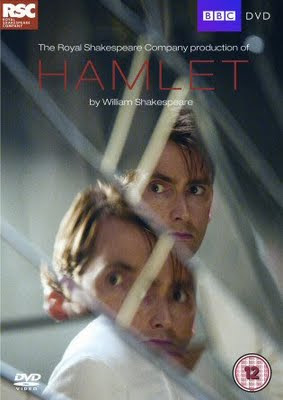
I love this. Usually it's Hamlet and the skull (see top right for what I was expecting) or the washed out face of the actor. This cuts straight to one of the symbolic heart of the play, the fracturing of Hamlet's personality and how he has to split himself into pieces in order to survive (the irony being that it doesn't work). Plus, look at that certificate. I'm hoping for a particularly bloody duel at the end.
The DVD is now available for pre-order direct from the RSC.

I love this. Usually it's Hamlet and the skull (see top right for what I was expecting) or the washed out face of the actor. This cuts straight to one of the symbolic heart of the play, the fracturing of Hamlet's personality and how he has to split himself into pieces in order to survive (the irony being that it doesn't work). Plus, look at that certificate. I'm hoping for a particularly bloody duel at the end.
The DVD is now available for pre-order direct from the RSC.
Wednesday, August 06, 2008
New Tennant in Elsinore
Have any members of the press used that headline this morning? Anyone? Either way, to save some work, here's a link to Outpost Gallifrey's round-up of reviews for David Tennant's Hamlet. Overwhelmingly positive, especially from Michael Billington of The Guardian, whose piece reads like a more articulate version of a post from this very blog. He doesn't, for example, like the cuts:
"Tennant is an active, athletic, immensely engaging Hamlet. If there is any quality I miss, it is the character's philosophical nature, and here he is not helped by the production. Following the First Quarto, Doran places "To be or not to be" before rather than after the arrival of the players: perfectly logical, except that there is something magnificently wayward about the Folio sequence in which Hamlet, having decided to test Claudius's guilt, launches into an unexpected meditation on human existence. [...] Unforgivably, Doran also cuts the lines where Hamlet says to Horatio, "Since no man knows of aught he leaves, what is't to leave betimes? Let be." Thus Tennant loses some of the most beautiful lines in all literature about acceptance of one's fate."Nothing on the state of Fortinbras though.
Thursday, July 31, 2008
"there is no such thing as Shakespeare's Hamlet ... there are as many Hamlets as there are melancholies"
Some obligatory posts from The Guardian related to David Tennant's Hamlet. Some photos & Michael Billington picks his ten best including some screen versions in with the stage.
Sunday, June 08, 2008
Interview: David Tennant talks Hamlet.
TV David Tennant appeared on The Andrew Marr show this morning to talk about playing Hamlet amongst other things and here's a transcript. Believe me, it was as excruciating to watch as it is to read:
"ANDREW MARR: Yeah. You're, you're a Shakespearian actor, have been for some time. But Hamlet is the big one.You can see the weird chemistry for the next on the BBC's iPlayer if you're in the UK. Spot the moment also when Marr, having called Doctor Who fans Trekkies he forgets the name of The Doctor's current assistant. [via]
DAVID TENNANT: I suppose. I'm trying not to look at it that way at the moment. Just another play isn't it Andrew?
ANDREW MARR: You're going to, well you're going to bring - yeah except you - and just another audience will be a, probably the RSC will get audiences it doesn't normally have for its productions because you're doing Hamlet I would have thought. Lots of Trekkies in there ... Who'ees, Who'ees.
DAVID TENNANT: Well there will be Trekkies cos we've got Patrick Stewart in the cast as well. But I don't know. I think, I mean I think Ian McKellan was there last year doing King Lear.
ANDREW MARR: Yes.
DAVID TENNANT: So I guess he probably has an audience from ..
ANDREW MARR: Yes.
DAVID TENNANT: .. Lord of the Rings that maybe ..
ANDREW MARR: But it's, I mean every, I mean, I mean people will be watching to see - I've got an Olivier, a little clip of Olivier's Hamlet which is ..
DAVID TENNANT: Oh right.
ANDREW MARR: .. yeah let's just have a quick look at that.
VT: Olivier in Hamlet.
[editor's note: which by the way amounted to a photograph and audio from the film of Larry saying 'To be or not to be, That is the question."]
DAVID TENNANT: I'll do it like that then.
ANDREW MARR: You'll do it like that?
DAVID TENNANT: Yeah.
ANDREW MARR: So we've got it sorted?
DAVID TENNANT: Yeah, that's fine.
Tuesday, September 04, 2007
What? Whaaat? 2
Continued from here. One of the reasons for the break is because David Tennant is due to give us his Hamlet for the Royal Shakespeare Company next year which is a really interesting and exciting piece of casting especially in relation to this blog. The lead actor of my favourite television series appearing in what's probably my favourite Shakespeare play. I'll have to start saving now...
Subscribe to:
Posts (Atom)