Showing posts with label BBC. Show all posts

Wednesday, September 10, 2014

Shakespeare at the BBC:
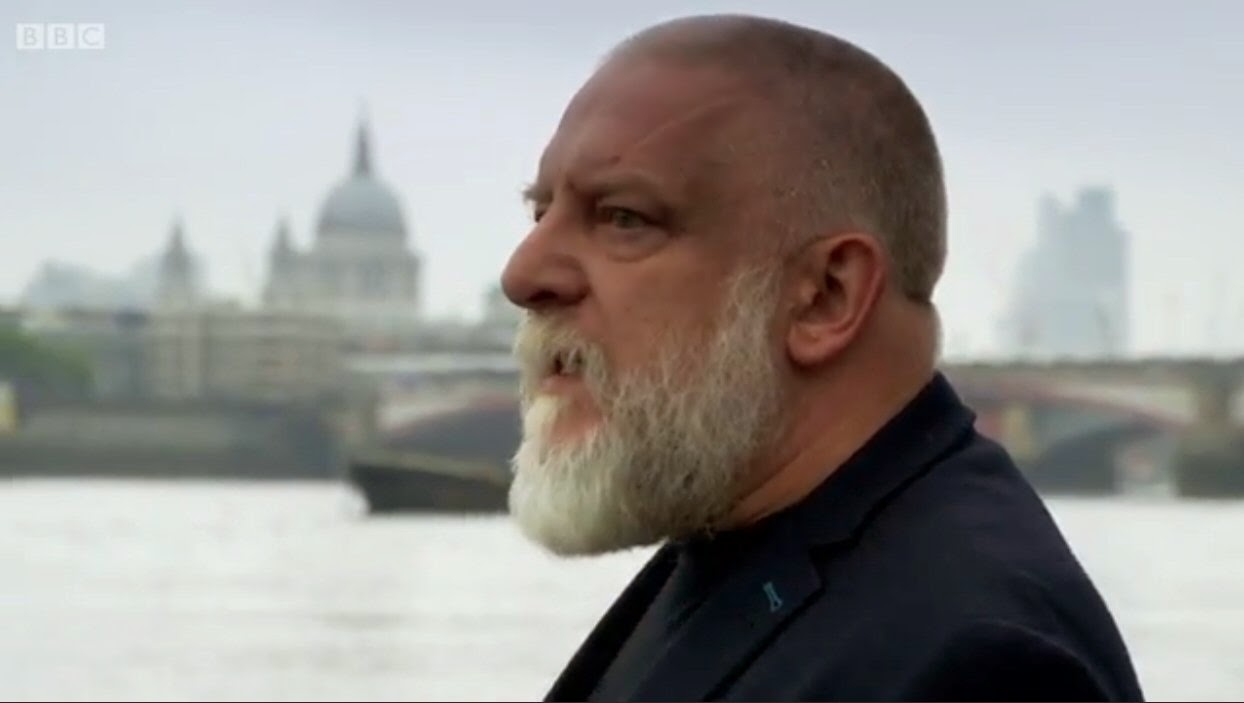
The Secret Life of Books: Shakespeare's First Folio.


As the BBC website describes, in The Secret Life of Books, "Six classic British books are considered with a fresh eye. Returning to the authors' original manuscripts and letters, expert writers and performers bring their personal insights to these great works."  Given the eclectic mix of books chosen, it wasn't exactly certain that Shakespeare's Folio would appear especially since it's been so well served on television previously not least during The Big Read whose campaigning series this 6x30mins superficially resembles.

There's a short potted history of Shakespeare's publishing history, the usually glee at the sheer apparent wrongness of "To Be Or Not To Be..." in the original quarto which Beale attempts to read out loud from the British Library copy, the words crumbling in his mouth.  Perhaps some day we'll have a series of programmes about literature's oddities which'll look at more closely.  The programme doesn't come to any real conclusions about its origin and even uses the words "bad quarto" almost in a pejorative sense as though it's a term we used in the past but we're much more enlightened now.

It's interesting to note the extent that scholarship has mode on that this kind of programme is now comfortable enough to stress Shakespeare as a collaborator in a way which I've not quite seen with such force in this kind of veneration.  That make's the oddity that the BL's manuscript copy of Sir Thomas More with its page and a half of potential Shakespeare handwriting isn't mentioned while Beale talks about how we don't have the ability to see the playwright's original papers quite strange.

Nevertheless this an enjoyable half hour and even more so thanks to Beale's own performance of speeches from Lear (which appeared in at the National during the production of the film), Timon of Athens and Hamlet which is represented by his heart-stopping rendition of "To Be Or Not To Be..." stood on the banks of the Thames, words spoken with a force of understanding which I've rarely seen, especially in extract.  You can really tell that this an actor whose lived with the play and Shakespeare's words his entire life.

The Secret Life of Books: Shakespeare's First Folio is on the iPlayer here and available to watch for the next month in the relevant territories.   

Clips from the programme can be sampled here.

Thursday, January 30, 2014

Kenneth and Alex.

From the BBC's press office:
"Kenneth Branagh and Alex Kingston to star in new BBC Radio 3 drama of Antony And Cleopatra for Shakespeare’s Birthday: Sunday 20 April

"Actors Kenneth Branagh and Alex Kingston will be cast as Shakespeare’s Antony and Cleopatra in a special production directed by BBC Radio drama’s Alison Hindell for BBC Radio 3 to mark the 450th anniversary of Shakespeare’s birth.

"Commenting on the announcement, Kenneth Branagh said: "I'm so happy to be teamed again with Alison Hindell, whose brilliant production of Life And Fate was one of the great pleasures of my work in radio. I'm also excited to be reunited with Alex Kingston after our hugely rewarding partnership in Macbeth on stage. To play another pair of Shakespeare's great couples, and for a personally beloved medium, is a privilege."

Wednesday, November 20, 2013

Shakespeare at the BBC:
An Age of Kings released in the UK.


Well, this is exciting news.  Here's the full press release because it is such exciting news.

FOR RELEASE ON DVD DECEMBER 8 2013

Illuminations presents an exclusive 5-disc DVD of

An Age of Kings

Eight History plays by William Shakespeare


'Monumental; a landmark in the BBC's Shakespearian tradition.'
The Times

Groundbreaking adaptation of Shakespeare's Histories available for the first time in 50 years

960 minutes including extras
£34.99 including VAT

An Age of Kings is the BBC's compelling 15-part series from 1960 of William Shakespeare's great national pageant of eight History plays. Watched by over three million viewers, it is the most ambitious Shakespeare project ever filmed for television.

Hailed by the Guardian as 'ambitious ... exciting ... a striking example of the creative use of television', it was a powerful demonstration of the BBC's unique strengths and abilities in a time when Britain's public service broadcaster was not principally in the hunt for ratings.

Planned as the inaugural production in the newly-built BBC TV Centre, An Age of Kings was later broadcast live on Thursday evenings every fortnight from Riverside Studios in Hammersmith as the series wasn't ready in time for the opening.

For more than 50 years, this TV landmark has been entirely unavailable in Britain. Yet its drama of power politics, betrayals, deceptions and deadly rivalries is as alive as ever. So too is the beauty of some of Shakespeare's greatest poetry and prose.

An Age of Kings features outstanding actors, including Robert Hardy, Eileen Atkins, Judi Dench, and Sean Connery, at the beginning of their highly successful careers. More than five decades after it was first seen, An Age of Kings is a vivid and vibrant drama, with an unparalleled clarity and immediacy, sense of scale and poetic depth.

With 600 speaking parts and 30 weeks of rehearsal before filming, each episode cost £4000. The series was shot on only four cameras with a cyclorama used for the battle scenes and lots of smoke.

DVD extras: The Making of An Age of Kings features Tony Garnett (Cathy Come Home, Days of Hope) interviewed at Riverside Studios. Garnett recalls his experiences on this groundbreaking series and the challenges of making one of the most ambitious Shakespeare projects ever filmed.

Also included in the 5 disc DVD pack is a 24-page booklet giving background information and critical writing about the production.

Barcode: 5060291820072
Catalogue number: AOK166

Saturday, December 15, 2012

35 John Duttine


Hamlet played by John Duttine.
Directed by Gordon House.

The BBC’s Research and Development group has built a prototype which puts the BBC World Service on the web, making over seventy thousand programmes from the past sixty years available to listen to here. Still in closed testing, I’ve been lucky enough to have been given access (which might be able to ask for too via the details on their blog) and have spent the past few weeks in an agog state, boggling at the mass of programming at my finger tips on hundreds of topics across dozens of genres.

Of course my first search was the Hamlet, of course it was, and apart from documentaries, magazine shows and reviews, sure enough there is at least one production, this production. Originally broadcast in two hour long episodes on Sunday 4th and Tuesday 6th September 1983, adapted for radio by Colin Davis, directed by Gordon House, as you can see starred raffish John Duttine in the title role (his appearance in Day of the Triffids is pictured) and what a privilege to have been given the opportunity to listen.

At first, as audio Hamlets go, it seems superficially orthodox. The sound design is basic and period, with echoes for the interior of the castle, harsh winds for the exterior, scene changes are punctuated by some jingly atonal tubular bells and noodling on a pipe organ, Cyril Shaps’s Polonius is a typically bumbling old buffer with little room for a military mind (no Reynoldo scene) with Hamlet Snr played by famous voiceover artist John Westbook to give the character some spooky gravitas.

Except all the while us listeners, if we’re familiar with the play, notice that Davis in his adaptation experimenting somewhat with the structure of the text and in reducing it to fit the timeslot is making some interesting character-based decision, especially in relation to Hamlet. There’s nothing online at all that I can see about the production, which is a shame because I’d love to know the extent to which the adaptation was done in collaboration with the director and actors or if these are Davis’s alone.

After the Ghost, Davis cuts the swearing scene (“Sweeearrr…”) so to add some time for Hamlet to be off stage (off mic) transposes the introduction of Rosencrantz and Guildenstern (in what amounts to their longest scene) with Ophelia’s description to her father of Hamlet’s visit which then leads almost directly into Polonius explaining to the King and Queen that their son is mad and the plan that become the nunnery scene later.

Except, and this is where is becomes really interesting, Davis also cuts the Fishmonger which offers a clue as to how he, the director and Duttine view their Hamlet. In losing Fishmonger, we lose the wilder metaphoric excesses of the characters’ “mania” or “faux-mania” and this is repeated when Claudius asks the prince where he’s placed Polonius’s body and he tells him directly, no convocation of politic worms are e'en at him.

This is one of those sane Hamlets you hear about and rarely played. Or rather this is a Hamlet who seems entirely in control of his faculties and whose madness isn’t a mental illness, but anger. He’s an even more sinister and cruel in places than Peter Vaughn’s Claudius, a figure much more representative of the blandness of evil, only really showing emotion and inconstancy during the prayer scene. When Hamlet’s confronting his mother in the closet, we’re not sure if he won’t do her in as well.

Yet there’s still a constant element of doubt as to whether he’s faking these mood swings too, it’s not just controlled anger. Duttine's is a very public “To Be…”, watched by Polonius and Claudius with Ophelia evidently in proximity but when he spies her, his “Soft you now! The fair Ophelia!” so often played as a way of attracting her attention is internalised, as though he’s realised what he’s about to do, what he must do because he’s being watched, and doesn’t like it. Which suggests these choices have to have been collaborative to some extent.

All of which said, presumably dependent on the timeslot and utility, this is still a Hamlet which includes the greatest hits, from Polonius’s advice through to all of Hamlet’s speeches with the exception of “to the manner born” even to the point of including Fortinbras and his Captain, textually missing in action up until that point, so that “How all occasions do inform against me” can be included with some logic (even if the warring army arguably appears from nowhere in much the same way Laertes does at the end of the Welles adaptation).

The break in story occurs just before an all male Mousetrap, as Polonius agrees that Hamlet should be sent to England and Claudius says “It shall be so. / Madness in great ones must not unwatch'd go.” It’s an unusual point, especially given the day between the broadcast of the episodes, but it does mean that episode two begins with the ear catching spectacle of the play, which while rushed through, also underscores the aspect of theatricality and “play” inherent in the story.

The climax is pretty traditional, even if the sword fight is pretty swift and Osric is retained, though Fortinbras’s reappearance at the close jars with the perfectly tender way in which David Horovitch’s stalwart Horatio says, “Good night, sweet prince” which feels like the emotional conclusion of this production, though the mood is retained somewhat by the suitably processional music composed by Bernard Shaw (not George).

There's plenty more Shakespeare in the World Service prototype, along with rare productions of Early Modern Drama, though it's worth noting that it's still relatively populist in its choices, there's no Arden of Faversham or anything by Philip Massinger.  But plenty of Marlowe.  Not that I've the time to listen to any of it.  But at least I found the Hamlet.  At least I did that.

Saturday, August 25, 2012

Shakespeare at the BBC: Prefaces to Shakespeare on Radio 4?

There's been a curious addition to BBC Radio 4's programme database.

During the broadcast period of the BBC Shakespeare series in the late 70s and early eighties, Radio 4 broadcast a series of "Prefaces to Shakespeare" in which well known actors, directors and writers offered introductions to plays.

If that sounds familiar, they were the inspiration for the recent television series, Shakespeare Uncovered, whose original title was to be Prefaces to Shakespeare (and still is on the Amazon listing).

The Hamlet edition of the original radio programme introduced by Derek Jacobi from May 1980 is available to stream at the BBC Archive.

Now, Prefaces to Shakespeare has been added to Radio 4's website, with episode pages added for three of the plays:

Henry V with Robert Hardy (originally broadcast Fri 21 Dec 1979)
King Lear with Tony Church (originally broadcast Sun 19 Sep 1982)
Richard III with Edward Woodward (originally broadcast Sat 22 Jan 1983)

The last one of which has a photograph. Originally I thought that perhaps it was to herald a broadcast on BBC 4 Extra, but there isn't any next on information and only the record of the first and only broadcast.

So either they are soon be broadcast again but the scheduling information hasn't been added yet (which can happen) or this is another occurrence of the BBC website's process of back-filling information from the BBC Genome project (see also the Doctor Who website).

Let's keep our eyes or rather ears peeled ...

02/09/2012  Something definitely is happening.  A 1998/99 series, The Shakespeare Trade has also been added and the Prefaces about Richard III has been assigned a QR code.

Friday, August 24, 2012

Shakespeare at the BBC: Vivat Rex: At a Glance.

Yesterday I completed listening to Vivat Rex and its one of the best drama experiences I've had.  Coincidentally this morning in the post I received the accompanying booklet published in the seventies which has a nice introductions from producer Marin Jenkins and composer Christopher Whelan, a map with notable places, a useful family tree and a synopsis for each of the episodes.

What it doesn't have is a simple list of which plays constitute which episodes so I've produced that list below.

Why is this useful?

The whole of Vivat Rex is available to download on AudioGo at £1.84 an episode.  To buy the whole lot would be £47.84 which is still a bargain but you could understand if someone might want to pick and choose individual plays, especially since as I mentioned the other day, Vivat Rex includes rare dramatisations of Edward IIEdward III, Thomas of Woodstock and Perkin Warbeck albeit in abbreviated versions.

Vivat Rex: At a Glance.

1/26 The King's Favourite
Edward II

2/26 Revenge
Edward II

3/26 Obsession
Edward II / Edward III

4/26 The Black Prince
Edward III / Woodstock

5/26 Treason
Woodstock / Richard II

6/26 King of Snow
Richard II

7/26 Victims
Richard II / Famous Victories of Henry V / Henry IV, pt 1

8/26 Vulgar Company
Henry IV, pt 1

9/26 Rebellion
Henry IV, pt 1 / Henry IV, pt 2

10/26 Corruption
Henry IV, pt 2

11/26 Deception
Henry IV, pt 2

12/26 Tennis Balls
Henry IV, pt 2 / Henry V

13/26 Harfleur
Henry V

14/26 St. Crispin's Day
Henry V

15/26 Joan of Arc
Henry V / Henry VI, pt 1

16/26 The White Rose - And The Red
Henry VI, pt 1

17/26 Witchcraft
Henry VI, pt 1 / Henry VI, pt 2

18/26 Jack Cade
Henry VI, pt 2

19/26 The Paper Crown
Henry VI, pt 2 / Henry VI, pt 3

20/26 Warwick The Kingmaker
Henry VI, pt 3

21/26 The Tower
Henry VI, pt 3 / Richard III

22/26 The Little Princes
Richard III

23/26 Ghosts
Richard III / Perkin Warbeck

24/26 The Pretender
Perkin Warbeck

25/26 Divorce
Henry VIII

26/26 Elizabeth
Henry VIII

Some notes:

The Edward III, Woodstock and Perkin Warbeck are heavily truncated and edited for the elements which reflect most on the Shakespeare/Marlowe portions of the piece.  That said, the Henry VIII though also shorter is coherent in and of itself.  The Famous Victories of Henry V contributes is just one scene.

The episodes are available here.

The above information is on the individual programme pages but I still hope you'll find this at a glance version.

Thursday, July 19, 2012

Shakespeare Uncovered:
David Tennant on Hamlet


The story so far: Shakespeare Uncovered is a series of six introductions to plays introduced by leading actors and directors produced in association with the Globe theatre. The highlights have included Joely Richardson magically covered in snow during her first visit to the recreation of Shakespeare’s playhouse and discovering during Trevor Nunn’s exposition on The Tempest that there’s a recreation of Blackfriars in Staunton, Virginia. Less appealing is Sir Derek Jacobi’s ten minute detor into authorship madness during an otherwise informative introduction to Richard II and Ethan Hawke subtly damaging a First Folio by stroking his finger across a page and knocking out an existing burn mark leaving a hole, the text on the next page now clearly visible.

Now we reach David Tennant on Hamlet and although I’m biased the best of the episodes. Focusing on Hamlet’s struggle with his mission and his own mortality, David gallops through the story from the ramparts to “the rest is silence” aided by a number of fellow actors, academics and as he wanders about in the bridging cutaways the architecture of Stratford-upon-Avon and the Southbank, struggling with the question of why the play is still considered the pinnacle of English literature, the one secular text which continues to enthral and inform us as much as holy texts if not more so. But again, I would say that, I’m biased. Yet as Ben Whishaw notes for six months after playing Hamlet in 2004 he found himself applying all of life’s big questions and presumably some of the small ones to the play, recalling the text over and over. I do that too.

Utilising a synopsis of the play as a spine for observation is a fairly typical approach (cf, Imagine ... Being Hamlet and Playing the Dane, the inspiration for this blog), questioning the action at key points, with contributors providing their experiences of playing the part or analysing them. Because Hamlet is so thematically rich the producers have had to make similar decisions to a company producing the play so the focus is very much on the domestic elements, with little to nothing on the politics of Elsinore and Denmark, the succession.  Fortinbras is cut. Lost too are Rosencrantz and Guidenstern other than the fact of their existence so nothing on the implications of their murder. “England” is generally glossed over. This is all about Hamlet’s personal j-word and those who’ve chosen to follow him.

All of which is perfectly understandable actually since entire books have been written about all of them, and there’s just an hour to play about with. It’s natural that you’d want to concentrate on the icons, whilst hinting at what lies beyond, the feigned madness, the implications of the willow scene that sort of thing. That’s especially true of the section shot at the Novell Theatre in which Michael Dobson offers a potted history of the closet scene which glanced towards Freud and also explains how Hamlet’s sometimes inappropriate attitude to his mother developed. Some productions almost treat the action in two discrete sections but as David notes there’s something very uneasy about Hamlet being so obsessed with Gertrude’s sex life with Polonius’s cadaver close by.

There are some unexpected inclusions. As with some of the other episodes, David was given the opportunity to see original copies of the text, in this case at the British Library and crucially all three versions including their copy of Q1 (one of only two in the world), comparing and contrasting the different versions of the big speeches and stage directions, discussing with curator of Early British Literature, Tim Pye the source of this earlier version. It’s worth noting that one of the potential weaknesses of the documentary is when David rhetorically asks who created this extraordinary character and where he came, we're not told about the Ur-Hamlet or Saxo Grammaticus but (admittedly touchingly) Shakespeare’s family and the death of Hamnet, which was also an influence on Twelfth Night in a very similar sequence in the Joely Richardson episode, one of the few occasions when the original source of a piece hasn’t been expounded upon.

Indeed, David has an impressively full participation, the episode’s presentation echoing his earlier presenter led episode of Doctor Who Confidential, “Do You Remember the First Time?” in which like this, he shared his affection for a much loved character whilst wearing a brown jacket. Then he visited the hallowed ground of Studio 8 of television centre, here it’s King Edwards Grammar Schoo, Shakespeare's school. Then he interviewed fellow fans like Steven Moffat and here we see him joshing over old reviews with David Warner and comparing approaches to the character with Jude Law.  At least in terms of the language of television, my favourite interview might be with Simon Russell Beale who (like Whishaw) has appeared in nearly all of the episodes in interviews clearly shot all together and so it seems here until David asks a follow up question and camera whip-pans in his direction. Beale himself almost startled to suddenly have his fellow actor sitting there.

Like that Confidential, this features dozens of illustrative clips though interestingly limited to Olivier directing himself, Zeffirelli directing Gibson and understandably Doran directing Tennant. An early trip through the RSC shop with David indicates other versions are available, but these three are interesting choices in that they’re not traditional renderings of the text, Olivier adding some, Zeffirelli deleting practically everything and Doran shuffling the order of the scenes. Odd that we should have the Warner interview but not the clips of his RSC appearance seen elsewhere. As with the other episodes, the emphasis instead is on newly filmed sections performed by the Globe’s cast with Jack Farthing (pictured below) cutting a youthful, lonely figure in a near empty theatre during “To Be Or Not To Be..” and Tom Lawrence later a teary Horatio as his prince dies.


As well as David greeting Andrei Tchaikovsky's skull again (pictured) the most poignant section for me is right at the very end, when he’s pondering what the part means to him and startling it resonates with comments he made when he left Doctor Who. Indeed just for a moment (thanks to a reference to filming), I wondered which role he’s actually talking about:
"In the end, there’s just no other character like him. […] I remember on the last day of filming thinking, “I’m so proud to have done that. I’m so pleased that’s something I got to do. And now I will never go there again.” And there was a huge relief to that. It was like having a weight lifted off your shoulders. And then, where are we now? Three years on… I do find myself, I catch myself, slightly fantasising about doing it again, going back there and seeing what that would feel like. But … that way madness quite literally lies.”
Fiftieth anniversary next year then.

[Assuming I haven't spoiled it too much for you, David Tennant on Hamlet is available on the iPlayer until 26th July.]

Monday, May 14, 2012

My Own Shakespeare.

The BBC's Radio 4 blog as a post about the making of My Own Shakespeare which has now begun on that channel and Radio 3.  Interestingly the same recording session also yielded the play excerpts for Shakespeare's Restless World, including this rendition of To Be or Not To Be from Rory Kinnear:


Monday, December 13, 2010

Macbeth (BBC Four).


Theatre Apparently at some point during last night’s broadcast of Macbeth on BBC Four, the title of the play was trending on twitter, which is quite an achievement considering it was running directly opposite the finale of The X Factor and demonstrating that there is an appetite for theatre and especially Shakespeare even on a so-called minority channel. But this was not a simple filming of the original Rupert Goold directed production originating from Chichester Festival Theatre (then the West End, then Broadway). This was a fully cinematic piece of drama that was as interested in the details of the characters behaviour as the depth of the poetry.

A typical example of this was in the moment just before MacDuff discovers his murdered king. Patrick Stewart’s Macbeth guides the general towards the door which will lead to his master and afterwards leans on a kitchen table as Lady Macduff (touchingly rendered by Suzanne Burden), who in this adaptation has been given Lenox’s lines, fills the idle moment with some small talk about the weather. Throughout Stewart watches the back of that door, genially but shortly answering the woman’s statements, but clearly very preoccupied because the sight MacDuff is about to discover etched on his brain and he knows as soon as the door opens, everything changes.

This is Macbeth as chamber piece; shot in and around Welbeck Abbey in Nottinghamshire, Goold’s drama trades the vistas of Polanski and Zeffrelli for a mix of cramped interiors and large halls which seem to oscillate depending upon the timidity or arrogance of the title character’s ambition. The choice of shots too, rather than simply resting on whomever’s lips are moving goes with the emotional centre of each scene. When Lady Macbeth reads of her husband's good fortune, our focus is on the letter. In the moment when MacDuff is related the bleak circumstances of the loss of his family, the camera fixes on his face as Malcolm turns this grief toward revenge.

Goold’s chosen setting is a non-descript east-European country in the mid-twentieth century. Sporting a generous moustache, once in power, Stewart’s Macbeth is represented by a giant Stalin-like portrait in the main hall with the tyrant’s arrogant grasps at holding onto power, the murdering of friends and families in the text fitting neatly into the general sense of oppression exemplified by the archival footage of massive armies marching along wide boulevards that fill the antiquated televisions throughout the living quarters. The impression is of a shift between a benevolent military dictatorship under Duncan into one built on paranoia.

The paranoia engendered in Macbeth by the three witches. In his post on the BBC blog about the making of this version of The Scottish Play, producer John Wyver of Illuminations offers the films Downfall and The Shining as inspirations for the drama and asks for other guesses. As well as The Third Man, for its projections of shadows across the tiled walls of the tunnels, I’d like to suggest the films of Guillermo del Toro for the depiction of the supernatural against a backdrop of jackboots and submarine jackets. Like The Devil’s Backbone in particular, the witches are rendered even creeper by the manipulation of frame rates to create totally unreal movements in the actresses and when Banquo walks he’s captured in the same state as the moment of his death.

These three minxes were genuinely unsettling. One of the worst episodes of The West Wing, from the fifth season, just after creator Aaron Sorkin had left, has all of the main characters literally bawling at each other, entirely out of character, for forty minutes. As unpleasant as that is, if these witches had passed through now and then and conspiratorially given us a wink, the seething mass of negativity in the fictional White House that day would have been rendered totally convincing. These nurses or servants or whatever they are act as puppet masters in this scenario, and it’s not entirely clear, and this is suggested by Shakespeare’s text, whether we’re watching their prophecies coming to pass or whether they’re simply bending the situation to their will, those emotions their playthings.

The brilliance of the lead performances, from Stewart and Kate Fleetwood as his eventual queen is that they don’t tip the balance in our understanding either way. Fleetwood offers a dark, manipulative figure, and sexual animal in the Nigella Lawson mould, but unlike many interpretations there’s a certain collusion from Stewart from the off, as though he was already considering a great future for himself even before the wyrd sisters presented themselves. He might look slightly gutless when Lady M bats away his suggestion that he won’t kill Duncan but is soon turned around when she seductively carries a massive chocolate cake past his eyes. He has that cake and as we see later when just one slice is left, he eats it too.

Saturday, June 14, 2008

19 Michael Sheen


Michael Sheen as Hamlet
Directed by Jeremy Mortimer

At the dawn of the new millennium, the BBC decided to commemorate the occasion with a series of radio productions of Shakespeare's plays. Some were critical of the project since the bard has hardly been ignored by Radio 3 and in the announcement there didn’t seem to be anything to suggest that these would be doing anything too out of the ordinary. When broadcast most were well received, especially since the casting suggested that the producers were looking to attract the young audience seeking accessible productions after the film cycle which ran in the late 90s beginning with Baz Luhrmann’s Romeo + Juliet.

The risk in the inevitable Hamlet was the casting of Michael Sheen who though respected for his stage work had yet to the hit the mainstream and define his career playing real people – Kenneth Williams, Brian Clough and of course Tony Blair. Anyone expecting that distinctive impression offering the famous lines will be disappointed. Sheen here as a much deeper cadence with a Welsh lilt, far more actorly and perhaps slightly mannered.

In his interpretation, Hamlet is already directionless at the opening of the play, apparently going back to college because there’s not much for him in Elsinore. His instability is given purpose by the visitation of the ghost (an understandably bitter, angry presence) the revenge for the bloody deed offering a course of action, almost a career. In carrying out his plan, he’s efficient but flamboyant and very much not mad. There’s a logic to his actions and it's only in the central soliloquy that the fear returns (and oddly this about as Blair as Sheen becomes).

All of which said, I’m not sure Sheen really wins here. His approach to what’s one of the most familiar scripts in drama is to ride over the famous lines, which he should of course, but he also doesn’t seem to be enjoying the language or the poetry. He’s more relaxed in the prose sections, certainly, and when Hamlet is in his best humours. But unlike Simon Russell-Beale, whose audio performance I loved, I found myself unable to empathise with him, or really believe in what he’s saying. I do suspect that he loses a lot of his presence in audio and I'd love to see what he'd do with it on stage. There’s no denying he settles down towards the end – he’s especially good in the gravedigger scene and the ‘Readiness is all is’ is heartbreaking.

Except that by then the rest of the production has begun to drag. This is the full text from the second Quarto and it certainly feels it. It's perhaps too accessible, designed to be as inoffensive as possible so as not to alienate a general and educational audience (it's a co-production with the Open University). At best, the production is doing some interesting things with the private and public face. David Bradley’s delicious Polonius is a different, more vital figure in his office sending Reynaldo to spy on his son than addressing Claudius (Kenneth Cranham) and Gertrude (Juliet Stephenson).

Elsewhere, the producers are largely leaving the interpretation up to the listener, and my taste has always been for directors and actors with a clear agenda, but this doesn't seem to have one. It also can't quite tell how epic it wants to be. Kenneth Cranham spends much of the time regally declaring the text whilst the likes of Stephenson and (the very young sounding Ophelia) Ellie Beaven are enjoying the chance to intimately address the audience and often in the same scene.

The simple soundscape lacks atmosphere and is a touch confused. Inconsistently, in the aforementioned (often cut) Reynaldo scene, typewriters clatter away in the background, yet everything else is clearly taking place in an echoing castle and other characters are transported by horse drawn carriage. Which should be interesting, I suppose, but acts as distractions stopping you from being taken in by the drama. The music is boring too – opening with a bit of plain song then drifting into something akin to electronic lounge music but again without a clear direction. The only truly great moment is when the mime before The Mousetrap is presented mickey mousing on a plonky piano of the kind synonymous with silent film; if only the rest of Mortimer's presentation was that distinctive.