"... when I was studying directing at Yale, I began directing my own Shakespeare productions. I felt at home in these worlds, at home with Shakespeare’s language and his ways of thinking and seeing. Immediately after Yale, I got married and went to New York. Now I was ready to do what I could not do seven years earlier, when my father died. I directed my first production of Hamlet, seeing in it the story of a son brought to a stop by the loss of his father. For me the question was not whether Hamlet was crazy; it was how he could continue in the face of such grief. I mourned the loss of my father."

Monday, October 05, 2009
Kitchen Hamlet
Daniel Elihu Kramer's new independent film Kitchen Hamlet sounds rather good. Stripped to the essential story of parental loss and just seventy-six minutes in duration, it's set not in a castle but a house and apparently has the duel play out in the back garden. The director's note points to an autobiographical interpretation:

Friday, September 25, 2009
dvd cover for the RSC production
The thrillingly evocative dvd cover for the RSC production has been released:
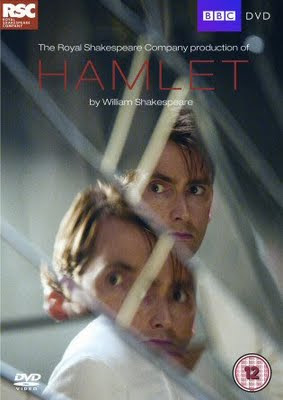
I love this. Usually it's Hamlet and the skull (see top right for what I was expecting) or the washed out face of the actor. This cuts straight to one of the symbolic heart of the play, the fracturing of Hamlet's personality and how he has to split himself into pieces in order to survive (the irony being that it doesn't work). Plus, look at that certificate. I'm hoping for a particularly bloody duel at the end.
The DVD is now available for pre-order direct from the RSC.

I love this. Usually it's Hamlet and the skull (see top right for what I was expecting) or the washed out face of the actor. This cuts straight to one of the symbolic heart of the play, the fracturing of Hamlet's personality and how he has to split himself into pieces in order to survive (the irony being that it doesn't work). Plus, look at that certificate. I'm hoping for a particularly bloody duel at the end.
The DVD is now available for pre-order direct from the RSC.
Monday, September 21, 2009
Urgent Appeal.
The roof of Holy Trinity Church, the site of Shakespeare's tomb, is rotting. Work was being carried out in the rafters and masonry came away and nearly fell on visitors, of which I was one not too long ago:


£50,000 is required for repairs. They're having an appeal and I've already chipped in to save what feels as close as odds to being my parish church. Considering how much the bard has given me, seemed the decent thing to do to give him a structurally sound resting place.
£50,000 is required for repairs. They're having an appeal and I've already chipped in to save what feels as close as odds to being my parish church. Considering how much the bard has given me, seemed the decent thing to do to give him a structurally sound resting place.
Saturday, September 19, 2009
John Simm wants to play Hamlet.
A lot: "I've asked him about the play he's rehearsing, of course, and he's told me, of course, that it's "a hell of a challenge", and that he was "intrigued" by the script, and the fact that it's "like a split-screen on stage", and that he's playing two characters, a detective (again) and a violent, alcoholic neighbour. And then he announces, casually, that he "wasn't particularly looking to get back on stage again", but was wanting to do Hamlet. Whoa! And he hasn't done any Shakespeare before? "No." And wouldn't it feel a bit like following in the footsteps of David Tennant? "I didn't really think about that." And he's only ever seen one Hamlet? "Yes, at drama school." And doesn't it, um, imply quite a lot of confidence?"
Tuesday, September 15, 2009
Macbeth: A Shakespeare 4 Kidz Musical Adaptation
+wih+the+weird+sisters1.jpg)
Macbeth played by Jason Lee Scott
Directed by Julian Chenery
Yes, indeed. The Hamlet Weblog is a broad church and with Shakespeare 4 Kidz’s 3D film in production, they were good enough to invite me along to see their theatrical version of Macbeth perhaps to give some idea of what to expect from a visit to Elsinore. So last night I was installed in the stalls of the ornate Palace Theatre in Manchester amid school groups and families watching a child friendly rendition of one of the bloodiest of tragedies. Adapting the Scottish play for a young audience is certainly provocative even at time when arguably kids are being exposed to violence far more than in the past. How would they manage to keep all of the black magic and death without watering down the play's moral message of cause and effect?
The answer is to simplify and modernise sections of the text and add some song and dance numbers and turn the play into a musical. It’s initially quite disappointing that so much of Shakespeare’s verse couldn't been retained and arguably the most powerful moments are when the undiluted text makes an appearance (“Life is but a walking shadow…”). But cunningly, though the iambic pentameter is often jettisoned for clarity's sake, by seemingly taking its influence from Japanese Kabuki theatre in which the characters wear their hearts on their sleeve, the actions are plainly presented, the results generally unsubtle, the performers addressing the audience more than themselves, the overall sentiment is retained.
+and+Macduff+(Kirk+Barker)+fight+to+the+death1.jpg) As is the plot. Done badly, once Macbeth has the Scottish crown, the play can easily descend into a soup of skirmishes and witchery, but adaptors Julian Chenery and Matt Gimblett's script and songs very cleanly set out the consequences of the thane’s actions and how his arrogance will ultimately lead to his downfall. The plot may be simplified but they don’t shirk from showing the more gruesome scenes, including the murder of MacDuff’s household and how that leads to the battle which spans act five. I’m sure I heard a gasp when it became apparent that Macbeth had misinterpreted the witches warning about the circumstances of his death.
As is the plot. Done badly, once Macbeth has the Scottish crown, the play can easily descend into a soup of skirmishes and witchery, but adaptors Julian Chenery and Matt Gimblett's script and songs very cleanly set out the consequences of the thane’s actions and how his arrogance will ultimately lead to his downfall. The plot may be simplified but they don’t shirk from showing the more gruesome scenes, including the murder of MacDuff’s household and how that leads to the battle which spans act five. I’m sure I heard a gasp when it became apparent that Macbeth had misinterpreted the witches warning about the circumstances of his death. In this production, witchcraft is pervasive, the heavily hooded weird sisters (close cousins of the Wraiths from the Lord of the Rings films) never far from and sometimes directing the action. In places they’re genuinely scary simply because of the wrongness of their movements, their speech patterns and the deathly howls which sometimes emanate from their mouths (the voices of the all actors are augmented and projected by speakers on either side of the stage) and it's their incantations that bring the curtains down, suggesting that at any moment their dark forces could break through into the auditorium.
When you add to this the musical element, if you’re an adult and with more than a passing knowledge of the play, Chenery's Macbeth becomes a camp extravaganza, a great big entertaining panto. For much of the duration I grinned from ear to ear even as Thane of Cordor considers the death of first Duncan then his co-captain with songs like “How Do You Murder A King?” and “Banquo Must Go”, not entirely sure how knowing the declamatory acting style is supposed to be but loving each glorious second of it, as the dialogue drift from straight Shakespeare to the modern idiom into the mix of the two which inhabits The Tudors tv series (incidentally the photographs you can see here were taken at Hever Castle, childhood home of Anne Boleyn).
 At the epicentre of all this is Emma Odell’s incandescent sitcom take on Lady Macbeth, who’s reaction on hearing that her husband might have murdered his king but forgot to pin the murder on the guards, is as delicious as one of Sybil’s verbal disembowelments of her husband Basil in Fawlty Towers. It’s not hard to feel sorry for Jason Lee Scott’s chiselled but dominated Macbeth. The deterioration of their relationship is like watching an alternate reality where Prince Charming has married one of Cinderella’s sisters instead and is now suffering the consequences. Odell arguably gets the best song too, “Out, Damned, Spot!” a scat like descent into madness.
But the moment which brings the best response from the children in the audience and when they clearly become locked into the show is Noel Andrew Harron’s Porter. The one deliberately light moment in the play, written by Shakespeare (like the Gravedigger in Macbeth) to give the clown in the company something to do, the Porter can be an opportunity for the show to relax for a moment after the murder of King Duncan. I’ve previously seen his speech replaced by a thematically relevant routine by George Carlin and S4K offers a child friendly version of that as Harron offers the audience some slapstick, knock knock jokes (“Knock knock” “Who’s there?” “Toby…” etc) and a short lesson on duplicity.
The children were wrapt, and that’s the point. At the interval I glanced about the theatre and I think every young face in the place was smiling, eyes glowing. At the end of the show, the deafening applause and cheers as each actor took a bow demonstrates that Chenery, who also directs, has pitched the production perfectly. If kids hate something, you’ll know instantly, through their chatter and toilet visits during the production and general indifference, but that’s not what I saw. If they were talking, it's because they were asking the adults questions, their eyes constantly fixed on the stage and Jaimie Todd’s set design which implies the kind of ruins you might find in a similarly addictive storybook. If any of those children grow up remembering Macbeth as an exciting, approachable spectacle, then Shakespeare 4 Kids’s is to be commended.
Macbeth: A Shakespeare 4 Kidz Musical Adaptation is touring. Click here for venue details.
Wednesday, September 09, 2009
Dover Thrift Editions.

Who's There?
"Thrift, Horatio, thrift!"
One of the features I always meant to bring to the blog, but failed to due to other distractions, was reviews of the various published editions of the play. Let’s begin. As well as the colouring book and paper dolls, Dover were also good enough to send copies of their version of the play itself, part of their Thrift Edition series, publishing the world’s literature at a nominal price. Already out is a straight reprint of just the play, UK price £1.50, which these days is cheaper than a Penguin.
This is a copy of the text from the 1892 complete works published by MacMillan and Co which combines the Second Quarto with the First Folio and means the gravediggers are still listed as Clowns. Some modern thought suggests that the different versions of the play don’t contain errors but an expression of Shakespeare revising his work later, but as a cheap entry level edition this is very good, drafting in annotations from Alexander Schmidt’s Shakespeare-Lexicon and it’s to Dover’s credit that they take the time to list their sources.
Coming to the UK in November is the Dover Thrift Study Edition (pictured), priced £4.95 which includes the same text married with a reprint of the “literary analysis and perspectives from MAXnotes for Hamlet, published in 2000 by Research & Education Association Inc, Piscataway, New Jersey”. Prepared by Joanne K. Miller from the Department of English, Harrison High School in West Lafayette, Indiana (the United States is a big place) the study guide is split into three sections, an introduction to Shakespeare and the play, a tour of the play noting points of interest and a bibliography (which is really a list of sources).
Introduction
Since I’m a fan, not an educator, I’m not sure how qualified I am to say whether the guide is detailed enough for today’s students (insert discussion about working to the test). Miller’s text is pitched lower than the nerdier excesses of the Arden editions but less arcane than the Signet Classic from which she has sourced some of her material. In other words, it isn’t afraid to throw about the acronyms (Q1, Q3, F1) and is happy to explain that Shakespeare based the play on earlier works. The rest of the ensuing guide is broken up into summary and analysis of each scene, coupled with quiz questions.
The main element I've noticed is that the play is treated very much as a text rather than a script; there's nothing I can see about how the play might be cut for stage and the implications that has on how we view Hamlet’s personality and for example whether he’s aware that he’s being watched during “To Be…” It’s arguable that this is irrelevant for the purposes of secondary education, which is largely about developing the child’s analytical as well as language skills, but its non-inclusion demonstrates a streamlined approach to this study of the play which also lacks the inclusion of previous critical opinion; Dover Wilson and Leavis are nowhere to be seen.
How is it, my lord?
If I was looking for an introduction to the play this would be good enough. One of the problems I encountered at school was because of the weight of critical opinion, the mass of text that surrounded the plays almost submerging them as entities, I did get terribly confused about the essentials of the story and what each scene is basically about. The slightly confusing York Notes lent a hand but ultimately I failed my English Literature A-Level (N-grade). I’m not saying this kind of straightforward study guide would have been the sticky plaster on the gash in my brain were cognitive understanding was spilling out amid exam pressure, but it might have helped
Hamlet. Dover Thrift Edition. Dover Publications. ISBN: 978-0486272788.
Hamlet. Dover Thrift Study Edition. Dover Publications. ISBN: 978-0486475721.
Monday, September 07, 2009
"Great Characters from Shakespeare - Paper Dolls" by Tom Tierney.

Ever on the look out for unusual ways in which Hamlet can been communicated, I find myself looking at the play in paper doll form. As you’ll know, paper dolls are the two dimensional equivalent of dollies, the way that little girls and I expect some boys played dress up before the invention of plastic. They’re of no fixed origin, with evidence of kimonoed versions cropping up in ancient Japan and Balinese designs dating back to biblical times. They first became popular in Europe during the eighteenth century and Milton Bradley made them popular in the US from 1920 onwards (wiki). Virtual versions have followed.
It says in the introduction to this book from Dover Publications that its been the dream of artist Tom Tierney to create a paper doll set featuring Shakespeare’s characters. Judging by the product list on his website he’s something of an expert and enthusiast and a google search reveals hundreds of examples of his work. Tierney’s the illustrator who created the Barack Obama and John McCain dolls during the presidential campaign last year. His latest publication features Obama and his family, part of a presidential series.
The best way to review a book of paper dolls would be to find a pair of scissors and cut out the figures and costumes. But being practically challenge, I’ve decided to simply look at the pictures. On page three of the book are the dolls themselves, Richard and Elizabeth, or Richard Geer and Julie Andrews or Heath Ledger and Jennifer Garner. I’m opinion oscillating but it’s impossible to see these images and not attempt to assign an identity. Elizabeth Taylor then? Elizabeth Hurley? They're painted in a simple comic book style, with their hands close to their chest presumably to allow for some flexibility in the shape of the costumes.
The rest of the book features those costumes. As Hamlet, Richard finds himself tunic’d all in black, clasping the skull to his stomach and wearing a wig which seems to have been borrowed from Adam, prince of Eternia and defender of the secrets of Castle Greyskull (He-Man). Elizabeth’s Ophelia is already gripped by madness, is draped in a white nightdress with long golden hair and clasping those flowers which are often imaginary depending upon the budget of the production. Of the all plays features in the book, it is noticable that Hamlet is about the only one where the apparel so clearly orientates the characters to a particular point in the play.
At the back of the book is a short synopsis of the plays which manages to offer the plot of Hamlet in about seventy words and confirms which part of each story is being illustrated. As ever, Fortinbras is cut. But if I was of a certain age, as with the colouring book I reviewed the other day, I’d probably find all of this fascinating. The only improvement I might have made would have been to include a short extract to give children to act from, but on reflection the lack of such only means they have to pick up a copy of the play which has to be for the good.
Great Characters from Shakespeare - Paper Dolls by Tom Tierney. Dover Publications. ISBN: 978-0486413303.
Friday, September 04, 2009
Lodestar Theatre Company's Rosencrantz and Guildenstern are Dead (2009)

Richard Kelly as Rosencrantz.
Simon Hedger as Guildenstern.
Directed by Max Rubin.
Utterly, utterly brilliant.
Before heading off into too detailed an explanation as to why the Lodestar Theatre Company’s production is so utterly, utterly brilliant, it’s important to urge you, if you’re in the Liverpool area and you have an interest in theatre, however vague, to seek out this production before it goes forever on the 13th September. It’s at the Novas Contemporary Urban Centre which you may not have heard of (the taxi driver who took me certainly didn’t), but if you can get to Caines Brewery, it’s opposite (ish) there. Here’s a map and and ticket details. If you manage to visit on 5th, 12th or 13th you will be able to see this show and their Hamlet (previously reviewed) back to back.
Now onward.
Nominally, Tom Stoppard’s Rosencrantz and Guildenstern are Dead is about what happens to these minor characters from Hamlet whilst the rest of the revenge tragedy is playing out, from their summons to untimely death. But rather than simply pouring in more plot, Stoppard wraps these journeymen around a structure heavily influenced by Samuel Beckett’s absurdest Waiting for Godot, unpacking the themes and structure of Shakespeare’s story to discuss the nature of chance, destiny and death and with the aid of the players throw in a meditation on the nature of acting and duality.
The writer isn’t interested in somehow giving G & R inner lives, but instead he creates two figures who find themselves in an impossible situation in which they’re dragged along until ultimately they die, trying to understand precisely what they did and what they could have done to change to outcome. It’s an existential puzzle, which to a degree mirrors reality more closely than a John Osbourne kitchen-sinker since we’re all drowning in a sea of questions which, depending upon your philosophical point of view, are given few answers.
And it’s a comedy. And I laughed like a drainpipe all night, big theatrical belly laughs. It’s to the credit of the actors that they weren’t distracted by my shaking about, head back, gob open, sitting on the front row, right in the middle. But I wasn’t the only one. The whole audience, guffawed and gaped, and oddly at different things. A line that went dead one side of the room became comic gold at the other, but often it was simply because you couldn’t laugh at everything. I’ve had a cold this week and it perked my right up, made me feel like myself again.
Sometimes, it was straight wit of the lines, sometimes the truisms, sometimes the commentary on the acting profession, sometimes the heroic criticism of Shakespeare’s poetry, particularly during Rosencrantz and Guildenstern’s first meeting with Hamlet, who as Stoppard points out offers a pack of lies and double talk which doesn’t get them anywhere and leaves them even worse off because the prince knows more about their state of mind than they do of his, proving the old theory from the studenty quiz show Blockbusters that sometimes one head is better than two.
In this production it was also the delivery. In my review of Lodestar’s Hamlet, I gave Richard Kelly and Simon Hedger special mention and thankfully, brilliantly, given the duration of a whole play to work with and these lines, they combine to create a classic double act, with razor sharp timing, and a genuine sense of two people who’s friendship has spanned a lifetime, the Kelly’s empiric Rosencrantz forever undercut by the realism of Hedger’s Guildenstern. There are moments, as they hammer out the dialogue that the words aren’t just simply learnt lines hanging from their lips, but something they genuinely believe.
Kelly and Hedger are one of the best theatrical double acts I’ve seen, at least as tight as Rik Mayall and Ade Edmondson were in their classic production of Godot, if not more so since Kelly and Hedger (seemed at least) to lack the fear of doing something approximating classical theatre for the first time, the fear of getting it wrong. Stoppard’s dialogue isn’t easy. This isn’t idle hyperbole. There are sections, such as the linguistic tennis game, which must require supreme concentration, but these two make it look easy. The few occasions I wasn’t laughing, it was simply because I was enjoying the spectacle of two young actors at the top of their game.
The rest of cast aren’t anything to be sniffed at either. The other minor characters to be given feature status in Stoppard’s play are the players led in this production by Liam Tobin. A travelling troupe of tragedians, the irony is of course that the process of them parsing their craft is hilarious. Tobin’s player is a ringmaster, marshalling events, a disruptive influence whenever R & G give the impression of finally marking out an equilibrium in their chaotic world. In fact, all of the players have lashings of pathos; under Max Rubin’s direction their mockable very public under-appreciation slowly gains a poignancy as we eventually understand that if an actor is unable to successfully ply their craft, they are nothing. It’s a kind of death.
When the rest of the cast from the other production do sweep through it’s like greeting old friends. As I suspected, in this space, more intimate than the Concert Room at St George’s Hall, the actors an increased vitality, though in the transfer, the performances are more clipped, slightly caricatured, perhaps as a way of melding them into these slightly different circumstances. The effect of having already seen them in that earlier production is to have the other story, in the other setting, playing at the back of your mind, almost imagining as Claudius and Gertrude disappear from this stage, that they’re reappearing over there, before a different audience.
It must be rather strange for them to get into those same costumes, prepare themselves and then have to wait for a cue to present just a splinter of their previous performance, albeit reconfigured slightly in this new venue. Does Tom Latham, who plays Horatio, wait around all night, or just turn up half an hour before the end to give a reprise of his final big speech? Stephen Fletcher has the most difficult job, because at times he's an on-stage presence, maintaining Hamlet's epic intensity while his fellow cast members clown about, sometimes mocking that thing which defines his character in the other production.
The Wake Theatre at the Novas is a bit of an unlikely space; like the rest of the centre it’s built into an old warehouse, but resembles a cinema screen from the period before multiplexes brought in stadium seating. It’s what you’d expect a dedicated university theatre to be like, large enough to hold a student body greedy to see their classmates acting up, but small enough to hold classes. The props from the previous production reappeared here, a rich on-stage visual reminder of previous events, some, like Shakespeare’s characters, reduced to silhouettes by the atmospheric lighting and dry ice effects. Just another demonstration of how well conceived these productions have been and I look forward to seeing what Lodestar do next.
Any chance of a Measure for Measure?
Rosencrantz and Guildenstern are Dead is at at the Novas Contemporary Urban Centre until the 13th September 2009. Click here to buy tickets.
Wednesday, September 02, 2009
'Great Scenes from Shakespeare's Plays' illustrated by John Green and edited by Paul Negri.

The task of bringing Shakespeare to children (or children to Shakespeare) has become something of a theme on the blog lately and Dover Publications have been good enough to send me examples from their Shakespeare lines directed a youngsters. Founded in 1941, Dover were one of the companies to spearhead the growth of the paperback book, republishing works which have fallen into the public domain, and one of their great successes was Albert Einstein’s The Principle of Relativity. Inevitably the wikipedia has a good biography of the company.
First up, Great Scenes from Shakespeare’s Plays, part of the pictorial archive series, a colouring book with drawings by prolific illustrator John Green who looks to have provided an infinite number of similar images on a range of topics, in science, the natural world, well, everywhere. Looking back, I even think he drew the A-Team colouring book I was given on holiday when I was a pre-teen. The format of the book, edited by Paul Negri, marries Green’s illustrations of various scenes from Shakespeare’s plays on the right hand side of a spread with a short synopsis and extract on the left.
For Hamlet, right at the front of the book, that means the gravedigger scene and the duel, the former perhaps because it’s the moment and speech which have become folklore because of the skull, the latter for its dynamism and there’s certainly something of the Errol Flynn about the way the two rivals grimace at each other mid swash. Green seems to have been influenced by a range of sources in creating his images; his Hamlet and Henry V both look like they've stepped out of Lawrence Olivier's films, Rossetti’s Proserpine portrays Lady Macbeth, and his King Lear looks just like a still from The Ten Commandments.
That’s not a criticism. I love the idea of child working tirelessly to fill in these drawings and at the same time building a acquaintance with the images and then later in life revisiting them in their original forms with an pre-built familiarity. And the scenes chosen reflect the sheer variety of different types of incident in Shakespeare’s plays and doesn’t shy away from the darker images, of Othello suffocating Desdemona, of Leontes denying his child, of Caesar’s assassination. Indeed, both of the Hamlet images are about death, and this is underscored by the inclusion of the prince’s final speech.
Hatches, matches and dispatches. They’re all here.
'Great Scenes from Shakespeare's Plays' illustrated by John Green and edited by Paul Negri. Dover Publications. ISBN: 978-0486409603.
Friday, August 28, 2009
Hamlet 2 (2009)

Hamlet played by Octavio.
Directed by Dana Marschz.
Without hopefully giving too much away (!) it’s important to note, right up front, since this (p)review is being published on a blog about Hamlet, that the provocatively titled Hamlet 2 has almost nothing to do with the play. The title of the film comes from the musical that Steve Coogan’s down at heels teacher is producing in order to save the drama department at the athletics driven high school in which he’s marooned following a failed acting career.
Though the story of the musical has the mysteriously resurrected young prince employing a time machine to visit key moments in the play to save Gertrude, Ophelia, Polonius and his father, do not watch the film expecting a sharp parody of Shakespeare’s story or themes in the tradition of Ten Things I Hate About You or even Get Over It, other than a very general mention of Hamlet oedipal complex.
That’s part of the joke; in casting about to create a production which demonstrates the power of theatre, rather than actually presenting one of the greatest works in the English language just as Michael Maloney’s similarly out of luck actor did during Ken Branagh’s In The Bleak Midwinter, Coogan’s hack egotistically writes his own version, an “offensive” travesty which also parachutes in Jesus, Einstein and a raft of other real life figures and pop culture references.
So while some of the resultant staging, in which Shakespeare’s scenes are lovingly augmented by a giant video screen, most remarkably with Hamlet Snr’s face looking down on his son, the dialogue is deliberately hammy, the film’s main trump card, the song and dance number Sexy Jesus Sing-Along has more to do with Grease and Jerry Springer: The Opera (and their ensuing condemnation by the religious right) than The Mousetrap.
With director Andrew Fleming’s film just about absolved of disingenuousness then, what enjoyment you dig up from this back stage high school musical probably depends on the extent to which you feel Steve Coogan is a comic genius. I have issues. I think he can be a very clever actor, and at his finest, in 24 Party People, A Cock and Bull Story, Marie Antoinette and the little seen Happy Endings, his work can be outrageous but poignant. Sadly, he also has a tendency, when he’s the focus of attention, to push himself too far, resorting to the worst variety of gormless mugging, as in The Parole Officer or Around the World in 80 Days.
During Hamlet 2, he’s in almost every scene, and Fleming, deep in the genius camp, appears to have given him a certain latitude to improvise which leads some scene to donder on beyond their natural end as Coogan attempts to ring out every drop of the “comic potential”. When Fleming (who in the 1990s brought us the righteous run of Threesome, The Craft and Dick) should be playing up the zanier aspects of the film in preparation for his finale, he’s too busy allowing Coogan to shout, gurn and toss his hair about as though it’s a punch line. That has the effect of stagnating the rest of the film and at worst Coogan becomes the boring one at the party who hogs the conversation but doesn’t realise he’s ruining everyone’s night.
Elizabeth Shue cameos, playing herself, having given up acting for the nursing profession, but much of her contribution is reduced to reacting to Coogan’s hero worship and shouting out of her back catalogue. The mighty Catherine Keener is wasted in the role of his wife, throwing out some good barbs, but generally looking like she knows she’s in a dud. David Arquette plays their “boring” lodger whose turn is to mumble obvious observations about the situation but otherwise has nothing to do. And at the moments when they’re at their funniest, Fleming cuts away to whatever bit of business Coogan is up to. Only Amy Poehler is given space to work as a ballsy civil rights lawyer who doesn’t care about the quality of the production.
Hamlet 2 barely manages to resuscitate when dealing with the teenagers who populate the drama club. There’s some interesting subtext in relation to our perception of the kid’s background, and their ability to turn in a good performance on stage despite the material. At a guess (though the deleted scenes on the dvd don’t reflect this) I’d suggest that there are a couple of sub-plots within this group which are still sitting in the editing software. The director has clearly decided that the film is about Coogan, Coogan and more Coogan, and I take no pleasure in saying this, especially since the film company have been good enough to supply me with a preview copy, on this occasion his timing off, off and even further off.
I will add this. I laughed four times, proper belly laughs, at very good jokes, which it would be a shame to spoil, especially since if you’re in the right mood, Hamlet 2 might just work, particularly in the finale where the population of the town turn up to simultaneously gasp and applaud the final production. The film is co-written by South Park's Pam Brady and these closing dance numbers clearly share some DNA with the productions in the film version of that series (Bigger Longer & Uncut).
But that’s not enough for me. As the first ambassador says in Hamlet 1, “The sight is dismal”. And it really is.
Hamlet 2 was released on DVD on the 7th September 2009.
Hamlet vs. Ophelia.
The Shakespeare Geek compares and contrasts film and tv versions of the 'remembrances' scene:
"The big question, in my mind, is to what degree Ophelia deserves the treatment she gets from Hamlet. Is she just a pawn, moved one way by her father and another by her boyfriend? Does Hamlet agonize over his decision to crush her, or is he so far removed from that relationship that he doesn’t think twice about it?"
"The big question, in my mind, is to what degree Ophelia deserves the treatment she gets from Hamlet. Is she just a pawn, moved one way by her father and another by her boyfriend? Does Hamlet agonize over his decision to crush her, or is he so far removed from that relationship that he doesn’t think twice about it?"
Thursday, August 27, 2009
Twilight's Catherine Hardwicke's new Hamlet film
News of another new screen Hamlet this time directed by Twilight's Catherine Hardwicke and starring Emile Hirsch as the young prince and Ophelia played by one of the actresses from the vampire film. No mention in the links as to whether it's to use Shakespeare language or an adaptation.
Update: It's a musical: "Hamlet will try to work out some of his more agonizing decisions through composing music and singing it in clubs to small groups of about six people. Harwicke has described hers and Hirsch's Hamlet as kind of an "early Kurt Cobain." Hirsch is taking singing and guitar lessons to prepare for the role."
Update: It's a musical: "Hamlet will try to work out some of his more agonizing decisions through composing music and singing it in clubs to small groups of about six people. Harwicke has described hers and Hirsch's Hamlet as kind of an "early Kurt Cobain." Hirsch is taking singing and guitar lessons to prepare for the role."
Monday, August 24, 2009
More on 3D Hamlet
I've been talking to the people at Shakespeare 4 Kidz who announced recently that they're working on a 3D film version of their Hamlet production. Here is their press release:
It is a bit annoying when people jump to conclusion without checking things out first -- it's part of the new culture I suppose, in which surface has replaced depth. I remember at Easter when certain books suddenly dropped from Amazon's listings and people where immediately jumping about and pointing (metaphorically speaking) and accusing Amazon of homophobia when in fact it was just one guy in Paris who'd clicked the wrong box when he was updating a database and it had spread through the webshop and nothing could be done because it was a bank holiday ...
Anything which brings kids to Shakespeare is a good thing from Lamb's Tales of Shakespeare to even the Romeo and Juliet cartoon with sea mammals. I wish I'd been exposed to such things at primary school -- we essentially reached third year secondary school and had Julius Caesar dumped in our lap which was incredibly difficult having only touched on the "All The World's A Stage..." speech from As You Like It the year before. In other words, Shakespeare 4 Kidz is a brilliant idea.
Even a cursory glance at their website shows that they've thought a great deal about how these shows should be put together, even to the point of offering for sale packs which can be used by schools to put on their own versions and teacher resources. Far from being a cynical exploitation of the bard, this looks like a carefully thought out strategy for bringing children to his work at a much younger age than usually, and the film is simply an extension of that, which can only be a good thing.
They've receiving some curious criticism for the project, a typical example being from the usually good Paste Magazine who are unusually snippy and cynical about the project the tone of their post exemplified by opening of the title "No seriously...".
S4K’s Hamlet in 3D will be the first of a series of six movie adaptations of the musical versions of the Bard’s plays originally created by the acclaimed UK theatre company Shakespeare 4 Kidz.
The film, which is produced by Mark Thomas and Elsinore Films, will be directed by double BAFTA winner John Godber, who is reuniting his partnership with Thomas, the producer of Godber’s film version of Up ‘n’ Under.
Series producer Mark Thomas of Elsinore Films explained “We have long admired the work that Julian and the team at Shakespeare 4 Kidz have achieved, which is often described as the “Disney-fication” of Shakespeare, and we are delighted that funding opportunities have presented themselves so readily.”
Executive Producer Michael Cowan, co-MD of Spice Factory and Stealth Media Group says: “We believe that there is a great commercial opportunity here for the S4K series to flourish in the worldwide market, and the titles to enjoy an ‘evergreen’ status which will still be selling in 50 years time.”
Not only will the story of Hamlet be told in a unique and exciting way, but the addition of the latest 3D technology brings added excitement to cinema audiences: a ghost that hovers in front of your eyes, cannon-fire that flies into the auditorium and a final sword-fight that seems to literally be all around you, are just some of the features promised in the first film, which is firmly targeted at the Harry Potter, Lord of the Rings and High School Musical market.
S4K’s Julian Chenery, who is a co producer of the new film series, says “Creating a Hamlet for children was the ultimate test for The Shakespeare 4 Kidz Theatre Company and we are thrilled that the team of Mark Thomas, John Godber and Michael Cowan are able to help bring this unique idea to the big screen.”
S4K’s Hamlet is the first in a series of three Shakespeare 4 Kidz movies that will be produced back-to-back over an eighteen month period. “Hamlet” will be followed by “Macbeth” and “Romeo and Juliet” in the first block of three. The second series will feature “A Midsummer Night’s Dream”, “Twelfth Night” and “The Tempest”.
Alongside the movies, Elsinore has developed a television show “Movie Quest – A Romeo 4 Juliet”, a public search to find two undiscovered young actors to play the lead parts of Romeo and Juliet.
S4K’s Hamlet will be distributed internationally and in the UK by Stealth Media who are about to release the 3D version of Garfield Petforce.
It is a bit annoying when people jump to conclusion without checking things out first -- it's part of the new culture I suppose, in which surface has replaced depth. I remember at Easter when certain books suddenly dropped from Amazon's listings and people where immediately jumping about and pointing (metaphorically speaking) and accusing Amazon of homophobia when in fact it was just one guy in Paris who'd clicked the wrong box when he was updating a database and it had spread through the webshop and nothing could be done because it was a bank holiday ...
Anything which brings kids to Shakespeare is a good thing from Lamb's Tales of Shakespeare to even the Romeo and Juliet cartoon with sea mammals. I wish I'd been exposed to such things at primary school -- we essentially reached third year secondary school and had Julius Caesar dumped in our lap which was incredibly difficult having only touched on the "All The World's A Stage..." speech from As You Like It the year before. In other words, Shakespeare 4 Kidz is a brilliant idea.
Even a cursory glance at their website shows that they've thought a great deal about how these shows should be put together, even to the point of offering for sale packs which can be used by schools to put on their own versions and teacher resources. Far from being a cynical exploitation of the bard, this looks like a carefully thought out strategy for bringing children to his work at a much younger age than usually, and the film is simply an extension of that, which can only be a good thing.
Saturday, August 22, 2009
Preview: 'Hamlet' Illustrated by Harold Copping.

When I was just old enough to understand the stories my father would read to me as I was going to bed, my first exposure to literature was from two giant story books which he’d been given as presents when he was very young. ‘Long, Long Ago…” collected the Greek myths and “Grimm's Fairy Tales” included the original versions, those with the nastier endings that Stephen Sondheim appreciated (cf, Into The Woods).
They were both being printed on quite rough paper (having been published during wartime) but inside were brightly coloured watercolour plates illustrating the action, of Perseus confronting Medusa and pigeons pecking out Cinderella’s stepsisters' eyes. Older eyes might have considered these a bit naïve and of the kind you’d see in the storybooks that introduce classic Disney films, but I investigated those pictures for hours, even days, as they transported me away from my drab seventies existence.
So it’s with some nostalgia I flick through the pages of Arcturus Publishing’s lushly printed new edition of Hamlet, which intersperses the text with paintings and drawings by the late Victorian painter Harold Copping, wondering if my interest in Shakespeare would have developed far earlier if I’d been given this to read too. This is Hamlet presented in a similar storybook style poignantly reflecting backwards to those simpler times.
Copping, who was taught at the Royal Academy before completing his training via a Landseer Scholarship in Paris, is perhaps best known for his work on the best selling Copping Bible (which he researched by visiting Palestine), but he worked on literature too, various Dickens, "Little Women", and as I’ve discovered, this play. The paintings and engravings reproduced here were originally published in 1897 by Raphael Tuck and Sons, both as a book and postcards.
The artist presents Shakespeare's characters in a similar fairytale style to those old books, Claudius and Gertrude the very figures of a medieval king and queen, Hamlet a prince charming with golden locks. Copping’s background in Bible illustrations only really reveals itself in his depiction of a Polonius carrying a staff and sporting a gloriously whispy beard which wouldn’t look out of place on Charlton Heston’s Moses.
These pictures won’t be to everyone’s tastes; there is an element of kitsch especially in the image of Ophelia’s madness where Hamlet’s ex stares vacantly off the page as the King and Queen concernedly huddle together in the background. The illustration of her ensuing suicide owes much to John Everett Millais and I’d say that if you hate the Pre-Raphaelites with their romantic notions you’ll hate these too.
But I like the Pre-Raphaelites and I like these very much too. The visions of Hamlet Snr greeting first Horatio then his son on the battlements is genuinely spooky and the gravedigger is exactly as I imagine him, a wizened old man with an earthy face. In just three images we see the death of Polonius, first skulking behind the arras, next on the floor behind the curtain Hamlet nearby sword in hand and then out in the open having later been abandoned by the prince.
There is one curious drawing though (on page ninety-four) of what appears to be Hamlet drinking from the poisoned cup, which could be Copping misunderstanding the story or perhaps using artistic license (as so many have before him and since) and showing a moment during his final speech in which he hastens death having seen how quickly the concoction works on his mother. Or at least, that’s what the younger, more imaginative version of me might have decided.
'Hamlet' Illustrated by Harold Copping will be published on 1st September 2009 by Arcturus Publishing.
ISBN 978-1-84837-368-6
Wednesday, August 19, 2009
20 Stephen Fletcher

Hamlet played by Stephen Fletcher.
Directed by Max Rubin.
Before I start the review proper, I should mention that my opinion is probably affected by the fact that I spent most of the show distracted by a bored ten year old sitting next to me who'd been dragged along by his parents and older brother. Out of the corner of my eye I constantly saw him rocking about, sighing, swinging his legs, looking up, looking down and at one point shifting his ticket backwards and forwards on the wooden floor with the tip of his toe, sweep, sweep, sweep. Only during the fencing match at the end did he seem to pay any attention to the show.
During the interval I overheard his mother asking him if he was enjoying it.
"No." he said.
She was obviously crestfallen.
"I'm bored. I don't understand what they're saying and it doesn't make any sense to me."
Well of course you don't and of course it doesn't. You're ten. I hated Shakespeare when I was ten as well. I didn't understand what they were saying and bits of it still don't make any sense. But at least you can constructively put your problems with the situation into words. That's a start. Just be happy that this version is a trim two and a half hours and you hadn't been handed the big cahoona.
So...
Sometimes a production is about the space within which it’s presented and sometimes that’s because of directorial choice and sometimes not. As part of the Liverpool Shakespeare Festival, the Lodestar Theatre Company have inhabited the Concert Room at the St George’s Hall, an opulent neo-classical gem which looks like the interior of the Titanic and has hosted concerts and theatrical performance since the main hall was built in the 1830s. BBC Liverpool has a 360 degree panorama of the room as viewed from the stage and here’s an article about the 2007 restoration project. I’ve been to meetings here before and always wondered how a theatre director would utilise it.
Aesthetically it’s a palace so director Max Rubin and Designer Nadia Tahiri have decided to set their Hamlet in an actual palace, with thrones on the main stage and a red carpet spilling over the edge and into the stalls were they’d boldly removed the chairs, the audience watching from the very edges. The room already has a grand piano and glorious chandelier and in this Elsinore they became the trappings of wealth, emphasising the aristocracy of the family, making us interlopers on a crumbling legacy, which is also reflected in the choice of 1930s costumes, a period which saw the last gasp of the old fashioned class structure, when old wealth still outweighed new (this was reflected also in the cuts which tossed out Fortinbras choosing to focus completely on the domestic drama).
Rubin took full advantage of this arena; after a prologue showing Elsinore in happier times, the room was plunged into darkness for the battlement scene Horatio and Co providing their own key lighting using torches. With the audience distracted, Liam Tobin’s Hamlet Snr presumably slipped into at the back so that when he suddenly ‘appeared’ bathed in spotlight it was a genuinely surprising flash, aided by the abject horror in Horatio’s eyes. When the Ghost emerged again later before his still living son, his resonant voice eerily filled the room from all angles (Tobin the only actor to enjoy mic support). When Hamlet spoke against this from his own location, the impression was positively supernatural.
The extra performance area also made sense of The Mousetrap, which on the few occasions I’ve seen the play in the theatre has looked a bit clumsy. Here, the family were placed just a row ahead of the audience and together we watched the action of the play up on stage, with Hamlet between us and the players offering his commentary placing us briefly within the world of the play, supporting players in the drama. From the back that did mean that we didn’t quite see the moment of Claudius’s realisation that he’s been exposed, but his ensuing anger (perfectly rendered by Renny Kruplinkski) and Hamlet’s relief more than made up for it, the exploits frozen at just this moment for the interval, picking up where we left off twenty-minutes later.
This choice of staging clearly had its benefits but with the performance occurring half in a proscenium arch and half in the round, whenever a scene was set completely on the back stage it tended to feel a bit remote and that barrier seemed to continue when the action spilled into the front area, with the actors rarely relating directly to the audience, speeches sent towards the floor or ceiling rather than directly at us. The play really came alive when Polonius passed his asides to us during Fishmonger and during To Be Or Not To Be when Hamlet fixed me with his eyes, and I would have liked to have seen more of that.
Outside of the director's control is that the concert room is essentially an echo chamber which might sound beautiful in concerts but as we I discovered works against lucid theatre. As a couple of the reviews have eluded to depending upon where you were sitting the re-verb tended to muffle quite a lot of the verse. This was particularly obvious from my position directly opposite the space -- when the actors had their backs turned and shouting towards the stage, their words disappearing through the window onto the plateau and car park outside.
Yet despite these potential impediments there was still much to enjoy. Stephen Fletcher took full advantage of the flexibility Hamlet offers, presenting us initially with a broken soul whose fatherly visitation motivates him to action, relishing the process of entrapping his uncle until his actions cause the deaths of Laertes immediate family at which point he obviously realised that this was not a winnable situation. He was well matched by Tom Latham’s Horatio whose expressive face balanced between abject horror and quiet resignation throughout, the barometer gauging the emotional pressure of the court.
But the highlight in this production, at least for me, was the first appearance of Rosencrantz and Guildenstern played by Richard Kelly and Simon Hedger, confidentally standing at the edge of the stage. Hamlet seemed genuinely pleased to see them, and we were too because with they confident humour proceeded to steal not just this moment but all of the scenes in which they appeared to the point that the eventual news of their offing off-stage was a genuinely tragic moment. There’s a good reason for this: as well as Hamlet, in September Lodestar will be offering a production of Tom Stoppard’s Rosencrantz and Guildenstern is Dead at the Novas Contemporary Urban Centre featuring the same cast.
So whereas in most stage productions, R & G are offered by actors doubling up servants roles or even the gravediggers which can lead them to being a bit bland, Kelly and Hedger have properly rehearsed their roles and boasted a clearer than usual idea of who these men are, which is reflected in their performance, sharing the looks and glances of fellow journeyman as the story spins on around them outside of their control, the Stoppard version of the characters transplanted back into Shakespeare. It works very well and certainly a good advert for their further theatrical adventures.
Click here for more information about the Liverpool Shakespeare Festival. They also have a production blog.
Monday, August 17, 2009
Shakespeare's Globe

I spent last Tuesday in a very giddy mood. I didn’t think anything could be more exciting than taking part in Anthony Gormley's One & Other project but then I was finally standing in Shakespeare’s Globe (mark 3) looking up at the deep blue sky through the roof waiting for their latest production of As You Like It and realised that in fact, whilst it was fun to be part of Anthony Gormley’s art project, looking at that empty stage awaiting actors was as close as I’ll ever come to sitting on the touchline of the baseball diamond in Field of Dreams, or being a distant Liverpool fan visiting Anfield, a Beatles nut at the Cavern Club, an Elvis aficionado at Gracelands. I was teary at the Royal Shakespeare Company because I was submerged in theatrical history. The Globe is like actually stepping into history (albeit with a concrete flooring). It’s a dreamland.
I decided to dedicate my final day to the Globe, knowing that I'd want to take my time. For a change. If you do ever decide to visit, I’d certainly recommend you take the morning tour before the show. Over about three quarters of an hour the chronology of the theatre is explained, that the timbers were originally part of The Theatre theatre (yes, indeed) until problems with a lease agreement led them to be shipped across the Thames and turned into the first Globe in 1599. Which then burnt to the ground during the third performance of Henry VIII (misfiring cannon) in 1613. Rebuilt the following year it continued to be a going concern until the 1640s when the Puritans took a dislike to theatre I general and shut it down, that building falling to demolition in 1644. There’s plenty more to hear, that’s just the bare bones. Just enough time for photographs.

The present structure is a product of a twenty year campaign by Sam Wanamaker, who sadly died before it was completed and opened in 1997. During the tour, there is plenty of time to become acclimatised to the shape of the interior, and if like me you’re planning to become a groundling a chance to see the stage from other perspectives. The space is smaller than I was expecting, more intimate, though logically it has to be for the words of the actors to project and bounce of the roof and walls and back into the space. The other surprise was how sound from the edges could be isolated within their relate enclosures – the tours begin every fifteen minutes and at one point at least four different groups were at different stages of presentation but the voice of the guide was perfectly lucid. It's a beautiful building with its painting ceilings and fixtures, as colourful in its own way as Westminster Cathedral, the images just as symbol suggesting the stage teeters between heaven and hell.
A tour ticket also allows admittance to the education centre and exhibition, which adds extra detail to the information relayed on the tour using artefacts related to the original playhouse. One good choice is the recreation of other contemporary theatres in miniature, including Blackfriars, a space I’m not as familiar with as I’d like (perhaps someone will rebuild that too someday!) which underscores how plays were very much written to take advantages of the available spaces and how they have to be adapted to fill a proscenium arch, a television studio, a film soundstage. The exhibition also demonstrates that as well as being a historical recreation, the Globe is a living theatre with guides to the rehearsal process, musicians and costume making with examples from past productions and a rather sparkly recreation of Elizabeth I’s dress from the Armada Portrait which was worn by Jane Lapotaire at the Gala opening. What a night that must have been.

Having already been inside as part of the tour and enjoyed the first woosh through the doors into the space, I was surprised to find that I was still equally thrilled as I ran in, along with the other groundlings, just before the show, grabbing a space on the edge of the stage. Perhaps it was turning around and seeing a nearly full theatre, the stalls and floor as they should be, crowded to the rafters, a sea of grins. The multitude seemed to be a mix of tourists and locals, a range of accent and languages, splashing together. A Spanish family installed themselves behind me, the father giving his kids a running commentary throughout the first half and cracking jokes, presumably on the assumption that he was bettering anything the playwright was offering. But unlike most theatres, this is to be expected; no one stood to attention in Shakespeare’s day and that the atmosphere which is being engendered here. To work, the Globe has to be noisy.
And it was. How we laughed. As You Like It is (surprisingly) a play I’m not that familiar with. Jaques speech “All The World’s A Stage” was the first Shakespeare I studied at school, but somehow with the exception of the cob-webby Argo audio production (which I heard on vinyl in the early nineties) and the BBC Shakespeare production with Helen Mirren, this was my first proper visit to the forest of Arden. That was to the good, because instead of simply trying judge whether this was a good version of the play, I was more involved in trying to follow the plot which is exactly how to experience a play in the Globe, allowing the actors, so close and often speaking from the stage and stalls and back of the yard to talk directly to you, to become involved in their story because you’re hearing much of this language for the first time. During the tour, the guide said that during their last production of Hamlet, the prince would ask someone in the yard, directly "To be or not to be?" and sometimes they would answer.

So brilliant was the ensuing production that my feet, throbbing from walking about for two days, seemed to stop hurting, or perhaps it's that I just stopped caring. About the only fly in the ointment (phrase which I thought was Shakespeare but turns out to be Biblical) was the process of standing. After finding my speck, I took off my shoes and stood on my jump, but by the end I was in bare feet. Also, because I have the bowels of an Labrador puppy, I had to nip out some time during the first half, when you have to go, you have to go. And sadly I went during “All The World’s A Stage…” it seems, which didn’t stop me spending some of the ensuing time wondering if I’d missed it have long since forgotten I’d gone to the toilet. Always half a perfect world. As with most things in fact, attending alone can be difficult to navigate. Luckily I was next to some people who didn’t mind keeping an eye on my stuff whilst I nipped outside to buy that ice cream. Is this the Globe as theatrical Woodstuck, a temporary community watching out for one another.
The proximity of the players to the audience means that they’re speaking directly to us and reacting to sounds from the audience and the environment. Typically, the clown, on this occasion Dominic Rowan’s Touchstone, was best at this, reacting to odd murmurs and physically chiding the audience when they didn’t laugh at his jokes, a natural comedian. But at no time did this seem forced; we didn’t feel like we were laughing because we were meant to (which often happens) but because this was genuinely funny. In the Globe’s souvenir brochures, actors line up to talk about how they relish acting within the space because they have this connection with the audience, a connection which is lost in a typical theatre were the rest of the auditorium is hidden in darkness. Often the characters would plead with us for understanding, emotionally charged which must be electric during the major tragic soliloquies. That suspension of disbelief is continued in our acceptance that all this is occurring in a forest, even though the only evidence we have of that is the words of the actors and columns wrapped in brown material to suggest tree trunks.
The best moments are the careless love between the gender disguised Rosalind and Orlando, in which she’s testing his resolve by making him believe that he’s pretending to woe a man when in fact he’s wooing the very woman he’s in love with. As played by Sophie Duval and Jack Laskey, these has elements of screwball comedy as Duval threw Laskey’s oaths back in his face, the actor’s gregarious approaches suggesting that he come from the same mould as Ed Tudorpole, Callum Blue and David Tennant. Though the theatre was noisy in the first half, during these scenes the Globe fell silent and hung one every word; even my Spanish commentator stopped intoning. That’s the magic of the place. By making an expectation of noise, makes these moments even more remarkable, that our suspension of disbelief is so total that it could be just us and Laura Rogers’s adorable Cecilia witnessing and reacting to the unfolding scene. This is one of those occasions when I don’t simply have the memory of what I saw, but also of how I felt. There aren’t many theatre productions that I can say that about.

Sunday, August 16, 2009
Shakespeare's Churches

When he was working in London, William Shakespeare mostly worshipped at just two churches because of their proximity to his theatres and whilst I was in London last week, I made a point of visiting both of them. The more famous is Southwark Cathedral which was just a short walk from the Globe Theatre, or as the church was known then, St. Saviours. The present building has been repaired and reconstructed a few times since the 16th century, the nave having been replaced at least twice, which means, like the best medieval churches, the history of the place is held within the fabric of its structure.
The church had an uneasy connection with local actors; though it was the place were the company worshipped (their names appearing on the parish registers and many would be buried within its walls) the chaplains would denounce the theatre from the pulpit. These days, it’s this connection which is the main tourist feature, and Shakespeare is commemorated by a monument in the south aisle, above which is a stained glass window depicting scenes from the plays including a very resolute Hamlet. There’s also a plaque offering thanks to Sam Wanamaker, whose determination led to the Globe reconstruction just down the Thames.
When Shakespeare and company decamped to Blackfriars Theatre (set up in a monastry), their church became St Andrew-by-the-Wardrobe. Its curious name derives from a house purchased by Edward III in 1361 which he used as the storehouse for his accoutrements, the “Royal Wardrobe”. That original church, the one Shakespeare would have known (and the wardrobe) were destroyed in the Great Fire of London in 1666. The shell of what exists now was one of the fifty-one baroque churches designed by Sir Christopher Wren in its wake, the interior a 1950s reconstruction after the original was gutted during the Blitz (in 1940).
Off the main road, hardly sign-posted, it’s not an easy place to find; by then Leo, or the person with the sense of direction, had gone home, and I took a few false turns and was given directions to the wrong church before I gave in and caught a taxi with a driver who only had a vague notion. As you can see from the photograph, it’s a forbidding place, the kind of gloomy edifice you’d expect to see an Ingmar Bergman film when the main character (played by Max Von Sydow) is falling out of love with God and is clamouring for answers but finds none. Look at this crucifix which is in the grounds. I can’t imagine you’d find much comfort here:

But them I’m not a religious person, and I know that people visit churches for different reasons. Perhaps the interior is different; though the church is closed during August, I was able to glance inside a bit, and saw some rather jolly wood panelling and the impression that as with many baroque churches, there is more than initially meets the eye. Like Westminster Cathedral, this could be another of London's secrets waiting to be rediscovered.
Imogen Carter on the current prevalence of the floating body as an artistic motif. "Step aside Prince Hamlet … it's Ophelia's turn to have a fashion moment. Shakespeare's aggrieved maiden met a soggy end but now, from theatre to art, the floating body as an artistic motif is once again in vogue."
Friday, August 14, 2009
Elsinore 3D
Shakespeare 4 Kidz' Hamlet to become 3D film: "A musical version of Hamlet by theatre company Shakespeare 4 Kidz is to be turned into a 3D film, as part of a deal that will see six of the organisation's plays adapted for the screen."
Sunday, July 19, 2009
'The BBC Shakespeare Plays' by Susan Willis.

In 1975 when BBC producer Cedric Messina was working on a drama at Glamis Castle, he decided that it would be the perfect location for a production of Shakespeare’s As You Like It. Thinking about it some more, he wondered why he should stop there? Why not film all of the plays in the canon (thirty-seven at that point, Two Noble Kinsmen and Edward III not having been admitted yet), some jolly good Shakespeare, for broadcast on television? The BBC liked that idea. And eventually so did the American co-producers, oilmen and bankers (the likes of Exxon and Morgan Bank who wanted to be seen to be very interested in culture). A big event, an epic undertaking, televising the canon was a chance for the BBC to thump it’s chest and shout “This is what we do!” (with a little help from some friends).
As Susan Willis explains in The BBC Shakespeare Plays: Making The Televised Canon, a celebration of Messina's undertaking, the Americans having stipulated that it shouldn’t be too radical, so none of that modern dress malarkey, the producer would see his original vision be revised and revised, and ultimately completed six years later, having gone through three producers with three different visions, a panoply of directors (some television veterans new to Shakespeare, some Shakespeare veterans new to Shakespeare) though Messina got his wish to film As You Like It at the castle and surrounds and later taking Henry VIII on location to the actual historical palaces, everything else was shot in the studio, engaging some of the greatest theatre actors of all time and whoever was popular on television.
As anyone lucky enough to own the dvd boxset will know, the results are something of a mixed bag. In her investigation, Willis (associate professor of English at Auburn University at Montgomery) notes (and I agree with her) that those plays which are less well know, Measure for Measure or Pericles or All’s Well That Ends Well are the best served out of the lot because the directors didn’t feel constrained by what has gone before, whereas Romeo and Juliet, huddled then in the shadow of the recent Zeffrelli movie doesn’t do anything new. The crowning achievement is probably Henry VI – Richard III in which director Jane Howell through an ensemble cast doubling roles, on a single set resembling an adventure playground, portrays this history as the games of school boys play-acting; in isolation it’s as entertaining as I, Claudius, with just as many wild performances and narrative meanders.
Writing just a few years after the final broadcast, Willis clearly has a great admiration for the series. Beyond the history, she offers a forensic analysis of some of the series’s auteurs, Jonathan Miller, Elijah Moshinsky and Howell demonstrating how they turned the constraints into benefits by taking full advantage of the televisual medium to emphasise the meaning of a scene through the mis-en-scene or stylising the sets to thematically underscore the motivations of a character. She carefully manages to keep such analysis with the production, only ever broadly venturing into the text when its absolutely necessary usually when describing cuts made or scene changes.
The book closes with some gossipy production diaries for Troilus and Cressida, Titus Andronicus and The Comedy of Errors, contrasting different directing styles and showing how the BBC’s production methods of the time constrained their artistic decisions (familiar to anyone who’s watched the documentaries on Doctor Who dvds – the 10pm shutdown effected high art too). It's the kind of thing which would be of use to anyone with an interest in this period of television or theatre history and has some wonderful moments were the diva gene in some actors takes full bloom, their competitive streak, but unfortunately more often than not, Willis refuses to name names, though a close analysis of the cast list would probably offer a few ideas.
If there’s a problem, having concentrated on her favourites, Willis rather dumps everyone else into a single chapter, though the writer does somewhat justify that choice by explaining what she thought went wrong with, for example, As You Like It. It’s the nature of these things that I’m bound to disagree with her on a great many things but her observations are correct more often than not, especially in relation to Richard Griffith’s Falstaff dozing his way through a The Merry Wives of Windsor (working against a wonderful Judy Davis and Ben Kinglsey), and particularly about the fiery chemistry between Tim Pigott-Smith as Angelo and Kate Nelligan as Isabella in Measure for Measure, an early triumph and one of the reasons I became interested in Shakespeare, which was the aim the project, to get the disaffected interested so it succeeded in that.
Monday, July 13, 2009
'Soul of the Age' by Jonathan Bate.

Up until recently, it was generally accepted that William Shakespeare’s final play was The Tempest; there was some historic evidence, not least that it was the first play to appear in the Folio that was published just after his death and how best to commemorate a genius than with their latest, perhaps last work. There’s also the romantic notion that Prospero’s final speech isn’t simply concluding the play but the writer’s career, one final humble exclamation to his audience before retirement:
“[..] Now I want
Spirits to enforce, art to enchant;
And my ending is despair,
Unless I be relieved by prayer,
Which pierces so, that it assaults
Mercy itself, and frees all faults.
As you from crimes would pardon'd be,
Let your indulgence set me free.”
Sadly, as Jonathan Bate’s brilliant biography, Soul of the Age, demonstrates, Shakespeare’s retirement was a myth. He continued working right through to his death, his hand potentially seen all over the place, his final work most probably the collaboration with upcoming playwright John Fletcher, Two Noble Kinsmen. After all, the man died at the age of fifty-two. He was wealthy, he didn’t need to work, but like similarly successful artists across the years, the impulse to create overwhelmed the potential for leisure.
Bate’s motive here (just as it was in the RSC complete works completed simultaneously) is mythbusting, though he comes not bury Shakespeare but to praise him. Taking Jacques’s seven ages of man speech from As You Like It as a backbone (“All The World’s A Stage…”), he traces through Shakespeare’s life extrapolating him onto those ages, but rather than offering a straight biography, he instead charts his external world, his historical context, gathering the collective miscellany of experiences he must have had in order to write the plays, poems and sonnets.
For example: many biographies give short shrift to his school days; they aren’t well documented and often there’s a preference to motor on to the juicy gossip, his marriage to Anne Hathaway and thence to London. Instead, Bate, using what evidence is available and applying a curriculum from a similar school, conducts a forensic year on year investigation into how Shakespeare may have been educated listing the books he must have studied and then, and here’s where it gets interesting, demonstrates how that learning blossoms within the plays, notably Plutarch (Anthony & Cleopatra, Coriolanus).
From there he sets about attempting to construct the personal library Shakespeare must have kept, suggesting books he must have read in translation and in their own language providing yet more examples from the texts, even to the point of suggesting which edition of the bible he would have had to hand, the heavily annotated Genova. The point he returns to again and again, is that far from the words and ideas popping into the bard’s mind, he was instead a literary magpie, grabbing snatches of language and ideas and themes and slotting them in to fit his own aims.
In other words, he was a writer. The effect should be to decrease our appreciation of the man and his work because it slowly becomes apparent that his original thought was rather less and the legend suggests. But curiously it simply increases our appreciation because though Shakespeare would often take old plays and texts and rewrite them, hammering in all of these allusions, the taste with which this was accomplished and the psychological, thematic and dramatic depth that shimmers through them is breathtaking.
And so Bate continues, explaining how the court scenes will have been influenced by his own brushes with Stratford law in cases related to land rights and how sexual scandal, which appears to have been rife in town, bubbles under in the likes of Measure for Measure. We’re given a thorough description of his contemporaries, his rivals and friends and so the circumstance in which many of the plays would have been written or revived, forever underscoring that though Shakespeare was the greatest writer of most times, he was also a businessman.
Though the cover suggests that it’s from the popular history genre, Bate never shies away from intellectual rigour; in places it reads like one of Stephen Fry’s deviations on QI, as he enjoys the opportunity to demonstrate the depth of his knowledge and simply lets fact after fact spill out on top of one another. Sometimes that can lead the text into areas that are difficult to pursue without a strong knowledge of the text (most impenetrably in a passage about The Tempest which I read twice and still couldn’t quite follow).
But turn a few pages and there’s something new; a useful discussion of the sonnets which, simply by unfurling the publication history (posthumous, exploitative) untangles the idea that in their present form they tell a biographical story of the artist’s amorous extra-marital entanglements, suggesting that there may have been more than one boy, who the dark lady might be and that in any case that these poems may not have been expressing Shakespeare’s own feelings but those of a fictional construct no more realistic than Romeo, Juliet, Hamlet or Falstaff ...
Saturday, July 04, 2009
Modern Stratford-Upon-Avon

I chose the Curtain Call Guest House because of the name and somewhat because of the price (£35 a night). It’s about fifteen minutes outside the town centre, which meant I had the daily anticipation of going to Stratford. Having not stayed in a guest house before, I wasn’t sure what to expect but this was exactly what I needed – a comfy bed. The landlords, Cheryl and David were very friendly, accommodating and thoughtful; on the nights I was going to be out late at the theatre they left the light on in the dining room. All of the other guests I met were regulars – regular enough to be able to chat about family – so this is the kind of place that people like to return to and feel safe.
Most mornings I kept to muselli and croissants but on the Friday I treated myself to a fry up and it was very, very nice indeed and I could tell it was local sourced – whilst I was eating the delivery from the local farm arrived. I needed a good breakfast because in general I’m horrible about keeping to lunch time whenever I’m away from home, even on day trips and this was no exception. The best lunch I had was at The Posh Corner Shop, a café/delicatessen not too far up from Shakespeare’s original school, where I sat in the window and ate a coffee and giant apricot Danish pastry and wrote my parents a postcard saying as much. I never know what to say on those things.
Evening mealtimes can be the strangest parts of the day when you’re travelling alone. Restaurants tend to be geared towards groups, the event of the meal playing slowly across an evening, whereas us singletons, even if we try and pace ourselves, can be in and out in half an hour and if we’re not careful the process is reduced to the function it really is rather than the entertainment it should be. Most of the streets in Stratford town consist of restaurants, chains and independents so there’s lots of choice, too much choice probably, so I tried to go for the ‘interesting’ options:
Historical
The Garrick Inn is reputed to be the oldest pub in Stratford; the building dates from the Elizabethan era and it became a drinking hole in the early 1700s. It was renamed for the actor in mid-late 18th century after he held a three day jubilee for his favourite playwright in the town which is seen as one of the attempts to confirm his legendary status in the modern era. The interior has clearly been remodelled a few times since then, so there’s a proper restaurant section at the back and waitress service.
The chicken and bacon salad was alright; the mix of two different dressings gave it an odd smell but the poultry was succulent enough. But the real entertainment came from watching the serving staff as they negotiated the order of an American couple who were sitting at the back who from what I could gather had given all of the necessary impressions that they hadn’t decided what they were having yet then strolled up to the counter wondering why their food hadn’t arrived yet.
The two waitresses thought through events and compared notes like detectives working over a witness statement and concluded that in fact the couple hadn’t ordered – there was no paper evidence – but then it became apparent that even after the man had appeared and complained they still weren’t sure what it was he wanted to be eating (was it fish and chips?) and that one of them was going to have to go to customer and get a clarification. I didn’t envy them.
The Chain
The “Godfather of Italian gastronomy” (according to his website) Antonio Carluccio has a string of restaurants and cafes across the country; blue and white trimmed interior is split between a well stocked shop and eating area. I think this was the worst experience of the week, but that probably had more to do with me being alone and not being able to work out what I’d be doing with the rest of the evening than the food, the Insalata Di Primaver a “sautéed pancetta, gorgonzola cheese and walnuts with rocket, spinach and radicchio leaves” (the menu is online) or the environment – it was early in the evening and there was only me and a large family group and as much as I enjoy my own company, sitting next to a mirror isn’t the same thing.
The Theatre
The Courtyard Theatre has a restaurant café which like the Everyman in Liverpool offers a mix of standard, regular menu items and specials. Reaching the theatre two hours before the performance I decided to try and spread the meal out so had all three courses (somehow managing the next thing half an hour after the last). Having watched people eating outside the previous couple of nights, I decided to take my soup near the entrance, but of course it was far too windy that and as I’m desperately trying to spoon the mushrooms into my mouth one hand I’m variously holding down my book and some paper napkins with the other.
The interior looks as you’d hope it would, with proper café style furniture with tables in RSC red the walls covered in posters advertising the latest productions. Being awkward and admittedly slightly ironic, I asked the waitress if I could have half of a Warwickshire share-board, a sort of ploughman’s lunch for two people. The question was passed through many mouths until it reached the kitchen then back again in the positive. It turned out to be a breadboard covered in chicken, ham, cheese, salad and bread and turned out to be the most filling meal of the week, so I can’t imagine what the full one was like.
As ever I hummed and hahared over the desert, eventually coming down on the side of a victoria sponge after the waitress suggested it because I was clearly going to miss the start of the play if she didn’t point me in a direction. I maintain I would have got there in the end, but given I was the sitting next to stage its probably best that I wasn’t trolling in, cake crumbs across my front, just as Caesar got the sharp end of Brutus’s knife. I told them as I left that this had been my best meal of the week. Which it had. Then.
Interesting
Banjaxed for reasons I’ll get to some other time (this holiday will be good for a fair few more blog posts I’m sure) I was looking for something easy but also interesting for my final night. I did consider something with a Shakespearean theme – Othello’s perhaps? Mistress Quickly’s? But stopped instead at Edward Moons. The penny farthing on the sign makes it stand out as does the mission statement printed in the window and also appearing on the website, describing who Mr. Moon was and why he deserved to have a restaurant named after him:
”Edward Moon was a travelling chef working in the British Colonial service in the early nineteen hundreds. […] Edward was also a creative cook, enthusiastic and excited by the local ingredients, cooking styles and methods he encountered on his exotic travels.[…] He retired to England in 1940 and recorded his experiences, philosophy and recipes in a book “The Travelling Cook’s Companion” It is the spirit described in this book that has helped us inspire our restaurants. “I’ve trimmed it a bit but you get the message. I was intrigued. Then the specials board drew me even closer to the door. Game pie. Game pie!?! I’ve always wanted to try that, properly cooked, not the soggy relic you find in some supermarkets. Inside the restaurant a group of people had spotted me looking in and were grinning and waving, two empty wine bottles nearby. I asked for a review. My thumb went up. Three thrumbs up was the reply. Good enough.
Inside looks like an Edwardian working men’s club. I sat next to a fireplace in which it looked like Phyllius Fogg had stacked his luggage whilst he to took repose and there was a general atmosphere of comfortable sophistication totally unlike anywhere else in Stratford. Some of that had to do with the waitresses; for the first time that week I felt like I was talking to a human being as they greeted me, sat me down, took my order, but all in such a way that made me feel welcome, like a regular. After each course they asked me if I’d enjoyed what I’d been presented with but in such a way that sounded like it actually mattered.
The tomato soup was light and a good appetiser but the Game Pie was something else. An oval dish filled with birds of a flavour I couldn’t identify, gravy and topped with a mountain of mashed potato but unlike similar dishes even when I thought I’d decimated the flesh, another piece appeared from underneath an onion. It tasted familiar and yet not at the same time and I was glad I was only drinking water with it so that my tastebuds could savour the culinary vacation they were experiencing. When asked all I could muster was “Lovely, thanks” which was understating things a little bit. In the donchyouknow parts of the world this is probably average, but for a mouth used to a frozen shepherd’s pie from Asda this was paradise.
But here’s why I’d return to Edward Moon’s again, and it’s a very small thing. At the end of the first two course I needed a break but knew I wanted to try one of the deserts which I’ve seen floating by. The waitress said that they closed at about 8:30 or 9:00 and after spending an hour at the RSC again I returned. They remembered who I was, remembered I was back for my desert and seemed genuinely pleased to see me, none of which sounds too special and should be standard but often isn’t. After I’d ordered the strawberry Crème-Brule (another new experience) she asked if I’d like another glass of water. She’d remembered that too and I hadn’t had to ask. Oh how I tipped …
Subscribe to:
Posts (Atom)